Friday, January 31, 2020

A Little Help for My Friends

Sometimes you just have to share some advice with those who don't ask for it...


There are at least five options Ms. Bruenig could choose yet her solution to changing jobs is that we need Medicare for All.
  1. COBRA - While the costs could be too high for her, this could be the best option for one wanting comprehensive coverage. Her insurance through The Washington Post (prior employer) would provide the least change. The plan she had the day she was last employed would continue. There would be no change in benefits or network. However, she would lose the employer contribution. Paying full boat is eye opening for most who leave employment and see their COBRA notice.
  2. Special Enrollment Period (SEP) - Under PPACA a loss of coverage constitutes a qualifying event. She could easily create an account through the DC Exchange and purchase a plan. If her income is low enough (doubt it) then she could potentially qualify for an Advanced Premium Tax Credit.
  3. Short Term Medical - This could be an affordable option. In DC these plans are limited to 90 days and have to cover pre-existing conditions. This could be viable because her new plan has to start on or before the 90th day of employment.
  4. Christian Sharing Ministry - While she would have to apply and could be denied, it's still an option that could have appeal. Her bio says she's Christian so I would assume that she can meet the requirements for participation. The costs are low and with the limited amount of time she needs coverage this platform could fit the need.
  5. Pay out of Pocket - Here's a novel idea...based on what premiums and benefits could cost it might make sense to pay for her healthcare costs directly to the physicians, labs, facilities, and pharmacies she uses during her period of time without coverage. Immunizations and a visit to the closest "minute clinic" for an ear infection may be less expensive than paying a month of premiums for COBRA or an individual plan. 

Maybe she should have consulted her health care reporter colleague Sarah Kliff? Or maybe not? Just sayin'.

Wednesday, January 29, 2020

Walking Away

Got a call this morning from a nice gentleman whose wife, through whom the couple have their health insurance, is retiring, and due to the nature of the business (not-for-profit hospital system) said employer is not required to offer COBRA continuation. As such, they'll be losing this coverage when she pulls the trigger, and they're looking for an individual health insurance plan to be in place once that event occurs.

Regular readers know that, outside of Open Enrollment, there is no agent compensation available (at least here in The Buckeye State) for ACA plans, and so there's really no way for us to help folks in these circumstances (I briefly considered, and quickly rejected, offering a Short Term Medical plan based on the caller's answers about their health). Now, I'll happily make an exception for existing agency clients, and those referred by colleagues, but I just can't afford to do so for call-ins.

I do feel bad about this, but the onus is on the carriers (which continue to defraud their insureds by not reducing premiums to reflect no agent compensation)  and on the politicos and Departments of Insurance who turn a blind eye to it.

Shame on them!

CORRECTION: I've been told by my friends at Cornerstone that at least two carriers are in fact now paying off-OE commissions.

I apologize for the error.

Monday, January 27, 2020

Carrier kudos: GR/UHC edition

About 15 years ago, I wrote a Golden Rule (now UHC) Medicare Supplement policy on a nice lady, who subsequently suffered a fairly significant stroke, and whose daughter called me this morning with the sad news that her mother had passed away on the 15th. She had received the quarterly billing statement that would be due early next month, and needed advice on how to handle this.

My initial counsel was to simply write "Virginia passed on [DATE], please cancel as of that date" and send it in.

But on further reflection, it occurred to me that she would most likely be due a partial refund, and of course there would likely be some claims still pending.

So, I told the daughter to stand by, and that I would call her back after I'd had a chance to speak with the Home Office. After a brief hold, Elandra asked how she could help, and I explained our concerns to her. After she'd had an opportunity to confirm with her supervisor, she told me that everything was taken care of, the daughter would be receiving a partial refund (for premiums paid forward) and that she could disregard the bill, and that the folks at Golden Rule were sorry for her loss.

No additional paperwork, forms or death certificates necessary.

I am so impressed with how this was handled: professionally, courteously, compassionately and easily.

Kudos!

Friday, January 24, 2020

Potential Good News, Rx edition

From our friend Holly R:


BigPharma© has become quite the bugaboo of late, and of course the ever-increasing price of often life-saving meds has been an issue for quite some time. Nice to see one of the 800 pound insurance gorillas bringing its own guns to bear on the problem:

"Health insurers usually just pay for drugs that are made by drug companies, but now a group of 18 Blue Cross Blue Shield health insurers is helping to create a nonprofit drug company to make certain generic drugs itself, targeting medicines where there is a lack of competition and a need to bring down prices."

Of course, this is hardly an altruistic move (the carriers themselves acknowledge this), but at least there's some positive action being undertaken.

Kudos, BX!  

Wednesday, January 22, 2020

ACA/OE Puzzler

From CMS in this morning's email:

[click to embiggen]

Pretty sure that that ship has long since sailed:

I spoke with Medical Mutual about this a while back, and they assured me that the grace period only extends to in-force plans, and so if the initial premium wasn't paid by January 1, the plan would not, in fact, be put in-force.

Hmmm.


Tuesday, January 21, 2020

And now for some *Good* news:

From co-blogger Bob V:

New Birth Missionary Baptist Church, partnering with RIP Medical Debt, has arranged for over $1.3 million of medical debt to be wiped clean:

"I jumped up and down and started praising God for this letter,” said Malcome, 58, who is disabled. “Other than my mother and God, no one has ever done anything for me like this. Oh, it was such a blessing.”

In a remarkable gesture of faith and generosity, the church's Senior Pastor, Jamal Harrison Bryant says:

"We are blessed to be a blessing and this effort has truly helped families start the new year without the stress, worry and concern that often accompanies looming medical bills and calls from debt collectors."

#Kudos to Pastor Bryant and his comminity.

Monday, January 20, 2020

What a convoluted mess (not to mention the circumstances)

I really don't even know where to start with this.

Okay, here:

"[Courtney Wilson] had moved to St. Thomas ... “for a change in, well, everything: scenery, culture, weather, people, way of life and of course the beauty of it.”

She took a waitressing job, but passed on buying health insurance.

Some three years later, she was in what appears to have been a very serious car accident, and she was careflighted to a Miami (FL) hospital for treatment. There, she was treated (uninsured, so she accepted full financial responsibility) and when she had recovered sufficiently, she "took a flight home to Paso Robles, California."

Umm, does anyone else see the glaring contradiction here?

Okay, moving along:

Once back in California, she applied for, and was retroactively accepted in, that state's Medicaid program. When she informed the Miami hospital of this change in circumstances, and requested that they bill MediCAL instead, they demurred:

"[T]he health system told her it does not bill out-of-state Medicaid programs outside of neighboring states like Georgia and Alabama."

Seems reasonable. After all, she had chosen to self-insure, and they were simply respecting her initial wishes.

Now comes the kicker (and the denouement we're all supposed to applaud):

"After the Herald inquired about Wilson’s case, she said UM reversed its billing decision."

How nice for her.

But notice this:

She moved away from California and took up residence in St Thomas, and then, when she faced substantial medical bills, she moved back  to
graciously allow Golden State taxpayers to foot her bill.

Gee, kudos for sure.

[Hat Tip: FoIB Holly R]

Friday, January 17, 2020

More #Winning from the MVNHS©


But remember: Free!

#Medicaid4All

Looking Ahead: A Life Insurance Poser

Recently, had a client refer her adult daughter to me for some life insurance. She's relatively young, and single, and without much debt, so I asked why she was even considering a policy. She replied that she wanted to lock in her rates while she was young and healthy (which was what I wold have suggested to her, so kudos to this bright young lady). She originally asked about several hundred thousand dollars in coverage, and specified that she wanted a whole life plan (we'll circle back to this). So I collected what information I needed from her to run some quotes, and got to work.

I looked at both Whole Life and Guaranteed Universal Life, and sent her the quotes. She thanked me, but then wondered if perhaps she'd be better off buying a smaller amount now, and then increasing it later. I explained that one can't really do that (well, not on a guaranteed basis, anyway), but that we could write a smaller plan now, and then buy additional coverage down the road (assuming her continued good health).

But then I got to wondering: it seemed to me that we used to have a Future Increase or Guaranteed Purchase Option rider, but that was long ago, does that even exist anymore?

So I reached out to our friends at Issue Insurance, to whom we turn for products and/or carriers outside our normal, day-to-day needs. Tana said that no, she didn't know of any carriers that offered that with the Guaranteed UL product, but that our own primary carrier had one on their Whole Life plan.

I hadn't even looked - Yikes!

Sure enough,m there it was, the Insured Insurability Rider:

"This rider allows you to increase the specified amount of the policy on each option date, without evidence of insurability. This rider expires in year 11."

So, 10 "bites at the apple."

Here's how I explained it to my young client (and her mother):

"So looking at permanent plans (that is, where the rate never increases, and the coverage lasts to age 100+), there are basically two "flavors:" Whole Life (WL) and Guaranteed Universal Life (GUL). The biggest difference is that the WL plan will accumulate a cash value over time, while the GUL does not. This means that the WL is going to be more expensive, because you're paying for two things: death benefit *plus* cash value. Not a huge deal, but important to understand.

"Off the shelf," neither plan will let you increase the face amount (death benefit) as/when you get older, you'd have to buy additional policies to do that. BUT: The WL plan offers an inexpensive rider that lets you buy additional insurance each year until (until the 11th year- so 10 "additions") at $10k each. So if you exercised all those options, your plan would increase from (for example) $50k (originally) to $150k (original plus 10 times the $10k additions). Of course, the premium would increase each time you did that (because more insurance). But that's the only plan I could find that let you do that.

So, numbers:

GUL (just insurance), $50k is $30/month.

WL ("off the shelf"), $50k is $40.moth (so paying $10/month more to build some cash vaue over time).

WL with "Additions Rider," as described above, starts at $41/month (the rider costs about $1/month). Of course, each time you increase the policy $10k, the premium will increase some, as well
."

She's currently traveling, so I don't know which way she'll go (if at all), but thought that readers might find it helpful.

[Major Thanks to FoIB Tana H at Issue Insurance]

Thursday, January 16, 2020

Medicare Part D: Explained

Co-blogger Bob V has another outstanding vid, this time on how to navigate drug plans:

Wednesday, January 15, 2020

More Canadian Health "Care"


Sure, sure, but hey: Free!

A Few Short (Term) Words

I have mixed feelings about using Short Term Medical plans for long term needs:

That is, they were originally developed for limited durations, such as group plan probation periods, that kind of thing. And, for a long time, the maximum policy period was generally 180 days (6 months). A while back, the Feds clamped down on even that, limiting them to no more than 90 days (3 months).

Recently, that cap was lifted, and a number of carriers now offer 360 or even 364 day plans (essentially a year).

But what happens at the end of that policy if one has developed a medical issue?

STM plans, unlike their ACA counterparts, are underwritten, and exclude any pre-existing conditions. This means they're generally a lot less expensive, and can offer a lot more benefit design options. But it also means that if, for example, one develops asthma during one policy term, then that condition will be excluded if/when a new policy is written; plans can be re-written, but not "renewed."

One of the cooler things I've seen lately has been a feature offered by at least one carrier (I'm sure there are others, just haven't had a need to look): concurrent plans.

That is, one can write a 364-day plan, and when that's up, can re-write  a second one, and anything that cropped up under the first plan is not considered pre-ex for the second. Nice.

The carrier that I've been using, Pivot Health, offers this option with a fairly modest extra "processing fee" (about $20 per policy). I like that a lot. My only real quibble with them is that they limit their policy maximum to $1 million. That's not a deal-breaker, but UHC (for example) offers a $2 million policy maximum.

Oh well, can't have everything.

Tuesday, January 14, 2020

2:1, an ACA:Medicaid Story

So:


By the way, that 8.3 million is folks who signed up during this year's Open Enrollment. As noted, almost twice as many folks qualified, and signed up, for Medicaid, which, as we've long pointed out, is not insurance.

But hey: Free.

Monday, January 13, 2020

Ooops: "Capitalist" vs "Socialist" Health Care

Or, what happens when one lets the agenda distort the facts:

Friday, January 10, 2020

404Care.gov Enrollment v 7.0: Final Results

[click to embiggen]
 
So, just over 8 million people signed up, of which about 25% were newly "insured."

How many new Medicaid enrollees were there, do you suppose?

Asking for a friend.

Oh, click here for details.

Wednesday, January 08, 2020

Un(?)-intended Consequences, Continued

Your tax dollars at "work:"

Monday, January 06, 2020

Oy Canada (A Continuing Series)

Shot:

Chaser:


#Medicaid4All

[Hat Tip: Amy Curtis] 

british dad, dead patient, revenue loss

Friday, January 03, 2020

Hunh: Government Agency Makes Sense

Just now in email:

"The Ohio Department of Insurance requests that when adding a date to Ohio course completion certificates or any other Department related document, do not abbreviate the year to just “20”. Please write the year as “2020”.  This is because the date of January 3, 2020 written as 1/3/20 could be modified to 1/3/2018 or 1/3/2019."

Okay, that tracks.

#Firsts

Perfection

An article in the Daily Mail caught my attention with the headline:


This is the “offending” portion of the ad:

“The advert posted by Ascend Medical Staffing said: 'Tough facility; medical staff must have back bone and be diplomatic, excellent customer service skills. Women don't do well here.'”

While civilians may be outraged by this ad, this is the ad that EVERY Medical Practice Manager wants to place. The reality is that medical facilities and offices are “den[s]of scum and villainy”. Medical staff are often mean to other staff. Tears are very common among staff in medical facilities brought on by other staff and doctors.

As a Manager I have had the F-bomb dropped on me by Doctors, I have had staff and employed Doctors work behind the scenes to sabotage me, I have been called vulgar names by patients and if I had a nickel for every patient that threatened to sue me I could retire.

I salute whoever had the balls to write this ad, as I am sure this was their parting shot as they exited this facility.

Thursday, January 02, 2020

Sure, sure, but hey: Free!

More #Winning from the Much Vaunted National Health Service©:

And from the comments at that post:

"Folks should read and absorb whole article. Headline incorrectly calls this delay in TREATMENT;  No, it’s a 15 month wait to be SEEN.

Waits for actual treatment, (including laser and traditional surgery) doesn’t even start till after assessment.

Meanwhile...just go blind....
"

But it's not just glaucoma patients being pushed aside:


They can't even meet the modest goal of treating patients in a few hours.

#Medicaid4All FTW!

Monday, December 30, 2019

Weird Insurance Tales #3,726

Over the years, we've posted about some very unique, even weird insurance policies. From love to virginity to moon-watching, I thought we'd pretty much covered it all.

Not so much:

"Ernest Digweed was a retired schoolteacher from Portsmouth. When he died in 1976, he left behind approximately $44,000, with instructions that the money should go to Jesus Christ, if Christ should return to Earth in the next 80 years."

Okay, Henry, that is unique, even weird, but what does it have to do with insurance?

Well:

"Digweed's relatives ... weren't happy at all with the will and sued to get the money. Eventually ... the courts [agreed] to give it to them, but with one condition. The family had to take out an insurance policy that would pay back the money, should the original benefactor (Jesus) make an appearance."

As one might expect, this was indeed a case for that most famous of insurance markets:

"A Lloyd's [of London] broker has arranged coverage through a private insurance firm ... One problem was identification: There had already been two unsuccessful claims."

Just the two?

[Hat Tip: Ace of Spades blog]

Friday, December 27, 2019

Disappointing Customer Service, then some Love(Pop)

I have been a longtime customer of LovePop, very imaginative and well-executed "pop-up" greeting cards. I've bought them for my wife for Mother's Day, and at various times throughout the year for significant holidays. They are (as my much missed sister used to say) "spendy," but I thought they were worth it.

So my most recent experience was disappointing (to say the least), though:

On December 18, I ordered a Chanukah-themed card. For the holidays, the site was offering free shipping which was attractive; unfortunately, it turned out that "free shipping" actually meant "very slow shipping." I waited and waited, and watched the delivery tracker slowly change. And I do mean slowly: it wasn't until the 23rd that I saw any actual movement. It's now the 27th, and the tracker says the card was delivered yesterday.

Unfortunately, even if true, it want to me, and it should haven't have taken over a week (even this time of year).

So I reached out to the LovePop folks to express my displeasure.

To my delight, I received a prompt reply:

"I'm so sorry to hear your card hasn't arrived yet! As you state, the tracking indicates that the card was delivered this morning, December 26th at 9:46 am. Because of how tracking works, occasionally packages are marked as delivered too early.

If you still haven't received the card with the mail tomorrow, please confirm the shipping address for me and I'd be happy to send a replacement Mennorah Lights card, a different card of your choice, or a full refund.

Thanks for reaching out, Henry. I'm so sorry again the card hasn't reached you
."

So I re-confirmed my address, and then sat back to see what would happen.

Soon, I received this:

"We've got your order

Thank you for placing your order with us - we know you're going to love it. We'll process your order and send you an update once it's shipped
"

Hunh. What's that about?

Ah, another email:

"Thanks for following up! I'm Rebeca​ and I'll be taking over. I read through your previous emails and I'm here to help.

I'm sending out a replacement ASAP through FedEx's expedited 2 business day shipping. Your new order number is #2352355 and you should receive an email update shortly.

I really apologize for the inconvenience because as you mentioned, it shouldn't have to take this long for you to receive your card. We always aim to provide our customers with the best experience possible and I really appreciate your patience
."

Now that's how it's done.

Kudos (and Thank You) LovePop!
 

404Care.gov Enrollment: Week 6 (Final) Results

Even with the illegal extension, these numbers are abysmal:


[click to embigen]

Called it.

Thursday, December 26, 2019

Life Lesson Update

Our recent post on Alcoa's latest life insurance kerfluffle left unanswered an important question. From the comments, posed by co-blogger Bob:

"I would think at least some of the cash settlement would be taxable. But perhaps not."

As promised, I reached out to longtime FoIB Joe Kristan, who kindly replied:

"Without knowing more, I don't see any reason why it wouldn't be taxable. It doesn't seem to fit in the rules for tax-free insurance settlements."

So potential double-whammy for the company's "valued" retirees.

#Fail

Tuesday, December 24, 2019

(Potentially) Exciting HSA News

Keep in mind that this has been proposed, it is far from law.

But it's a start:

"U.S. Sens. Ted Cruz (R-Texas) and Mike Braun (R-Ind.) this week introduced the Personalized Care Act (PCA), legislation to make Americans' health care more portable, accessible, and tailored to meet their unique needs by dramatically expanding Heath Savings Accounts (HSA) - a pre-tax savings tool millions of Americans use to cover the costs of their health care."

Some highlights:

• Expand HSAs to Millions of Americans

This is perhaps the most important feature, since, as we've been proposing for years, it "decouples HSAs from high deductible health insurance plans (HDHP)." In fact it seems to go even further, and, as we've also long endorsed, it includes alternative mechanisms and policies like Sharing Ministries and Short Term Medical plans.

• Allow HSAs to Pay for Direct Primary Care and Other Direct Medical Care Arrangements

This is fantastic: by allowing folks to use HSA funds to pay for DPC, these plans should become even more popular, both with patients and as a model for doc's.

One disappointment is that it doesn't seem to contain any mechanism for re-legalizing true catastrophic plans. Still, it's a great step in the right direction.

Kudos, Senators!

[Hat Tip: FoIB Dr Lee Gross]

Friday, December 20, 2019

A Life Lesson

Well, a life insurance lesson.

I've recently been working on an outreach program to our agency's clients to remind them that we also do life insurance, and to educate them on why that's important. One of the most common responses has been that "I already have life insurance at work." What they mean, of course, is that their employer provides them coverage while they are employed there (although some may, in fact, also have coverage like AFLAC which they do own). That employer-provided plan is called 'group term life' and it almost always terminates when one's employment does.

But Henry, I've worked at XYZ Widgets for years, plan to retire from there, so why should I worry?

Well, friend, here's why (and Thanks to co-blogger Bob for the heads' up):


Is this right? Maybe, maybe not, but it's real, and I bet the folks that also bought their own coverage are sleeping a little easier right now.

More to the story?

Bob also sent along this update from a colleague:

"Yes we have an Alcoa plant near us. I had the first walk in with one of those policies in the cancellation paperwork and a check in his hand yesterday.

They can send the check back to Alcoa and fill out a form and have life insurance continue. But the only problem is they don’t tell them how much coverage to have or if they have to make any premium payments in addition to the check. When we called the phone number it was with the letter they acted like we didn’t need to know all the information they could just cash the check and put it in the bank or they could send it in and have some life insurance.

The man I was helping was almost 90 years old and not in great health so I feel very certain the G.I. option on the life insurance is what he needs to go with. But you can’t make decisions like that without knowing how much that check is going to buy.

That check was for $6000. If that gets him $10,000 of paid up coverage then it’s a no-brainer. But if it gets him $7500 of coverage plus he still needs to continue his monthly payment then I probably wouldn’t do it. It was way beyond the scope of what they could help us with getting that information. They said they can have an insurance agent calling within five business days. The man is 90 years old and he was overwhelmed with it and very frustrated. They should have people on those phone lines that can give you the basic information you need or better yet put it in the letter that you sent out to the retirees along with the check
."

This is unconscionable. So I reached out to Alcoa, and their Director of Communications, Jim Beck, offered this reply:

"While any action that affects our retirees is difficult, this decision is in alignment with our strategy to improve Alcoa for the long term, including through balance sheet improvements. As a voluntary action, however, we are offering affected retirees cash payments that can be used for any purpose, including finding alternative insurance. If a retiree does not cash the check, that will not change the planned termination of coverage on December 31, 2019. We took similar action with other retirees in 2018.”

Make of that what you will.

Thursday, December 19, 2019

What does it mean?

By now, readers have no doubt heard the news that the 5th Circuit Court of Appeals has (also) found the (Evil) Mandate/Tax/Penalty unconstitutional:

"The 5th Circuit U.S. Court of Appeals by a 2-1 vote concluded the original law’s key funding mechanism ... was properly eliminated by Congress and therefore the entire law could not be enforced."

That last is due to a little something called "severability," about which we last wrote a year-and-a-half ago:

"Severability simply means that if one part of a particular law is deemed unenforceable, the rest of it could still be fine. But its absence would mean that if one part is tossed, then the rest is, too."

The key is whether or not the law as written contains a clause explicitly stating that severability does not apply, which clause was glaringly omitted in the ACA itself. This ruling is the latest in the Saga of the 19 (states suing to eliminate ObamaCare altogether).

At issue now is how the Supreme Court (where all of this will eventually end up) will finally rule. I suspect that Chief Justice John "It's Not A Tax" Roberts will side (again) with the Democrat Associate Justices and scuttle this effort, leaving ObamaCare largely in place.

Wednesday, December 18, 2019

Mutual of Omaha LTCi Underwriting: Behind the Curtain

Over the past few months, we've been featuring videos from the folks at Mutual of Omaha, which in turn feature some of that carrier's senior Long Term Care insurance underwriters. They're an opportunity to peek "under the hood" at how carriers assess and price risk.

In this final installment, MoO's Director of Underwriting, Allen Gregoire, "discusses the effort his LTC underwriting team puts into quick turnarounds, and wonders how the future of insurance underwriting, especially concerning genetic testing and cognitive diagnoses like Alzheimer's and dementia."

We've touched on genetic testing before, and all I can say is that we'd better be aware of just how insidious its inclusion in the underwriting process would be.

Here's Allen:

Monday, December 16, 2019

You have GOT To Be Kidding Me

Because of course, let's just pretend there are no rules (because clearly there aren't: 


In an abundance of caution, to accommodate consumers who attempted to enroll in coverage during the final hours of Open Enrollment but who may have experienced issues, starting at 3:00PM EST today, December 16 we are extending the deadline to sign up for January 1 coverage until 3:00AM EST December 18."

Oh for crying out loud. This has nothing to do with "caution," and everything to do with number padding. Those final ACA sign-up tallies must look truly awful.

#Disgusting

[Hat Tip: Health Agents for America]

Top of the Week Roundup

#1: Golden State heads' up:

We previously covered this at the beginning of this year, when California "enacted legislation that permanently establishes different enrollment dates within the state, both on and off-exchange."

Hunh.

#2: Across the Pond, the Much Vaunted National Health Service© continues swirling:


As we've long noted, this is a feature, not a bug.

#Medicaid4All

#3: Finally, as we wait for final numbers from Open Enrollment v7.0, this interesting observation from FoIB (and actuary) Greg Fann:

Friday, December 13, 2019

Sharing is Caring - Or maybe not

Over the years, we've written pretty extensively about Health Care Sharing Ministries (HCSMs), both their advantages and their flaws.

On the one hand, they are ACA-compliant, which means that they technically check the Mandate/Tax/Penalty-avoidance box. And, they are typically far less expensive than comparable ObamaPlans.

On the other hand, they are underwritten, and they are not insurance, which means that there are few (if any) consumer protections available for folks who enroll (notice that we can't call them "insureds"). They often have religious restrictions, as well, which could be problematic for some.

Back in August, we noted that Washington State insurance regulators were taking a hard line against Aliera's HCSM arrangement:

"The top insurance regulator in Washington state is accusing a high-profile health care cost sharing ministry, and its program manager partner, of trying to avoid state insurance regulation by wrapping ordinary health insurance in a health care sharing ministry wrapper."

Fast forward to now, and co-blogger Bob tips us to this item from the Peach State:

"... health shares marketed by Georgia-based Aliera, the company through which Greer bought his plan, exemplify those risks, with the company under investigation or ordered to stop selling plans by regulators in at least four states."

I can sympathize with Alierra's clients: as anyone who's recently shopped at the 404Care.gov site can attest, plans are increasingly expensive, both in premium and potential out-of-pocket, even with subsidies (tax credits). So it's easy to understand the allure of alternatives like health sharing, while overlooking the very real pitfalls.

I must say, I'm not sure how insurance regulators think they have the authority to ban an explicitly non-insurance product, but maybe that's just me.

#CaveatEmptor

Thursday, December 12, 2019

MVNHS© & Medicaid4All: A Study In Health "Care"

As we've long noted, when health care is a "right" bad things happen:

"Quebec’s health minister said Thursday he would sign a ministerial decree to block dentists from withdrawing from the public health system amid a bitter standoff over contract negotiations."

Here, of course, we have the 13th Amendment.

For now.

As we've also long noted, Britain's Much Vaunted National Health System© (which is based on that premise) continues to prove my conclusion true:


And that, dear readers, is what awaits us with #Medicaid4All.

Wednesday, December 11, 2019

Google vs Privacy

"I'm the Google whistleblower. The medical data of millions of Americans is at risk - Anonymous"

Hunh?

Well:

"I didn’t decide to blow the whistle on Google’s deal, known internally as the Nightingale Project, glibly. The decision came to me slowly, creeping on me through my day-to-day work as one of about 250 people in Google and Ascension working on the project."

The challenge, of course, is how we define privacy these days. As co-blogger Kelley recently pointed out about this very story:

"In America only one State (New Hampshire) stipulates in its laws that the patient owns information in the medical record. In all other States it either stipulates that the Provider (Hospital and/or Physician) owns the medical record or there is not such stipulation."

And when we use devices, we've given explicit permission about what the folks on the other end may do with it.

From 4 years ago:

"[I]f a person receives a wearable device through their hospital or doctor, the healthcare data that device collects is covered by HIPAA. At least, the data HIPAA defines as protected healthcare information (PHI) is safeguarded."

And we've seen how well that's worked out.

[Hat Tip: FoIB Shari G]

Tuesday, December 10, 2019

Weird 404Care.gov Tricks

Working with a new (to me) client on an Exchange plan, husband and wife, $28,000 annual income (2020). Very vanilla, no real issues. Plug in their demographics, hit the button, and see that they qualify for a fairly substantial subsidy tax credit. The only 'off' thing is that the income is 100% from hubby (this comes into play in a moment).

So continue on to the quote screen, see that they can buy a $5,250 deductible HSA-compliant plan for about $50/month (total for the two of them, after applying $1,250 subsidy). Nice.

Yesterday, Suzy stopped in to pull the trigger, and we went to sign them up. We carefully went through each screen, and confirmed that we'd entered all the relevant personal info for both of them. But when we got to the "checkout lane," the premium had gone from $50 to almost $80, and - weirder still - it seemed to only list Suzy.

Hmmm.

So, we call the 404Care.gov hotline, and sure enough, they were only showing her as on the plan; keep in mind, we both saw me click the buttons to include hubby. Okay, no big deal, nice guy at the other end got us all hooked up, hubby added and, lo and behold, a miracle:

Instead of $80 for Suzy alone, it was $40 for the two of them.

And yeah, I'm thinking this, too.

Apparently the gummint also works in mysterious ways. How else to explain why it's half the cost to insure both of them?

Monday, December 09, 2019

404Care.gov Enrollment: Week 5 Results

As we head into the home stretch:

[click to embiggen]

Total plan selections are down from last week, which makes sense: at this point it's primarily fence-sitters finally taking the plunge. Ditto on new consumers, down by about 25%.

Will be interesting to see how this week, the final one of Open Season Enrollment '19, shapes up.

Friday, December 06, 2019

Is this the "Next Big Thing?"

Probably not, but still very promising:


Regular readers will be familiar with Dr Rob, one of the pioneers of the Direct Primary Care (DPC) practice model. As the video explains, he's expanded the practice to include family medicine and even an obesity focused doc. As always, we wish Dr Rob the greatest success, and are delighted that he's taken this to the next level.

Oh, you wondered why I said it's probably not "the next big thing?" Well, for starters, lacking availability of true catastrophic health insurance plans (which are illegal under ObamaCare), folks still need to have some kind of insurance coverage for big ticket items, which means double coverage.

For another, DPC proponents decry the lack of choice offered by narrow networks (now the norm), but this seems to me to be the epitome of such.

I do like that they're looking beyond the scope of individual subscriptions ("retail") and seeking to partner with employers. The issue there, of course, is capacity and scalability. Will be fascinating to see this develop.

Thursday, December 05, 2019

Sure, sure, but hey: Free! A #Medicaid4All Story

Shot:

Chaser:

Interesting ACA case: Tax Credit Conundrum edition

Sometimes Open Enrollment can be interesting. Case in point: Pastor Jerry.

Pastor Jerry is the newly hired clergyman for a local church, with a nice compensation package made up of three parts: a salary, a housing allowance, and a reimbursement arrangement for medical insurance. The salary and housing allowance are fixed, known costs, while the health insurance budget is "up to $2,000 a month." And therein lies the rub:

Based on his salary/housing allowance, his family qualifies for about $800 in tax credits (aka "subsidy"). Nice, but not the end of the story. The problem is that if his employer reimburses him for the premium and/or out-of-pocket expenses that increases his annual income and screws up the subsidy calculation. It's kind of chasing its own tail. I spent quite a bit of time in separate phone calls with the nice folks at 404Care.gov; the best advice (well, the easiest advice) was to just forgo the subsidy and avoid the whole mess.

There's a lot to be said for this: indeed, the KISS Principle holds much sway. But I really hate to leave (government) money "on the table," and wracked my brain trying to come up with a better way.

Lying in bed the other evening, it hit me: when choosing how much of one's subsidy to use, folks almost always pull the trigger for the full amount (which makes sense: results in lowest premium). But one can, in fact, choose to use $0 upfront, and just claim it the following April. This was a true epiphany: it means there's no real downside, nor is there any possibility of "clawback." Indeed, the worst case scenario is that he gets very little money back, but it's still better than having to cough it up in the following year's taxes.

Pretty nifty.

Oh, we also discussed precisely how to handle that out-of-pocket reimbursement, and decided on an HSA over an HRA. They'll be working with our friends at FlexBank on this.

Exit question:  given the facts above, what potential issue do you see regarding the employer's reimbursement versus the delayed tax credit?

Wednesday, December 04, 2019

The Importance of Life Insurance: Real Life

Co-blogger Bob V tipped us to this important, all too common story:

"My husband is my caregiver, and spending $45 a month on his life insurance means I won't be alone if he dies."

Rebecca Chamaa was diagnosed with paranoid schizophrenia, and relies on her husband as her primary caregiver and advocate. If he were to die, she would need to be able to afford a full-time nurse (or equivalent), which can get pretty spendy. Hence, the importance of life insurance:

"Like many people, my husband had a small life insurance policy at work, but that policy wouldn't cover our mortgage or provide enough cash for me to stay in our home, pay for funeral expenses, and arrange for someone to help me with household tasks, or at a minimum some caregiving activities."

Very moving, very timely.

Tuesday, December 03, 2019

Waiting on the MVNHS©

And we do mean waiting:

[click to embiggen]

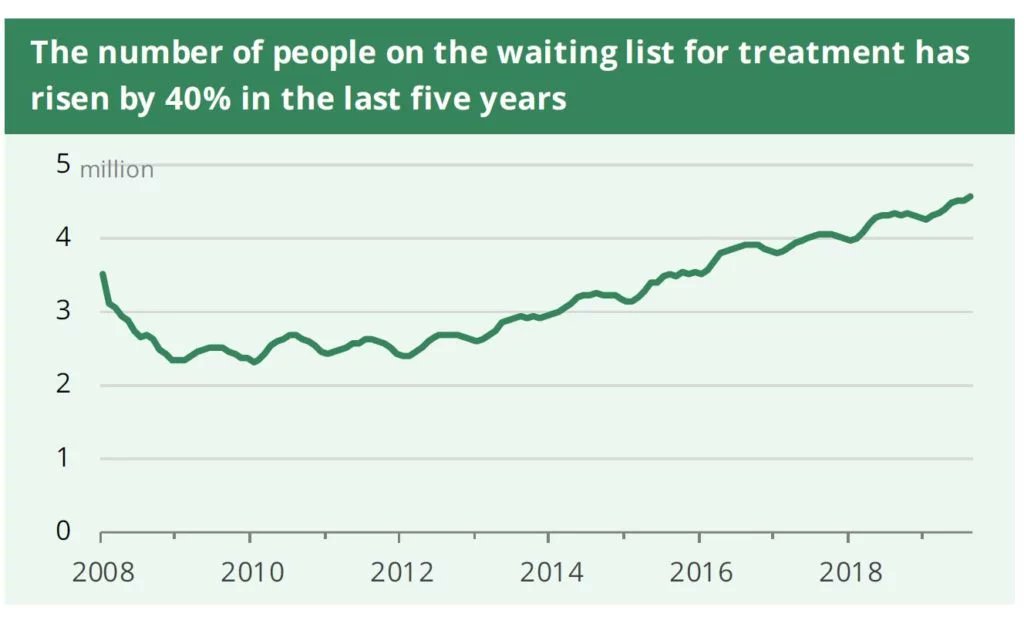
Thanks to our friends at the Association of American Physicians and Hospitals, we learn that north of four-and-a-half million Brits are on waiting lists. For those keeping score, that totals out to almost "7 percent of the entire British population."

Talk about a 7 percent solution...

And it's not just in hospitals:


#Medicaid4All

Monday, December 02, 2019

404Care.gov Enrollment: Week 4 Results

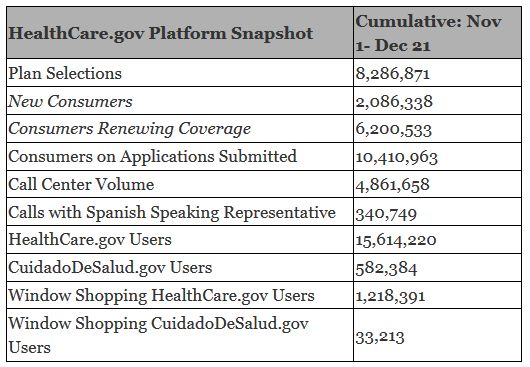
According to email from the Feds, "in week four of the 2020 Open Enrollment period, 703,556 people selected plans using the HealthCare.gov platform."

Of course, this just means that folks have added plans to their carts, the real numbers will be when (if?) they actually pull the trigger and send in a check.

In any case, here's last week's snapshot:
[click to embiggen]

Total plan selections are down about 7% from Week 2 (we missed last week dues to Thanksgiving travel). New consumers are down, as well, as are renewals.

This makes sense, however: we're already a month into the process, and (presumably) most of the folks who are going to make a choice have already done so. I do expect a slight uptick the final week as procrastinators make their choice.

Friday, November 29, 2019

November is LTC Awareness Month

While we're primarily focused right now on Open Enrollment v7.0, November is also a time to be thinking about Long Term Care, both its cost and how to fund it.

One issue is a common misconception that getting older automagically means a decrease in one's quality of life:

"Most older adults and caregivers mistakenly believe that sharp declines in quality of life are inevitable with age ... The majority of seniors think that depression, dementia and lack of mobility can’t be helped."

But are they correct?

Not necessarily:

"Nearly 40% of respondents are not aware that certain prescription medications can impact cognition, and only half know that certain medicines should be avoided as a person gets older."

And that's just the tip of that iceberg. Click on through for more.

Oh! And click here for the survey results themselves.

[Hat Tip: FoIB Randy G]