
Saturday, June 30, 2012


Friday, June 29, 2012
Speaking of fine messes

As the ObamaTax kicks into high gear heading into its full implementation in '14, it doesn't take a Nostradamus to foretell the consequences. Indeed, some are already making themselves rudely obvious:
"The next year is one massive scramble for employers to implement the [ObamaTax] now that it’s been upheld, and not all the regulations businesses need to follow have been written."
Most of these will affect businesses with 50 or more employees (ouch!), which means a lot of small to mid-sized firms have to be thinking "why do I need this headache?"
Here in the Buckeye State, the[Evil] Mandate ObamaTax may cost north of "$940 million in 2014 and 2015 based on the 400,000 people in the state who are eligible for Medicaid but are not enrolled"
Of course, Gov Kasich could just go all Walker/Jindal here. Good times, good times.
Finally (well, for now):
"The [Deloitte Center for Health Solutions] is set to release a study that says the number of businesses offering coverage – 130 million – could be cut in half during the next decade"
Told. You. So.
"The next year is one massive scramble for employers to implement the [ObamaTax] now that it’s been upheld, and not all the regulations businesses need to follow have been written."
Most of these will affect businesses with 50 or more employees (ouch!), which means a lot of small to mid-sized firms have to be thinking "why do I need this headache?"
Here in the Buckeye State, the
Of course, Gov Kasich could just go all Walker/Jindal here. Good times, good times.
Finally (well, for now):
"The [Deloitte Center for Health Solutions] is set to release a study that says the number of businesses offering coverage – 130 million – could be cut in half during the next decade"
Told. You. So.
[Hat Tip: FoIB Holly R]
MedTech: VERY cool

That's the premise behind EmergencyLink, a free app and service accessible on your smartphone. You create a profile and contact list, and the service takes it from there.
Very cool.
But what if you just need some quick, helpful answers to a non-emergency qiestion? Well, that's where HealthTap comes in:
Like EmergencyLink, HealthTap can be accessed from your smartphone, but it also offers a web-portal for those of us with dumb ones. The service even lets you exchange files for more in-depth conversations with its 12,000+ physicians.
No word yet on how many of them make housecalls.
Time to get to work
Now that ObamaCare is here to stay, for now, the real work begins. How do we make the best of the situation and minimize the damage?
Tens of Thousands if not hundreds of thousands of mostly small employers self fund under a high deductible that will be going away in 2 years or less. This model has been extremely effective, save 15% on your auto insurance in 15 minutes comes to mind. Employers can offer the same benefits just 10-20% cheaper. It also has brought the expertise of true professionals onto the issues of excessive provider reimbursement, inefficient care, and cost control. Ten thousand engaged brokers and TPAs will deliver far better results then 500 politicians and 100 Academic quacks any day. This model is counter to the principals of ACA which is looking for high premiums and top down cost control. It is going to take some major efforts and lots of luck for these plans to survive. Small employers need to be prepared for not only a 10-20% increase when high deductible plans go away but a 30-50% increase when their new low deductible plan is community rated. If your in Ohio and rated 1-36 in small group everyone under 20 better be prepared. If your under 10 I don't think a 3 digit rate increase is out of the realm of possibility.
The people that think professionally are strong believers that a $100 tax, penalty, tax is going to prevent adverse selection. 30+ years of reality says it will just make the issue worse. Employers are going to have to find an affordable plan they can pay 100% of the employee cost for to maintain participation. Prepaid plans sponsored by a local health system might be back in vogue pretty quickly. Choice will be the first casualty of ACA.
Tax rates will be the second, when this doesn't work, reform always fails to do what reform says it will, the logical thing to do would be to scrap it, just like Medicare they will borrow to cover it instead. Eventually we will hit our credit limit and when we do taxes will skyrocket. If you can't stomach health insurance as a career any longer accounting and financial planning are going to be very busy.
Finally the practice of medicine is about to get considerably more altruistic. You would think providers learned their lesson after getting suckered on Medicare. This time they are not getting flowers and dinner first. 80-85% of spending goes to providers, when the budget is busted that is going to stick out like a cancer for the scalpel.
The one positive I see is every time government has tried to fix healthcare they have made a complete mess of things and created entire new industries to address it. There is going to be a whole lot of fixing to be done and thus a whole lot of work for those that identify it.
Tens of Thousands if not hundreds of thousands of mostly small employers self fund under a high deductible that will be going away in 2 years or less. This model has been extremely effective, save 15% on your auto insurance in 15 minutes comes to mind. Employers can offer the same benefits just 10-20% cheaper. It also has brought the expertise of true professionals onto the issues of excessive provider reimbursement, inefficient care, and cost control. Ten thousand engaged brokers and TPAs will deliver far better results then 500 politicians and 100 Academic quacks any day. This model is counter to the principals of ACA which is looking for high premiums and top down cost control. It is going to take some major efforts and lots of luck for these plans to survive. Small employers need to be prepared for not only a 10-20% increase when high deductible plans go away but a 30-50% increase when their new low deductible plan is community rated. If your in Ohio and rated 1-36 in small group everyone under 20 better be prepared. If your under 10 I don't think a 3 digit rate increase is out of the realm of possibility.
The people that think professionally are strong believers that a $100
Tax rates will be the second, when this doesn't work, reform always fails to do what reform says it will, the logical thing to do would be to scrap it, just like Medicare they will borrow to cover it instead. Eventually we will hit our credit limit and when we do taxes will skyrocket. If you can't stomach health insurance as a career any longer accounting and financial planning are going to be very busy.
Finally the practice of medicine is about to get considerably more altruistic. You would think providers learned their lesson after getting suckered on Medicare. This time they are not getting flowers and dinner first. 80-85% of spending goes to providers, when the budget is busted that is going to stick out like a cancer for the scalpel.
The one positive I see is every time government has tried to fix healthcare they have made a complete mess of things and created entire new industries to address it. There is going to be a whole lot of fixing to be done and thus a whole lot of work for those that identify it.
The 50th Employee

Here's the problem: if you currently employ 49 people, you're not going to be hiring that 50th guy, because that would cancel your exemption. Which means your current workforce is either going to have to work harder (to make up for that missing 50th employee), or you're going to need to scale back even further.
And if you're the 50th employee right now, you'd best be updating your resume.
HWR Supplemental: SCOTUS rules edition [UPDATED]
Health Wonk Review co-founder Joe Paduda hosts a special edition highlighting blggers' reactions to yesterday's ObamaTax decision. Pro or con, there's some great analysis all conveniently available - check it out.
UPDATE (7/2/12): Joe's now posted a second part to this Special Edition. Kudos!
UPDATE (7/2/12): Joe's now posted a second part to this Special Edition. Kudos!
Thursday, June 28, 2012
ObamaTax: A Silver Lining

Now that SCOTUS has affirmed that we must pay higher taxes, while placing our health care in the hands of unelected and unaccountable Death Panels, it's helpful to know that there are alternatives.
Since we'll now be seeing fewer medical innovations, what can folks do if (when?) they need health care and can no longer find it (or are denied outright)?
Well, the folks at Medical Travel Today report that "[s]afety is and has always been a key issue in the world of healthcare and medical travel ... one organization is doing its part to bring a new level of safety to many medical travelers' first step: the search."
MTT has an exclusive interview with DotHealth CEO Andy Weissberg; DotHealth "aims to create a safer, more secure environment for both consumers and global health stakeholders from a variety of fields."
Those of us with Health Savings Accounts (HSA's) will also be interested in this item, which reports that "HSA account holders will now have the opportunity to take advantage of a medical travel option and access high quality healthcare services at significant savings virtually anywhere in the world."
Of course, HSA-compliant plans will be phased out as ObamaTax is fully implemented, and it's unclear how the accounts themselves will fare down the road. But for now, it's up, up and away!

Wednesday, June 27, 2012
Something else to ponder...
Although we've had an unofficial moratorium on predicting tomorrow's SCOTUS decision re: ObamneyCare©, it's worth noting that the [Evil] Individual Mandate and the Exchanges aren't the only issues to be decided:
" [T]here are some major health-insurance regulations besides community rating and guaranteed issue ... Medicaid expansion"
Although the CornHusker "dodge" was withdrawn, the very real financial (and legal) issues that accrue to the expansion (at state cost!) to Medicaid are very real.
Money is money.
" [T]here are some major health-insurance regulations besides community rating and guaranteed issue ... Medicaid expansion"
Although the CornHusker "dodge" was withdrawn, the very real financial (and legal) issues that accrue to the expansion (at state cost!) to Medicaid are very real.
Money is money.
Cavalcade of Risk #160: Wildfire Edition
Louise Norris hosts this week's smokin' hot edition of the Cavalcade of Risk. Come for Money Mustaches, stay for the Financial Cents. But do stop by.
Tuesday, June 26, 2012
More Stupidity from Ezra [UPDATED]
Alleged health blogger Ezra Klein, noted rocket surgeon extraordinaire, continues to double down on the stupid. Today he opines that even the Father of Our Country liked him some mandates. As reported on Twitter:
"In 1798, Congress mandated that sailors buy health insurance. John Adams signed it into law."
The twit (tweet?) directs the unwitting to Ezra's latest contrivance, wherein he demonstrates profound difficulty discerning the difference between forcing all citizens to purchase a product as a condition of citizenship and specifying that certain individuals must buy a product in order to serve in the military.
Seems pretty clear to me.
In order to show that he really doesn't get it, Ezzie doubles down by citing a 1790 Congressional mandate that "ship owners buy medical insurance for their seamen." Perhaps noticing that there's a pretty glaring logical fallacy here [ed: is there any other kind with this guy?], he observes that "in 1798, Congress ... enacted a federal law requiring the seamen to buy hospital insurance for themselves."
Again, one can choose whether or not to be a sailor. But the [Evil] Individual Mandate applies to all citizens (well, almost all). How come you don't talk about those exceptions, Ezra?
[Hat Tip: FoIB Holly R]
UPDATE/IRONY ALERT: I can't believe I missed this before posting. Ezra Klein relies on legislation from the 18th Century to make his "point?" Is this the same Ezra Klein that pooh-poohs the Constitution because it's "not a clear document. Written 100 years ago, when America had thirteen states and very different problems, it rarely speaks directly to the questions we ask it?"
Why yes, yes it is.
The stupid burns strong in that one.
"In 1798, Congress mandated that sailors buy health insurance. John Adams signed it into law."
The twit (tweet?) directs the unwitting to Ezra's latest contrivance, wherein he demonstrates profound difficulty discerning the difference between forcing all citizens to purchase a product as a condition of citizenship and specifying that certain individuals must buy a product in order to serve in the military.
Seems pretty clear to me.
In order to show that he really doesn't get it, Ezzie doubles down by citing a 1790 Congressional mandate that "ship owners buy medical insurance for their seamen." Perhaps noticing that there's a pretty glaring logical fallacy here [ed: is there any other kind with this guy?], he observes that "in 1798, Congress ... enacted a federal law requiring the seamen to buy hospital insurance for themselves."
Again, one can choose whether or not to be a sailor. But the [Evil] Individual Mandate applies to all citizens (well, almost all). How come you don't talk about those exceptions, Ezra?
[Hat Tip: FoIB Holly R]
UPDATE/IRONY ALERT: I can't believe I missed this before posting. Ezra Klein relies on legislation from the 18th Century to make his "point?" Is this the same Ezra Klein that pooh-poohs the Constitution because it's "not a clear document. Written 100 years ago, when America had thirteen states and very different problems, it rarely speaks directly to the questions we ask it?"
Why yes, yes it is.
The stupid burns strong in that one.
So, are you a Hep Cat?

FoIB Jeff M alerts us to this disturbing news for the Boomers among us:
"A government proposal that all baby boomers get tested for hepatitis C may be drawing high praise for its potential health benefits, but it’s also raising questions about the unintended consequences of screening for those seeking insurance."
We see this a lot: doc's prescribing tests and/or med's for conditions that may (or, you know, may not) exist, which then show up in the medical records of folks seeking insurance. I recently spoke with a Long Term Care insurance prospect whose physician had prescribed a particular med for her anxiety; this has caused her some grief in the application process.
The Hep C issue is, I must admit, news to me. On the one hand, it was a routine blood exam for a life insurance policy that turned up HIV in a famous professinal athlete. On the other, well:
"Even treatment for hepatitis C might not guarantee acceptance since current protocols may not be 100 percent effective."
I do have a problem with this:
"I would never, ever tell anybody to delay getting any kind of medical exam ... But you have an advantage over the insurance company if you apply for insurance before undergoing any kind of medical checkups.”
Ooops.
Here's the problem: life and health applications ask not just whether you've seen a doc recently, but whether or not you've experienced any "issues" which might be a clue that you do so. Long Term Care apps are especially stringent on these points. And although carriers routinely act stupidly, they're not run by stupid people.
"A government proposal that all baby boomers get tested for hepatitis C may be drawing high praise for its potential health benefits, but it’s also raising questions about the unintended consequences of screening for those seeking insurance."
We see this a lot: doc's prescribing tests and/or med's for conditions that may (or, you know, may not) exist, which then show up in the medical records of folks seeking insurance. I recently spoke with a Long Term Care insurance prospect whose physician had prescribed a particular med for her anxiety; this has caused her some grief in the application process.
The Hep C issue is, I must admit, news to me. On the one hand, it was a routine blood exam for a life insurance policy that turned up HIV in a famous professinal athlete. On the other, well:
"Even treatment for hepatitis C might not guarantee acceptance since current protocols may not be 100 percent effective."
I do have a problem with this:
"I would never, ever tell anybody to delay getting any kind of medical exam ... But you have an advantage over the insurance company if you apply for insurance before undergoing any kind of medical checkups.”
Ooops.
Here's the problem: life and health applications ask not just whether you've seen a doc recently, but whether or not you've experienced any "issues" which might be a clue that you do so. Long Term Care apps are especially stringent on these points. And although carriers routinely act stupidly, they're not run by stupid people.
Monday, June 25, 2012
Hoosier Healthcare Hijinx
We last discussed the Healthy Indiana program almost 4 years go. At the time, we noted that low income Hoosiers were eligible for Health Savings Account (HSA) plans. Even then, preventive benefits were available with little or no out-of-pocket. The major downside seemed to be the $300k lifetime cap on all covered expenses.
Well, a few years later and along comes ObamneyCare©, and the most vulnerable of Hoosiers can kiss their Healthy Indiana coverage goodbye:
Well, a few years later and along comes ObamneyCare©, and the most vulnerable of Hoosiers can kiss their Healthy Indiana coverage goodbye:
[Hat Tip: FoIB Bob D]
Ill-advised Citizen Tricks
FoIB Patrick P sent us this item:
"I canceled my very expensive individual health insurance coverage through California's state-run high-risk plan and became insurance-free ... no one will insure me on the individual market ... I have made do with the state's high-risk insurance plan. California ... The federal high-risk plan would cost me just $265 a month"
It's hard not to feel some compassion for Randy Dotinga (Mr D): his health issues don't seem to be self-inflicted. But I have a number of issues with what he proposes. Of course, I completely respect his right to make this choice, even if ill-advised.
University of Chicago professor Harold Pollack nails it:
"[Randy's] responding in an understandable way ... Any program that requires people to be actively uninsured creates a very paradoxical and painful set of incentives and encourages people to do what you're doing."
As we've noted before, PCIP requirements are not only counter-intuitive, they actually punish folks who've played by the rules (as Mr D appears to have done). In this case, he's taking a calculated risk that he'll make it through that half-year wait without a major setback (ie "claim"). Given that he's already acknowledged his precarious (if not imminently threatened) heart health, this is either really gutsy, or really stupid.
And to be frank, I'm not sure which way I lean here.
I do respect that he at least touched base with the government agency overseeing the program. They were less than enthused that he might encourage others to follow his example, which I suppose is justified, but I think unfair. After all, it was the rocket surgeons who dreamed upthe train-wreck ObamneyCare© that insisted on making folks "go bare" for six months. What did they suppose was going to happen?
I have two particular problems with this strategy, both of which Mr D acknowledges: first, there's no guarantee that there'll be space for him once he's eligible; and second, the program has limited funding (and a sunset provision) that could leave him in the middle of a claim with no coverage.
Mr D's claim that he was uninsurable through the individual market gave me pause, so I reached out to California health insurance gurus David Fluker and our own Bill Halper. Turns out, this claim is likely valid; as Bill notes "any cardiac condition that requires ongoing treatment is pretty much death in the individual market." David expanded on this, explaining that "California individual health plans do not provide for any waivers, exclusions or riders. It’s all or nothing whatever the plan covers. As such our decline rates are much higher here and any condition of the heart is too risky for an insurer to cover."
Which is good to know.
The real problem, though, is the timing. As noted in the article, one must be uninsured for (at least) six months to be eligible. But (at least in California), one can't even apply for coverage prior to that six month "waiting period." David went above and beyond, and caught a disturbing flaw on Mr D's part:
"With the enrollment process for PCIP, a person would likely be uninsured 7-8 months by the time they were enrolled in PCIP, which is very risky for those with serious health conditions. PCIP enrolls 10th of the month for 1st of the following month and since you have to be uninsured 6 or more months before you apply, the 10th of month 7 is the earliest one can apply. If a person submits the application prior to the 6 months having elapsed, the app is deemed ineligible for PCIP and sent over to MRMIP.
It can be done but it’s a bit complicated."
Talk about understatement.
I've had more than one client (or potential client) in the same boat as Mr Dotinga, and I must admit that I am torn about what to advise. I am not comfortable telling folks they should "roll the dice," but the alternatives are difficult, as well.
On the other hand, there are any number of programs available to folks in his position to access health care for nominal or no cost. In fact, we've linked to some of these in the sidebar for many years. Of course, one must take the initiative and at least contact these folks, but help is available.
For now, anyway.
"I canceled my very expensive individual health insurance coverage through California's state-run high-risk plan and became insurance-free ... no one will insure me on the individual market ... I have made do with the state's high-risk insurance plan. California ... The federal high-risk plan would cost me just $265 a month"
It's hard not to feel some compassion for Randy Dotinga (Mr D): his health issues don't seem to be self-inflicted. But I have a number of issues with what he proposes. Of course, I completely respect his right to make this choice, even if ill-advised.
University of Chicago professor Harold Pollack nails it:
"[Randy's] responding in an understandable way ... Any program that requires people to be actively uninsured creates a very paradoxical and painful set of incentives and encourages people to do what you're doing."
As we've noted before, PCIP requirements are not only counter-intuitive, they actually punish folks who've played by the rules (as Mr D appears to have done). In this case, he's taking a calculated risk that he'll make it through that half-year wait without a major setback (ie "claim"). Given that he's already acknowledged his precarious (if not imminently threatened) heart health, this is either really gutsy, or really stupid.
And to be frank, I'm not sure which way I lean here.
I do respect that he at least touched base with the government agency overseeing the program. They were less than enthused that he might encourage others to follow his example, which I suppose is justified, but I think unfair. After all, it was the rocket surgeons who dreamed up
I have two particular problems with this strategy, both of which Mr D acknowledges: first, there's no guarantee that there'll be space for him once he's eligible; and second, the program has limited funding (and a sunset provision) that could leave him in the middle of a claim with no coverage.
Mr D's claim that he was uninsurable through the individual market gave me pause, so I reached out to California health insurance gurus David Fluker and our own Bill Halper. Turns out, this claim is likely valid; as Bill notes "any cardiac condition that requires ongoing treatment is pretty much death in the individual market." David expanded on this, explaining that "California individual health plans do not provide for any waivers, exclusions or riders. It’s all or nothing whatever the plan covers. As such our decline rates are much higher here and any condition of the heart is too risky for an insurer to cover."
Which is good to know.
The real problem, though, is the timing. As noted in the article, one must be uninsured for (at least) six months to be eligible. But (at least in California), one can't even apply for coverage prior to that six month "waiting period." David went above and beyond, and caught a disturbing flaw on Mr D's part:
"With the enrollment process for PCIP, a person would likely be uninsured 7-8 months by the time they were enrolled in PCIP, which is very risky for those with serious health conditions. PCIP enrolls 10th of the month for 1st of the following month and since you have to be uninsured 6 or more months before you apply, the 10th of month 7 is the earliest one can apply. If a person submits the application prior to the 6 months having elapsed, the app is deemed ineligible for PCIP and sent over to MRMIP.
It can be done but it’s a bit complicated."
Talk about understatement.
I've had more than one client (or potential client) in the same boat as Mr Dotinga, and I must admit that I am torn about what to advise. I am not comfortable telling folks they should "roll the dice," but the alternatives are difficult, as well.
On the other hand, there are any number of programs available to folks in his position to access health care for nominal or no cost. In fact, we've linked to some of these in the sidebar for many years. Of course, one must take the initiative and at least contact these folks, but help is available.
For now, anyway.
Will SCOTUS striking down ACA cause for reflection?
It amazes me how often I see comments like this from Jodi Kantor of the NY Times:
The article in whole is about SCOTUS striking down all or part of Obama's Affordable Care Act, something these same people said was impossible. To question the constitutionality of ACA was dismissed and ridiculed; yet here we are today widely expecting just that to happen.
When will people like Jodi realize they are idiots, the problem is not the aggressive courts or divisive politics? They just don't understand healthcare or the law and thus tend to get analysis wrong. Just as the ACA was always unconstitutional, Death Panels were always a legitimate concern, Jodi just isn't intelligent enough to understand why.
We can only hope that people like Jodi Kantor take some time after the court ruling and reflect on why, once again, they got it wrong and make the connection to their lack of talent. Jodi could have had a perfectly accurate article if she had left that partial sentence out, yet for some reason they always feel compelled to over reach and show just how little they know.
Friday, June 22, 2012
Health Wonk Review: SCOTUS on hold edition
FoIB and HWR founder Joe Paduda hosts this week's assortment of posts on health care policy and polity. As usual, it's chock full of interesting, sometimes provocative posts.
Do check it out.
Do check it out.
Cavalcade of Risk #160: Call for submissions
Next week's Cavalcade of Risk will be at
Jay and Louise's place.
Entries are due by Monday (the 25th).
To submit your risk-related post, just click here to email it.
You'll need to provide:
■ Your post's url and title
■ Your blog's url and name
■ Your name and email
■ A (brief) summary of the post
PLEASE remember: ONLY posts that relate to risk (not personal finance tips and the like).
Thanks!
Thursday, June 21, 2012
Propaganda Never Dies
Commenting on another blog I came across an all too familiar problem:
Ignoring the debatable opinion in the first paragraph, it is the highlighted part that is really the problem. Since HIPAA passed in 1996 small groups are not only guaranteed issued but the rates are capped meaning sick groups are subsidized by healthier groups. As Kaiser shows all 57 States have Guarantee issue up to 50 lives; the only variable is does it start at one or two. Husband and wife is two, so no matter what state she lives in they are guaranteed insurance.
Maybe this is Darwin's way to prevent people from starting businesses that shouldn't, but it is concerning that people with these misbeliefs are voting. If someone wants to start a business so badly but is stopped by a problem that doesn't exist to what measure will they go to solve this imaginary problem?
MLR vs SCOTUS: Under the radar

As we wait breathlessly for the SCOTUS decision on ObamneyCare©, I'll engage in some completely baseless (but fun) speculation. We've written extensively on the stupidity that is MLR (Medical Loss Ratio), and FoIB Holly R sent us this link on the latest:
"Health insurance plans owe $1.1 billion in rebates ... Millions of consumers and businesses will receive $1.1 billion in rebates this summer from health insurance plans that failed to meet a requirement of the new health-care law"
Thus sayeth HHS Secretary Shecantbeserious.
As an aside, do "professional journalists" and/or "editors" actually proofread the stuff they spit out? It would appear not, since they seem to be saying that Madame Secretary envisions checks totaling multiples of billions of dollars ("Millions of consumers" will be getting checks for "$1.1 billion"). On the other hand, given the current regime, maybe that's just the next Spendulus.
Compounding this idiocy is that Madame Secretary and her minions have no idea how many rebates will be "earned," let alone the total dollar value. I guess we'll have to send out the checks to see how many - and how much - they are.
But here's the piece that has me chuckling: the naysayers claim that if SCOTUS scuttles ObamneyCare©, “adult children” will be booted off parents’ insurance, policies will be rescinded willy-nilly, and other assorted clamors of doom.
So here's my question: in that scenario, wouldn't those who received MLR-generated rebates have to return them to the carrier(s)? And yes, I'm quite serious. Sauce for the goose, and all that.
"Health insurance plans owe $1.1 billion in rebates ... Millions of consumers and businesses will receive $1.1 billion in rebates this summer from health insurance plans that failed to meet a requirement of the new health-care law"
Thus sayeth HHS Secretary Shecantbeserious.
As an aside, do "professional journalists" and/or "editors" actually proofread the stuff they spit out? It would appear not, since they seem to be saying that Madame Secretary envisions checks totaling multiples of billions of dollars ("Millions of consumers" will be getting checks for "$1.1 billion"). On the other hand, given the current regime, maybe that's just the next Spendulus.
Compounding this idiocy is that Madame Secretary and her minions have no idea how many rebates will be "earned," let alone the total dollar value. I guess we'll have to send out the checks to see how many - and how much - they are.
But here's the piece that has me chuckling: the naysayers claim that if SCOTUS scuttles ObamneyCare©, “adult children” will be booted off parents’ insurance, policies will be rescinded willy-nilly, and other assorted clamors of doom.
So here's my question: in that scenario, wouldn't those who received MLR-generated rebates have to return them to the carrier(s)? And yes, I'm quite serious. Sauce for the goose, and all that.
The "Other" Mandate: Not Just for Catholics
While it might be tempting to write off objections to the mandating of coverage for convenience items birth control and abortion as a purely Catholic issue, it's really not:
"Many Protestant institutions are also trying to overturn the compromise that coerces private religious institutions to fund health insurers who can provide beneficiaries with abortion-inducing drugs"
Cans of worms....
"Many Protestant institutions are also trying to overturn the compromise that coerces private religious institutions to fund health insurers who can provide beneficiaries with abortion-inducing drugs"
Cans of worms....
Wednesday, June 20, 2012
So what?

FoIB Holly R tips us to this shocker from The Hill:
"More than 3 million young adults have been able to stay on their parents' insurance plans because of [ObamneyCare©]."
One of the provisions allows "adult children" (see also: "jumbo shrimp") to stay on their parents' health insurance plan until they're 27 (29 in Ohio). This is also a case of "bootstrapping:" ObamneyCare© did away with individual policies for actual children in favor of those who can actually fend for themselves.
Theoretically, anyway.
It's a fairly innocuous piece of thistrain wreck initiative, but it's also expensive for those who choose to take advantage of it: in most cases, the cost of the rider is far greater than an individual policy would be (particularly if the group plan is the typical co-pay arrangement).
But of course we can't expect The Hill to report on that.
"More than 3 million young adults have been able to stay on their parents' insurance plans because of [ObamneyCare©]."
One of the provisions allows "adult children" (see also: "jumbo shrimp") to stay on their parents' health insurance plan until they're 27 (29 in Ohio). This is also a case of "bootstrapping:" ObamneyCare© did away with individual policies for actual children in favor of those who can actually fend for themselves.
Theoretically, anyway.
It's a fairly innocuous piece of this
But of course we can't expect The Hill to report on that.
LTCi: Greater Need, Fewer Choices
Jim Reynolds runs Caring Companion Home Care in Concord, Massachusetts. The 20 year old company provides home health care services, and Mr Reynolds has a message for those of us who sell Long Term Care insurance (LTCi):
"You're doing a good job; keep at it."
That's the good news.
The bad news is that, according to the National Association for Home Care & Hospice, some "7.6 million Americans received formal home health care and related services with a total value of about $58 billion in 2007;" by now, that number is likely to have grown substantially. The problem, of course, is that this care isn't free, and Medicare pays only a part (if any at all).
That's where LTCi comes in:
"When asked during an interview about how many of the families can use LTCI coverage to pay for the care, he thinks a bit, then says the percentage might be "10% to 10%." Then he thinks a bit more and says, "Closer to 10 percent.... It's not near as high as it ought to be."
And therein lies the rub: just as we see the need for this kind of plan peaking, its availability is on the decline:
"Shopping for long-term-care insurance? You should expect higher costs and a tougher approval process as a growing number of household-name insurers quit selling the policies."
As Bob noted this spring, "Prudential has announced they will be withdrawing from the individual long term care market." Met and Unum had already bailed on the individual LTCi market, and other carriers are now tightening their belts.
Those carriers "toughing it out" are making significant changes (aka reductions) in their product offerings. The latest comes from MassMutual. Although it's unlikely that they'll completely exit this market anytime soon, they're making some pretty significant changes. From email I received this morning:
Indeed.
So what to do? Well, if you have a need for this kind of coverage, then you'd best be acting sooner rather than later in getting it.
[Hat Tip: MM's Jeff M]
"You're doing a good job; keep at it."
That's the good news.
The bad news is that, according to the National Association for Home Care & Hospice, some "7.6 million Americans received formal home health care and related services with a total value of about $58 billion in 2007;" by now, that number is likely to have grown substantially. The problem, of course, is that this care isn't free, and Medicare pays only a part (if any at all).
That's where LTCi comes in:
"When asked during an interview about how many of the families can use LTCI coverage to pay for the care, he thinks a bit, then says the percentage might be "10% to 10%." Then he thinks a bit more and says, "Closer to 10 percent.... It's not near as high as it ought to be."
And therein lies the rub: just as we see the need for this kind of plan peaking, its availability is on the decline:
"Shopping for long-term-care insurance? You should expect higher costs and a tougher approval process as a growing number of household-name insurers quit selling the policies."
As Bob noted this spring, "Prudential has announced they will be withdrawing from the individual long term care market." Met and Unum had already bailed on the individual LTCi market, and other carriers are now tightening their belts.
Those carriers "toughing it out" are making significant changes (aka reductions) in their product offerings. The latest comes from MassMutual. Although it's unlikely that they'll completely exit this market anytime soon, they're making some pretty significant changes. From email I received this morning:
"MassM announced ... that they are eliminating/limiting the following LTC options:Granted, these tend to be the more expensive, low-volume offerings, but they indicate that the carrier is taking the shrinking market very seriously. That is, when there are fewer carriers even offering LTCi, "no carrier wants to be out on an island offering riders/benefits no one else does because it attracts an inordinate amount of business and remaining in balance is critical to LTC success."
*Lifetime and 10-year benefit periods
*Full Return of Premium on Death and Return of Premium on Death riders
*All limited premium-payment options (10-year, paid-up at age 65 and discounted renewals
*Limiting the Shared Care rider to 2-3 year benefit periods
Indeed.
So what to do? Well, if you have a need for this kind of coverage, then you'd best be acting sooner rather than later in getting it.
[Hat Tip: MM's Jeff M]
Tuesday, June 19, 2012
MSM Plays Captain Obvious

From the "No Kidding, Sherlock" Department:
Wait, what??
Wasn't this train wreck "reform" going to guarantee that everyone would be insured while cutting premiums 3000 percent? Is the Associated Press, that well-known conservative mouthpiece, trying to tell us us it was all a big lie?
Hmmm.
Who, exactly, would still be uninsured among us?
Well, that would be "illegal immigrants and those who can't afford to pay out-of-pocket for health insurance."
Very interesting.
Why would illegals care about insurance in the first place? After all, they already get free care courtesy of the states. And of course, those who "can't afford" the premiums would be eligible for expanded Medicaid coverage and tax credits.
Sheesh.
[Hat Tip: FoIB Holly R]
Death by MVNHS© [UPDATED]
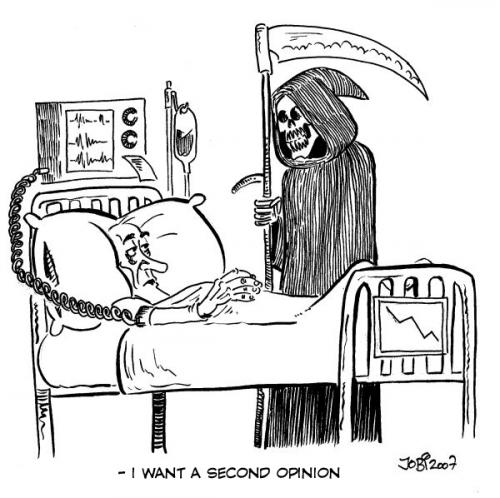
Last time we looked, the Much Vaunted National Health System© was busy killing off 78 year old bladder cancer patient Kenneth Ward. Lest Mr Ward feel left out, here's news that he's far from alone:
This is nothing new, of course: last year, we noted that "[h]ip replacements, cataract surgery and tonsil removal are among operations now being rationed in a bid to save the NHS money." Still, these new numbers show why a single-payer system can never really sustain itself. As Bob mentioned last week, "true single payer eliminates private industry. The government decides how much to pay the provider and what services are expected. The British NHS works like this" and the fact that 90% of British hospitals engage in health care rationing of this magnitude simply underscore his point.
Defenders of single payer like to point out that they're more cost effective than a free-market model. Of course, it's easy to be cost-effective when providers "are denying treatment despite guidance from the National Institute for Health and Clinical Excellence that patients should receive it."
Meet the ultimate Death Panels.
UPDATE: Well, well, well - Thought we were exaggerating about those Death Panels? Think again:
"The NHS kills off 130,000 elderly patients every year ... NHS doctors are prematurely ending the lives of thousands of elderly hospital patients because they are difficult to manage or to free up beds ... Professor Patrick Pullicino said doctors had turned the use of a controversial ‘death pathway’ into the equivalent of euthanasia of the elderly."
But of course.
UPDATE: Well, well, well - Thought we were exaggerating about those Death Panels? Think again:
"The NHS kills off 130,000 elderly patients every year ... NHS doctors are prematurely ending the lives of thousands of elderly hospital patients because they are difficult to manage or to free up beds ... Professor Patrick Pullicino said doctors had turned the use of a controversial ‘death pathway’ into the equivalent of euthanasia of the elderly."
But of course.
Fewer Choices, Higher Costs: ObamneyCare©
Starting a new business is challenging enough, but navigating the maze of group insurance adds a whole new dimension. A frequent roadblock is the issue-and-participation requirement. This is a carrier rule based on the number of employees and how many opt for the group plan. Carriers justify this based on the concept of adverse selection (only sick people would sign up).
I recently met with the owners of a new company, and we quickly established that they'd be ineligible for a group plan based on participation requirements. Looking for alternatives, we wondered if a "stand-alone" Health Reimbursement Arrangement (HRA) would do the trick.
A stand-alone HRA is basically a health care debit card funded by the employer. A typical design might be $500 per year per employee; the first $500 of one's medical expenses would essentially be borne by the employer. Unlike a qualified Health Savings Account (HSA), there was no requirement for an underlying health insurance plan.
We thought this would be a great option in this case: it would mean that at least some of an employee's medical expenses could be shifted off his or her shoulders.
Alas, ObamneyCare© has ruled this out:
"Health care reform requires most group health plans to provide minimum annual levels of coverage for “essential health benefits” ... In 2014 group health plans will have to provide unlimited annual benefits for “essential health benefits” ... The government has ruled that most HRAs are considered group health plans for these purposes."
In other words, stand-alone plans would themselves have to be "unlimited," a rather daunting prospect for any business. Needless to say, this plan was a no-go.
So of course we can see how ObamneyCare© has increased choices and lowered costs across the board.
Or not.
[Hat Tip: FoIB Alissa C]
I recently met with the owners of a new company, and we quickly established that they'd be ineligible for a group plan based on participation requirements. Looking for alternatives, we wondered if a "stand-alone" Health Reimbursement Arrangement (HRA) would do the trick.
A stand-alone HRA is basically a health care debit card funded by the employer. A typical design might be $500 per year per employee; the first $500 of one's medical expenses would essentially be borne by the employer. Unlike a qualified Health Savings Account (HSA), there was no requirement for an underlying health insurance plan.
We thought this would be a great option in this case: it would mean that at least some of an employee's medical expenses could be shifted off his or her shoulders.
Alas, ObamneyCare© has ruled this out:
"Health care reform requires most group health plans to provide minimum annual levels of coverage for “essential health benefits” ... In 2014 group health plans will have to provide unlimited annual benefits for “essential health benefits” ... The government has ruled that most HRAs are considered group health plans for these purposes."
In other words, stand-alone plans would themselves have to be "unlimited," a rather daunting prospect for any business. Needless to say, this plan was a no-go.
So of course we can see how ObamneyCare© has increased choices and lowered costs across the board.
Or not.
[Hat Tip: FoIB Alissa C]
Monday, June 18, 2012
ObamneyCare© SCOTUS Meter... [UPDATED]

For those waiting with bated breath for a decision on the ObamneyCare© case, take a deep breath and relax (for the nonce):
Um....
UPDATE: Something to ponder while we're waiting. FoIB (and Cato Institute Director of Health Policy) Michael Cannon shares his thoughts on the latest ObameyCare© "bug:"
"Under the statute as written, if Congress fails to repeal IPAB [aka Death Panels] in 2017, then as of 2020 Congress will have absolutely zero ability to block or amend the laws that IPAB writes, and zero power to affect the Secretary’s implementation of those laws."
Michael, I'd observe that the folks behind thistrain wreck initiative would call that a feature, not a bug.
UPDATE: Something to ponder while we're waiting. FoIB (and Cato Institute Director of Health Policy) Michael Cannon shares his thoughts on the latest ObameyCare© "bug:"
"Under the statute as written, if Congress fails to repeal IPAB [aka Death Panels] in 2017, then as of 2020 Congress will have absolutely zero ability to block or amend the laws that IPAB writes, and zero power to affect the Secretary’s implementation of those laws."
Michael, I'd observe that the folks behind this
MVNHS© Customer Satisfaction takes a hit
As we've long noted, actual care delivery under the Much Vaunted National Health System© has been - at best - substandard. But don't just take our word for it:
"A new survey carried out by the King’s Fund health charity ... indicates that the general public’s levels of satisfaction with the running of the NHS have seen a marked drop. The number of people who were satisfied ... fell significantly to 58% in 2011."
Ooopsies.
MVNHS© leadership observed that these findings indicated that Brits are “worried and confused.” No kidding: they're worried because they see precisely how such systems fail to perform, and they're confused by the fact that it's still touted by the ruling class as terrific.
Regular readers already know thatvictims of participants in the MVNHS© can buy health insurance that can help pay for private care. The catch, which may be new to some, is that this service is available only to those on a waiting list.
Fortunately, this apparently comprises the majority of patients.
"A new survey carried out by the King’s Fund health charity ... indicates that the general public’s levels of satisfaction with the running of the NHS have seen a marked drop. The number of people who were satisfied ... fell significantly to 58% in 2011."
Ooopsies.
MVNHS© leadership observed that these findings indicated that Brits are “worried and confused.” No kidding: they're worried because they see precisely how such systems fail to perform, and they're confused by the fact that it's still touted by the ruling class as terrific.
Regular readers already know that
Fortunately, this apparently comprises the majority of patients.
"We have to change and we know that"
The Supreme Court decision on the Affordable Care Act is
expected the week of June 25th, so the chatter is picking up
again. Kaiser Health News has
an interesting article here that includes this comment:
“We have to change and we know that,” said Ken Raske,
president and CEO of the Greater New York Hospital Association, which
represents 250 hospitals and medical care facilities. “But it’s easier if
you’re going to build the building to have the shovels and picks and the hammer
and nails than trying to dig it out with your hands. That’s what the Affordable
Health Care Act is.”
I think this suggests an attitude within the hospital industry that is worth thinking about. Although Raske concedes hospitals have a business imperative
to change, he warns they might have to slow down, unless government provides
“shovels and picks and the hammer and nails”. Since the Federales cannot supply these literal tools to
the hospital industry I think it’s clear Raske is talking about money.
The attitude is that, unless
the government pays for change, change will be slow or nonexistent. I just don’t accept that attitude. Do you?
When other, non-hospital businesses have to change and they
know it, what do they do? Do they rely
on their own resources? Or do they
rely first on getting government money - and tell their customers that they
might not change – or might change slowly – if they don’t get it? You know the answer.
Short version of the above - News flash: the hospital industry says it must have
more money from the government or it might slow down efforts to serve its
patients better.
Health & Chocolate Down Under

"[R]esearchers at Monash University have discovered that eating a 100g [about 3.5 oz] bar of dark chocolate a day (yes, the whole seductive, delicious, mouthwatering brown slab, from each melting cube to the last sticky crumb) is one way to avoid cardiovascular disease."This magic elixir apparently reduces both blood pressure and cholesterol. Obviously, one must avoid over-consumption, but it sounds like a great way to eat healthy.
Friday, June 15, 2012
IRS: More ObamaBux©

Although we often mock HHS Secretary Shecantbeserious (and justifiably so), it's important to remember that the really big guns behind ObamneyCare© belong to the IRS, and the revenuers don't work cheap:
"The Internal Revenue Service is expected to use $881 million of taxpayers’ money to implement the first four years of Obamacare, including about $500 million that [HHS Secretary Shecantbeserious] diverted to the agency"
Remember, though, that thistrain-wreck reform package is going to save us buckets of cash.
Rubbing salt in the wound, we also need to be aware of this little "glitch:"
"[T]he Centers for Medicare & Medicaid Services (CMS) are predicting that health care spending will increase about 4% for the next couple of years."
Meh, that's not so bad.
Wait, what?
"Spending could then jump about 7% in 2014, when coverage expansion programs created by [ObamneyCare©] are supposed to start, the CMS analysts said"
Oh, well, it's only money, right?
"The Internal Revenue Service is expected to use $881 million of taxpayers’ money to implement the first four years of Obamacare, including about $500 million that [HHS Secretary Shecantbeserious] diverted to the agency"
Remember, though, that this
Rubbing salt in the wound, we also need to be aware of this little "glitch:"
"[T]he Centers for Medicare & Medicaid Services (CMS) are predicting that health care spending will increase about 4% for the next couple of years."
Meh, that's not so bad.
Wait, what?
"Spending could then jump about 7% in 2014, when coverage expansion programs created by [ObamneyCare©] are supposed to start, the CMS analysts said"
Oh, well, it's only money, right?
Thursday, June 14, 2012
MassCare Uh-oh

It will come as no surprise to regular readers of IB, but MassCare (famous for killing health insurance competition and increasing premiums in the Bay State) seems to be a gold-mine for folks gaming the system:
"Illegal aliens, out-of-staters and others who failed to produce proof of Massachusetts residency drained $118 million from the pool of cash the state uses to reimburse hospitals and clinics that care for the poor"
Ooopsies.
As we noted last Fall, Bay Staters were already on the hook to the tune of $93 billion for illegals' health care. As State Rep James Lyons points out:
"If you open a business in the commonwealth, you’ve got to provide documentation of where you live and what the business is ... If we’re providing benefits, all I’m suggesting we do is level the playing field. Don’t just give benefits out if we’re not requiring documentation.”
Yeah, rotsa ruck with that.
"Illegal aliens, out-of-staters and others who failed to produce proof of Massachusetts residency drained $118 million from the pool of cash the state uses to reimburse hospitals and clinics that care for the poor"
Ooopsies.
As we noted last Fall, Bay Staters were already on the hook to the tune of $93 billion for illegals' health care. As State Rep James Lyons points out:
"If you open a business in the commonwealth, you’ve got to provide documentation of where you live and what the business is ... If we’re providing benefits, all I’m suggesting we do is level the playing field. Don’t just give benefits out if we’re not requiring documentation.”
Yeah, rotsa ruck with that.
Maggie explains why we are all worse-informed
In her propagandizing for ACA (hope they pay her for all the hard work she does), Maggie Mahar had this to say in regards to State's not setting up exchanges;
"Tea Partiers celebrate such reports as a sign that health care reform is toast. Better-informed conservatives understand that even if states don’t create exchanges, the federal government will come in and do it for them. The law is very clear on this point."
If you're the governor of any State but ND, WI or AK you probably have a budget deficit, one that is getting worse, not better. You can spend tens of millions up front, or more, to create an exchange that will then have to be staffed and maintained at the cost of tens of millions of tax dollars. Or you can do nothing and someone will do it for free....that second option doesn't sound so bad.
The real question is why is government spending even a penny on this. There have been numerous exchanges done in the past by private industry (Cal Choice for example). These have been paid for by private capital and maintained by private capital. Private industry also has a much better track record - see my post from a few days ago - with getting such programs to actually work.
There is no shortage of private companies that would be more then willing to create these at no cost to the taxpayer, and do a much better job at it. NAHU would be a great sponsor of exchanges, for example. It is also important that we have competition amongst multiple exchanges, something that tends not to happen when competing against the government.
Wednesday, June 13, 2012
Stupid Carrier Terminology

[Warning: inside baseball-type rant ahead]
Renewals happen. Specifically, health insurance rates are generally fixed for a year at a time. At the end of the year, rates go up (yes, theoretically they could stay the same or go down, but how often does that happen?), and one is usually given the option to make plan changes that mitigate the increase. These are typically along the lines of increasing deductibles or co-insurance percentages, or dropping optional prescription benefits and the like.
Not exactly rocket surgery.
These options are often included with the renewal letter; sometimes one must request them from the carrier. Regardless of how they're obtained, they'll require no additional underwriting (since one is actually reducing the carrier's exposure).
So far, so good.
Here's my beef: Anthem calls these options "downgrades."
How stupid is that?!
For better or worse, Anthem gets a major share of my individual medical business (and truthfully, aside from this particular aggravation, they're actually a decent enough carrier). It just ticks me off to no end to begin conversations with clients by telling them they can "downgrade" their plan.
Who the heck wants to downgrade anything?
This is not a new phenomenon with Anthem, it's just hit a boiling point for me: why would you risk alienating your own customers by implying substandard coverage?
It's not like there aren't perfectly good alternatives: plan adjustment, design change, anything neutral or (heaven forfend!) positive. But telling clients that they're being "downgraded" hurts Anthem's own image, while adding nothing of value to the process.
Sheesh!
Renewals happen. Specifically, health insurance rates are generally fixed for a year at a time. At the end of the year, rates go up (yes, theoretically they could stay the same or go down, but how often does that happen?), and one is usually given the option to make plan changes that mitigate the increase. These are typically along the lines of increasing deductibles or co-insurance percentages, or dropping optional prescription benefits and the like.
Not exactly rocket surgery.
These options are often included with the renewal letter; sometimes one must request them from the carrier. Regardless of how they're obtained, they'll require no additional underwriting (since one is actually reducing the carrier's exposure).
So far, so good.
Here's my beef: Anthem calls these options "downgrades."
How stupid is that?!
For better or worse, Anthem gets a major share of my individual medical business (and truthfully, aside from this particular aggravation, they're actually a decent enough carrier). It just ticks me off to no end to begin conversations with clients by telling them they can "downgrade" their plan.
Who the heck wants to downgrade anything?
This is not a new phenomenon with Anthem, it's just hit a boiling point for me: why would you risk alienating your own customers by implying substandard coverage?
It's not like there aren't perfectly good alternatives: plan adjustment, design change, anything neutral or (heaven forfend!) positive. But telling clients that they're being "downgraded" hurts Anthem's own image, while adding nothing of value to the process.
Sheesh!
TravelMed Apps

So you're taking that long-awaited cruise. Or flying to Italy for a week in the Tuscan sun. Or perhaps you're finally taking that ride on the Orient Express. Problem is, you have a few pills you take every morning, maybe a couple others at bedtime.
Or perhaps you have a more extensive health history, and worry about needing your medical records at a moment's notice.
Yeah, there's an app for that:
"Travelers can tap into technology before the trip begins, by storing information that can help ensure the right care is delivered if health issues crop up."
Everything from your most recent chest x-rays to pill and injection reminders can be loaded (or accessed) on your smartphone. For those tech-averse among us, there are also paper-based forms (even laminated cards with your info) that you can download, print-out and carry with you.
And for those who fret that their portable medical apparatus might be a problem, what with stricter luggage allowances, the TSA has a helpful site that explains how items like CPAP machines are exempt.
There's even an emergency care provider locator app available for folks who find themelves in unfamiliar surroundings while sporting a broken limb or major chest pains.
Pretty cool New World, indeed.
[Hat Tip: FoIB Holly R]
Or perhaps you have a more extensive health history, and worry about needing your medical records at a moment's notice.
Yeah, there's an app for that:
"Travelers can tap into technology before the trip begins, by storing information that can help ensure the right care is delivered if health issues crop up."
Everything from your most recent chest x-rays to pill and injection reminders can be loaded (or accessed) on your smartphone. For those tech-averse among us, there are also paper-based forms (even laminated cards with your info) that you can download, print-out and carry with you.
And for those who fret that their portable medical apparatus might be a problem, what with stricter luggage allowances, the TSA has a helpful site that explains how items like CPAP machines are exempt.
There's even an emergency care provider locator app available for folks who find themelves in unfamiliar surroundings while sporting a broken limb or major chest pains.
Pretty cool New World, indeed.
[Hat Tip: FoIB Holly R]
Cavalcade of Risk #159: The Early Edition
CavRisk veteran My Wealth Builder hosts this
week's roundup
of risk-related posts. MWB does a terrific job of keeping things on-track,
with a short but powerful collection.
We're starting to schedule Fall Cavs. Just drop us a line to snag yours.
We're starting to schedule Fall Cavs. Just drop us a line to snag yours.
Monday, June 11, 2012
What could possibly go wrong
Exchanges, either state or federal, are supposed to be one of the transformative benefits of PPACA. A highly automated, uber-efficient insurance buying experience brought to us by those mavens of technology: government. Recent stories like this has we wondering how the exchange delivered will measure up to the one promised.
From Oregon:
From Ohio:
From Oregon:
"Choose easy! The woman who used TurboTax to falsely claim a $2.1MILLION tax refund and went on a spending spree until she was caughtOregon is only one of numerous states that tried and failed to upgrade antiquated computer systems. Most states are running Medicaid systems that are just as bad or worse. No private company could stay in business with the software systems the states use. And when they finally do attempt to upgrade they go tens or hundreds of million over budget and often times fail completely.
...Due to the size of the refund, her electronic claims was examined by several people within the Oregon Revenue Department. Incredibly, they approved the payout and Reyes was sent a visa card ... The revenue department processes about $7billion in tax returns each year on computer systems designed in the 1980s."
From Ohio:
"To accommodate the eligibility changes, health officials are seeking federal support to help replace a more than 30-year-old computer system that frequently erroneously denies Medicaid eligibility and causes a huge administrative burden. "The system is so old that the county case workers have to go in and modify the answer based on information they know, but that the system can't accept"If the exchanges do stay in place after the SCOTUS ruling we better get use to them, there is a good chance we will be using the exact same system for 20-30 years, in-spite of what technology advances.
Friday, June 08, 2012
Backs + Wash: Some Assembly Required
 For anyone still harboring delusions about the sacred underpinnings of ObmaneyCare©, we bring unwelcome news:
"Central to Mr. Obama’s drive to overhaul the nation’s health care system was an unlikely collaboration with the pharmaceutical industry that forced unappealing trade-offs."
In one fell swoop, importation of less expensive meds was swept off the table, and less expensive alternatives remain verboten. And, of course, it's one more nail in the coffin of "transparency" in the process.
[Hat Tip: FoIB Holly R]
Holocaust Life Claims Update
Last Fall, we reported on the efforts to get Allianz and other insurers to honor the death claims of Holocaust victims' families. Spearheading this effort was Florida Congresswoman Ileana Ros-Lehtinen, who at the time was trying to convince the media to deny commercial time to the carrier.
While I have some issues with her apparent ignorance of how free speech is supposed to work (cf: Citizens United), I certainly applaud her enthusiasm.
Her latest effort to allow victims' families to sue the various insurers is currently stalled in committee:
"That brought dozens of Holocaust survivors, many of whom live in Florida, to Washington on Thursday to urge the House Judiciary Committee to consider legislation that would allow lawsuits to be filed in U.S. courts ... The proposed bipartisan bill ... would give thousands of survivors the right to sue Germany’s Allianz SE, Italy’s Assicurazioni Generali and other major European firms in U.S. courts to recover the value of life insurance policies bought before World War II."
Unfortunately, this looks like an uphill battle, since the current claims process was pretty much set in stone over the course of the three most recent administrations. And it also doesn't help that there's little enthusiasm on the part of Congress for revisiting the issue.
Still, it's a noble cause, and one which doesn't seem to be going quietly into that good night.
While I have some issues with her apparent ignorance of how free speech is supposed to work (cf: Citizens United), I certainly applaud her enthusiasm.
Her latest effort to allow victims' families to sue the various insurers is currently stalled in committee:
"That brought dozens of Holocaust survivors, many of whom live in Florida, to Washington on Thursday to urge the House Judiciary Committee to consider legislation that would allow lawsuits to be filed in U.S. courts ... The proposed bipartisan bill ... would give thousands of survivors the right to sue Germany’s Allianz SE, Italy’s Assicurazioni Generali and other major European firms in U.S. courts to recover the value of life insurance policies bought before World War II."
Unfortunately, this looks like an uphill battle, since the current claims process was pretty much set in stone over the course of the three most recent administrations. And it also doesn't help that there's little enthusiasm on the part of Congress for revisiting the issue.
Still, it's a noble cause, and one which doesn't seem to be going quietly into that good night.
Cavalcade of Risk #159: Call for submissions
Next week's Cavalcade of Risk will be at
My Wealth Builder's place.
Entries are due by Monday (the 11th).
To submit your risk-related post, just click here to email it.
You'll need to provide:
■ Your post's url and title
■ Your blog's url and name
■ Your name and email
■ A (brief) summary of the post
PLEASE remember: ONLY posts that relate to risk (not personal finance tips and the like).
Thanks!
Thursday, June 07, 2012
Thursday Afternoon Link-Fest
■ From FoIB Jeff M, we learn that Medicaid may be in even more dire straits than we'd imagined:
"West Virginia is peering over the cliff of a Medicaid funding shortfall ... Medicaid goes into FY 2013 with a slight budget surplus, but FY 2014 poses a $236 million shortfall, “which is daunting.”
Now what could possibly be happening in 2014 that would cause this financial earthquake?
Oh, yeah.
■ Next up, the Institute for HealthCare Consumerism (IHC) reports that consumer-centric health plans (aka High Deductible Health Plans, or HSA's) could save tens of billions of health care dollars each year. They note a RAND study claiming that "[g]rowth Of Consumer-Directed Health Plans To One-Half Of All Employer-Sponsored Insurance Could Save $57 Billion Annually."
Regular readers know that we're big fans of these kinds of plans, but I have to say that I'm still a bit skeptical of that number. And, since these plans are outlawed under ObamneyCare©, we may never know the truth.
■ We've written before about "hidden providers" (most recently, here); recently, a local man and his son ran into that particular buzz-saw (metaphoricaly, anyway):
"Steve Mahoney took his youngest son ... to the emergency room at Children’s Medical Center of Dayton after the boy sliced off his fingertip in a door ... no one told Mahoney that the plastic surgeon ... doesn’t accept health insurance."
On the one hand, it's really not the hospital's responsibility (or even ability) to confirm whether or not a particular provider is in-network, or even accepts any insurance. On the other hand, when you're dealing with your young child's missing digit, how likely are you to be considering that at all?
As you'll see in the article, the problem stems in part from EMTALA.
What's EMTALA?
Glad you asked.
■ And, finally, FoIB Holly R sent us this article on health care alternatives for folks without insurance:
"I’ve gone to a bunch of doctors, and have learned some things along the way about getting health care without health insurance"
Well-written, not preachy, some helpful tips.
"West Virginia is peering over the cliff of a Medicaid funding shortfall ... Medicaid goes into FY 2013 with a slight budget surplus, but FY 2014 poses a $236 million shortfall, “which is daunting.”
Now what could possibly be happening in 2014 that would cause this financial earthquake?
Oh, yeah.
■ Next up, the Institute for HealthCare Consumerism (IHC) reports that consumer-centric health plans (aka High Deductible Health Plans, or HSA's) could save tens of billions of health care dollars each year. They note a RAND study claiming that "[g]rowth Of Consumer-Directed Health Plans To One-Half Of All Employer-Sponsored Insurance Could Save $57 Billion Annually."
Regular readers know that we're big fans of these kinds of plans, but I have to say that I'm still a bit skeptical of that number. And, since these plans are outlawed under ObamneyCare©, we may never know the truth.
■ We've written before about "hidden providers" (most recently, here); recently, a local man and his son ran into that particular buzz-saw (metaphoricaly, anyway):
"Steve Mahoney took his youngest son ... to the emergency room at Children’s Medical Center of Dayton after the boy sliced off his fingertip in a door ... no one told Mahoney that the plastic surgeon ... doesn’t accept health insurance."
On the one hand, it's really not the hospital's responsibility (or even ability) to confirm whether or not a particular provider is in-network, or even accepts any insurance. On the other hand, when you're dealing with your young child's missing digit, how likely are you to be considering that at all?
As you'll see in the article, the problem stems in part from EMTALA.
What's EMTALA?
Glad you asked.
■ And, finally, FoIB Holly R sent us this article on health care alternatives for folks without insurance:
"I’ve gone to a bunch of doctors, and have learned some things along the way about getting health care without health insurance"
Well-written, not preachy, some helpful tips.
Wednesday, June 06, 2012
Astute Carrier Trick
In email this morning, Aetna reported on its experience with the new MLR (Medical Loss Ratio) rules. Aetna claims that, because of its pricing strategies, they're in pretty good shape:
"The reports we filed with [HHS Secretary Shecantbeserious] demonstrate our ability to price appropriately ... Aetna's rebates represent about 0.5 percent of the premiums we collected"
In fact, they claim that most of their insureds won't even see a rebate check.
Good for them (one supposes).
They acknowledge that the increasing cost of health care does, in fact, drive premiums, and that (as Bob has frequently pointed out) lifestyle choices (ie obesity) is a major contributor, as well. Of course, there's the usual sop to "waste and inefficiency" (why is it that no one can ever actually quantify this?).
But what really intrigued me was their answer to the question "is MLR even working?" They must be closet IB readers:
"The rules also unnecessarily increase administrative costs for us and our customers, and could even force insurers out of some markets, reducing competition and limiting choice."
Spot on.
"The reports we filed with [HHS Secretary Shecantbeserious] demonstrate our ability to price appropriately ... Aetna's rebates represent about 0.5 percent of the premiums we collected"
In fact, they claim that most of their insureds won't even see a rebate check.
Good for them (one supposes).
They acknowledge that the increasing cost of health care does, in fact, drive premiums, and that (as Bob has frequently pointed out) lifestyle choices (ie obesity) is a major contributor, as well. Of course, there's the usual sop to "waste and inefficiency" (why is it that no one can ever actually quantify this?).
But what really intrigued me was their answer to the question "is MLR even working?" They must be closet IB readers:
"The rules also unnecessarily increase administrative costs for us and our customers, and could even force insurers out of some markets, reducing competition and limiting choice."
Spot on.
Subscribe to:
Posts (Atom)


 Posts
Posts


