Thursday, November 30, 2006

A Northern Front...

We've blogged before (here and here, for example) about importing med's from our neighbors to the north.
Turns out, most Americans favor such practices, and by a wide margin:

Now, will the politicos listen, and what's the potential downside if they do?

Health Wonk Review is up

Absolutely terrific HWR this week, courtesy of Mike Cannon at the Cato Institute's blog. He presents some 16 interesting entries, all with helpful (and often humorous) context.
Bryan Caplan, who hosts the EconLog, has a quick and effective takedown of Ezra Klein's assertion that HSA's won't do much to bring down the cost of health care. Who knew economics could be fun?

One Doc "Gets It"

My TMBN colleague, Dr Rob Lamberts, has an interesting post on his practice’s answer to “doc in the box” clinics. Instead of decrying the drain it might represent on traditional practices, he welcomes such services as a call for physicians to “think outside the box.”
In fact, Dr Rob writes, “patients are sick of how doctors run their offices.” And so his office has found ways to streamline the delivery of health care. Left unsaid, but certainly implicit in this model, is whether this results in cost savings to either (or both) the doc’s or their patients.
Worth reading in full.

Tuesday, November 28, 2006

Big Brother, or Good Risk Management?

Although we tend to focus on the life and health side of the insurance business, we are InsureBlog, so we sometimes stray into P & C (that's Property and Casualty) territory, as well.
Did you know that more teens are killed in auto accidents than by any other cause? Neither did I, but as the father of two teenage daughters, this story got me thinking about it:
There are a number of such devices on the market now, and as more become available, and as their use spreads, prices should come down somewhat. I spoke with some of my P&C colleagues about these widgets, to see if any carriers were offering discounts to folks who had them installed. Apparently, though, this tech is still under the radar.
I'm ambivalent about the idea: on the one hand, I do worry about my kids. On the other, I trust them, as well.
Any thoughts from IB readers?

Grand Rounds...

Dr R W presents an outstanding edition of 'Rounds, boasting 31 entries. Each one has a helpful summary. Bravo, Doc!
The Grunt Doc has a (short) story that illustrates what we don't mean by Consumer Driven Health Care.

Monday, November 27, 2006

Medical Tourism: A New Twist

I must confess to being a bit apprehensive about this post. We've touched on IVF in the past, as it relates (or not) to risk. And we've discussed medical tourism, as well.
Remember the old Reese's Cup commercials? "You got chocolate in my peanut butter! "No, you got peanut butter in my chocolate!"
That's right, English lasses are trading in their scones for "a Danish." (Or maybe, a Dane). Turns out, the Brits have all but outlawed anonymous sperm donations, which has caused their supply to, um, dry up. Stoking the flames is the fact that a sample of less than half a milliliter (less than a teaspoon) can fetch as much as $32.
Different strokes, I guess.

Carnival Time!

Overachiever My Financial Journey hosts this week's Carnival of Personal Finance. With almost 50 entries, he still managed to get it out a day early (nothing wrong with that!), and with helpful context, to boot. Kudos!
Kristine at Beacon Financial Tips has some, well, tips about how to stay in-budget this holiday season.
This week's Carnival of the Capitalists can be found at Bargaineering. Over 30 posts, many with context (but alas, not all).
One Man Band blog's cehwiedel (not a typo) sounds an early warning bell about a new California universal health-insurance initiative.

Sunday, November 26, 2006

Insurance Dispatch

Would you spend 2% of your income to protect 70% of it? In this week's column, we look at a recent survey that holds some surprising answers.

Check it out at The Medical Blog Network.

Saturday, November 25, 2006

Is Fair, Fair?

According to a recent study in the Health Affairs Journal, almost two thirds of those surveyed believe that smokers should have to pay more for health insurance; about a third felt that obese folks should, as well.

We talk a lot about personal responsibility here at IB, but have so far shied away from this particular controversy (mostly because it’s been somewhat under the radar). But we have discussed the importance of “risk” many times, and this would seem to fall squarely in that milieu.

Longtime readers may recall the IVF kerfluffle some time back: we sometimes forget that behavior choices have consequences. Certainly smoking falls under that heading: I’m aware of no medically-approved treatment plan that mandates one to “light up” (medical marijuana use notwithstanding). Smoking has been linked to any number of health risks, and of course smokers are subject to an increasing number of restrictions on their behavior.

Weight is another such issue: obesity can increase one’s chances for heart attacks, diabetes, and other dread diseases. Overweight folks might argue that they are subject to metabolic challenges that affect their condition, and there is probably some justification for that. Nevertheless, their condition does affect their health; underwriters are less interested in the why than in the fact.

In the life insurance and individual medical markets, smoking status and weight have long been used in assessing one’s rates. In the group market, though, these issues receive considerably less play. Generally, group plan underwriters look at the results of the behavior (cancer, diabetes, stroke, etc) when determining final rates for a group. I haven’t (yet) seen a group screening questionnaire that asks about smoking status of employees; likewise, there’s been no evidence that the behavior itself plays any part in the underwriters’ decisions.

But, if there’s enough of a demand, the industry will most likely respond. At some point, some carrier will announce a special discount for smoke-free groups, or some other program along those lines. It will be interesting to see when (not if) that happens.

Thursday, November 23, 2006

How to Insure a Great Thanksgiving

According to the South Carolina Insurance Department, there are over 4,000 fires every year on Thanksgiving. They cause 15 deaths and dozens of injuries, not to mention over $25 million in property damage. And that's not just the folks who fry their birds.

Speaking of fryers (the cooking technique, not the variety), the U.S. Consumer Product Safety Commission reports that over a seven year period (ending last year), there were over 100 "incidents" related to turkey frying, mostly by folks who lit up their birds (metaphorically, we hope) and then just wandered away for a bit.

Never having been bitten by the frying bug, I think our family's (relatively) safe. One tip: if you've never brined your bird, this year's a great time to start. There's no better way to insure a moist and tender tom.

And speaking of turkeys, our friends in Massachusettes may well cry "fowl!" According to a Bay State bond filing, it appears that the state's new MassHealth plan will end up costing its taxpayers twice what had been anticipated. Talk about 3rd degree burns!

Have a great, and safe, Thanksgiving.

BONUS: A blast from the past. Enjoy!

Wednesday, November 22, 2006

The Cavalcade of Risk #13...

Just in time for Thanksgiving, Dr Alex Kavokin has a terrific roundup of posts from around the blogosphere. Each entry has a summary, and most have interesting commentary, as well.

I was intrigued by Car Geeks' report on the dangers of electric cars. While they may get terrific mileage, they've got some major safety problems, too.

Tuesday, November 21, 2006

Younger and Younger…

When we talk about Long Term Care insurance (LTCi), we most often think about “seasoned citizens:” retired folks who’ve put in their time, parents and grandparents, Bob Dole and Andy Rooney. And certainly that’s the most obvious demographic when considering the type of condition that would necessitate a nursing home (or home home) stay.
Remember Superman?
Well, Christopher Reeves, really; a young man, in his prime, thrown by a horse and confined to a wheelchair. He was the “poster child” for a number of causes, but it seems to me that the most appropriate of these might have been LTCi.
And your point, Professor?
Well, in reviewing their claims data from 1989 through this year, UnumProvident (one of the bigger LTCi carriers) found that almost 60% of their long term claims were from folks under age 65. And some of the causes surprised me (although they really shouldn’t have): obesity and diabetes (related, to be sure, but not the same), cancer and strokes, of course, car accidents and even dementia. In fact, the average age of these “preemies” is 53, hardly an old fogey. One in seven is 45. Who knew?
Something else to consider when you’re working on your financial plans.

Grand Rounds...

Dr Anonymous hosts this week's compendium of the best of the "medblogosphere." He's compiled some 45 entries, including 27 of his "best of the best."

And speaking of Thanksgiving [ed: hunh?!], Dr Paul Auerbach has some handy tips for avoiding shark attacks.

Monday, November 20, 2006

Monday Money...

Very cool Carnival of the Capitalists this week. Host Brian Gongol has done an outstanding job, herding almost 60 posts into an easily sorted spreadsheet format, complete with comments and even ratings. Very cool!
Joe Kristan, at Roth & Co, has a unique tribute to the late Milton Friedman. Recommended.
Over at the Carnival of Personal Finance, you'll find a familiar (if unexpected) site: a used car salesman. Oops, sorry! A pre-owned automobile broker. Either way, an interesting metaphor for the topic. With over 60 entries, this is one huge lot!
Since we recently blogged on FSA's, you might also want to check out Jenna's advice on them over at Money Bucks Cafe.

Sunday, November 19, 2006

Insurance Dispatch

In this week's column, we learn about using annual bonuses as a powerful new way to fund Health Savings Accounts.

Check it out at The Medical Blog Network.

Friday, November 17, 2006

Cavalcade #13 - Submissions Due

Just a reminder that submissions for next week's C of R are due Monday (the 20th). Alex at RDoctor would love to see your work.
You can submit entries:
■ via email or
PLEASE include:
► Your blog's url
► Your post's url
► The trackback url (if applicable)
► A (brief) summary
PS: We're still looking for hosts. If you'd like to host a future edition, just drop us an email.

Thursday, November 16, 2006

The Best Laid Plans of Mice and Men...

An electronic health records management system being rolled out by Kaiser Foundation Health Plan/Hospitals has been nothing short of an IT project gone awry, according to sources at the company and an internal report detailing problems with the HealthConnect system.

Questions about the project arose last week at about the same time Cliff Dodd, the company's CIO, resigned. Dodd stepped down last Monday after another Kaiser employee, Justen Deal, sent a memo to every company worker
(n.b. all 180,000 of them!) warning of technological and financial repercussions related to the rollout of the nearly $4 billion system.

Kaiser is reportedly spending $76,920 per physician on the project. The full ComputerWorld article is here. There's another good article in eWeek.

For those not in the electronics industry, the 99.5% uptime mentioned in the eWeek article may sound good, but a system like this should have enough software scaling ability and redundant computer horsepower to be running at 99.99+%. The power failures that the CEO cites should never affect system availability.

CDHC: Smaller Increases?


Deloitte Consulting recently surveyed about 150 large employer groups, and found that Consumer Driven plans (CDHP) experienced lower rate increases than their "generic" cousins. Now, this was on "large" groups, which probably included quite a few self-funded plans; I'm not comfortable (yet) extrapolating from this survey to small groups. Still, it shows a definite trend, which is good news.
Among the other findings in this survey:
■ the rising cost of health care benefits was a primary factor driving respondents' health care strategy
■ extensive plan designs, increased utilization and cat claims were cited as having major impact on medical plan costs
■ most employers believe that CDHP offers the most effective approach for managing costs and maintaining quality care
One of the challenges cited by folks who are wary of CDHC is the perception that it's all about shifting cost onto employees. Obviously, there is some truth to this: higher deductibles (even with lower total out of pocket exposure) means that folks need to become more involved in their health care decision-making. On the other hand, encouraging employees to become better health care consumers, along with wellness programs and disease management programs, were cited by 38% of the respondents as important, which would seem to mitigate this. That's almost double the percentage of just 3 years ago, when only 21 percent of respondents gave that answer.
Now that's progress.

Health Wonk Review at HBB

David Williams hosts another great HWR, this time with 18 interesting entries. I know I sound like a broken record [ed: or a scratched CD], but I really like the informative context David has for each one.
I was unaware that of this Kaiser brouhaha, in which an employee blew the whistle on some EMR problems. HIStalk has an interview with the whistleblower (and if you're in the mood for some interesting geekspeak, check out the comments, too).

Wednesday, November 15, 2006

Life Insurance, for FREE?!

Stupid Carrier Tricks ™ are a virtual staple here at IB, so when a carrier actually does something right, it’s only fair to recognize that, as well:
Apparently, MM introduced LifeBridge about 4 years ago, in an effort to help “the working poor” with life insurance protection. Eligible families can opt to insure either Mom or Dad (but not both), with $50,000 of term life insurance, at no cost.
I like the fact that, to qualify, both parents must be permanent, legal residents of the US. They must also be working, and bringing home between $10k to $40k a year.
Another unique aspect of the plan is that it doesn’t pay a benefit to the kids (or surviving spouse); rather it’s a scholarship (of sorts) that’s paid directly to the childrens’ school.
Oh, and it’s not just Florida, either:
Kudos to MassMutual!

Tuesday, November 14, 2006

Grand Rounds is up...

It's a Python 'Rounds this week, hosted by Topher at the Rumors Were True blog. Although he received over 60 submissions (WoW!), he selected only 26 for publication. In an interesting twist, he plugged in my recent Insurance Dispatch column, instead of the one I'd submitted, but I can't get mad about that.
Achoo! Ever wondered about the "correct" etiquette for sneezing? Shinga, posting at Breath Spa for Kids, has the answer.

Monday, November 13, 2006

Not Quite Ready for Prime Time…

Belay that line!” In rock-climbing, it means controlling one’s rope to prevent a nasty spill; in insurance, it apparently now means the latest gizmo from the minds of United Healthcare:
According to UHC, working stiffs make up a sizeable percentage of “the uninsured,” and are prime candidates for affordable health insurance. Their latest offering, called “Belay,” is built on a High Deductible Health Plan (HDHP) chassis, and comes in two models: with an HSA (Health Savings Account) and without. Sold directly to unsuspecting consumers through the Golden Rule distribution channel, these plans appear to directly challenge the notion that HDHP’s are primarily for “the wealthy.”
It’s an intriguing idea, and one which, on its face, appears to be the answer to a lot of prayers: high deductible, low cost, and easy to understand. Initially available only in the Cleveland and Chicago markets, no one can accuse UHC of over-reaching. And certainly, any effort toward reducing the number of folks without insurance at a given time is to be commended.
But I remain underwhelmed.
Why is that, you may ask?
Well, for one thing, Golden Rule has a (well deserved) reputation of being quite stringent in their underwriting. While that’s not necessarily a bad thing, it’s not something the layperson would be expected to know. Professional agents do, though, and can offer suggestions about which carriers a given client should be considering. But Belay isn’t available from agents, only directly from the carrier, which could leave consumers worse off if they’re declined.
For another thing, the press release touts how easy it is to sign up: “just click here.” Problem is, that just takes you to the regular GR site; even feeding in a Cleveland address gets one zero info on Belay (is Belay delayed?).
Expect a lot of hoopla surrounding this newest venture (they’re bringing in a professional rock climber for the official “rollout"); what follows should tell us whether or not this is indeed an idea whose time has come, or whether it’ll end up “on the rocks”.

Carnival Monday!

With over 35 entries (all with context), in 11 categories, Casey Software has done a tremendous job with this week's Carnival of the Capitalists.
I was intrigued by this post on alternative fuel technologies, brought to us by the Long or Short Capital blog. Unfortunately, it doesn't appear that it will be available in Israel (or Saudi Arabia).
Geek's World brings us this week edition of the Carnival of Personal Finance. It has almost 70 entries, most with helpful summaries.
With that much content, it was challenging to find my "favorite:" since my family is also dealing with "ageing parent issues," I found Wenchypoo's post on finances and the elderly to be spot on.

Sunday, November 12, 2006

Insurance Dispatch

In this week's column, we look at how failing to disclose your medical history can cause problems when buying insurance. You could wind up with a big loss on a large claim.

A lesson in truth-telling, available at The Medical Blog Network.

Saturday, November 11, 2006

And Now For Something Completely Different...

Okay, this post has absolutely nothing to do with insurance, but hey, it’s the weekend, so what the heck:

Is a burrito a sandwich?

The Panera Bread Co. bakery-and-cafe chain says yes. But a judge said no, ruling against Panera in its bid to prevent a Mexican restaurant from moving into the same shopping mall…

"A sandwich is not commonly understood to include burritos, tacos and quesadillas, which are typically made with a single tortilla and stuffed with a choice filling of meat, rice, and beans," Locke wrote in a decision released last week.

Apparently, the Panera at this particular mall has a clause in its lease that prohibits another “sandwich shop.” Their contention is that a burrito is a sandwich, meaning that Qdoba (the Mexican eatery at issue here) is outta luck.

I don’t know: the folks at Slashfood say “A sandwich is any kind of food that you can combine with another kind of food and/or condiment and eat it while holding it in your hand…sometimes (especially in these carb-counting times), a sandwich can be made without bread.

On the other hand, “The first recorded sandwich was by the famous rabbi, Hillel the Elder, who lived during the 1st century B.C. He started the Passover custom of sandwiching a mixture of chopped nuts, apples, spices, and wine between two matzohs to eat with bitter herbs.” (At our family’s seder, we call this a “Hillel Big Boy") Since matzah is unleavened bread, this would seem to settle the question in favor of the ubiquitous bakery/café.

On the gripping hand, Sandwich is a town in Barnstable County, Massachusetts, United States. The population was 20,136 at the 2000 census.

I guess that doesn’t really help much.

I tend to side with the judge here; if a burrito is a sandwich, then so is a crepe, a blintz, and moo shoo. Just because a food can be held and eaten with one hand doesn’t mean it’s a sandwich (ice cream or otherwise).

Bon appetit!

Friday, November 10, 2006

The lawyers have been at it again...

As has been covered in several previous posts, Blue Cross of California is in the middle of a class action lawsuit over rescission of coverage. When used appropriately and with discretion, the ability to rescind coverage is important to protect the carrier against fraud. It's also a disaster for the consumer if it's inappropriately applied.

We've just received the new version of the small group application forms and there have been dramatic changes that address this issue. I thought you would be interested to see the differences between the old and new forms.

Here is the wording in previous version of the employer app:
Coverage may be rescinded if there are misstatements in this application.
Simple. No? And now for the new version:
Rescission

We have provided a complete history of material information that is considered in the acceptance or denial of the enrollment application. Following approval of coverage, if Blue Cross discovers that we intentionally provided incomplete or false material information or withheld material information from Blue Cross prior to the Effective Date of the Agreement, Blue Cross may revoke coverage. This means Blue Cross may cancel coverage as if it never existed.
If Blue Cross revokes our Group coverage under the Combined Evidence of Coverage and Disclosure Form, Blue Cross will send a written notice explaining the basis for the decision and our appeal rights. We have the option to submit a new application in the future to be underwritten and considered for enrollment.
We will be required to pay for any services that were covered for an employee, and Blue Cross will refund any amounts paid by our Group except amounts already paid by Blue Cross on behalf of our employees.
We have personally read and attest to the completeness and validity of the information provided on this application for coverage. If we are accepted, this application will become part of the contract between Blue Cross and our Group. We and any enrolled family members agree to abide by the terms of that contract.
Initials: (emphasis added)
That's potentially a bankruptcy-level penalty for a small business.

And on the employee's side, the old app read:
Even if this application is approved, any misstatements or omissions may result in future claims being denied and the policy being rescinded.
The new employee application reads:
Rescission

I have provided a complete history of material information that is considered in the acceptance or denial of this enrollment application. I understand and agree that I alone am responsible for the accuracy and completeness of this application, and to the best of my knowledge and belief, I have done everything necessary to be able to assure you that all information about any children under the age of 18 listed on this application is true and complete. Also, all of my dependents listed on this application that are over the age of 18 years have read this application and have provided complete and accurate Information for this application. I understand and agree that following approval of the enrollment application, if Blue Cross discovers that I intentionally provided incomplete or false material information or withheld material information from Blue Cross prior to the Effective Date of the Agreement, Blue Cross may revoke coverage. This means Blue Cross may cancel coverage as if it never existed.
If Blue Cross revokes your coverage under the Combined Evidence of Coverage and Disclosure Form, Blue Cross will send you a written notice explaining the basis for the decision and your appeal rights. You have the option to submit a new application in the future to be underwritten and considered for enrollment. You will be required to pay for any services that were covered while you were a Member, and Blue Cross will refund any amounts paid by you except amounts already paid by Blue Cross.
I have personally read and attest to the completeness and validity of the information provided on this application for coverage. If I am accepted, this application will become part of the contract between Blue Cross and I. I and any enrolled family members agree to abide by the terms of the contract. Initials:


Notice that the old version of the employee application has ambiguity in the difference between "future claims" and the concept of rescission back to day one. The new version clears that up and basically says that you're toast if the coverage is rescinded. It also specifically adds in the words "intentionally" and "materially" so trivial and accidental omissions don't provide a basis for rescission...regardless of the size of the claim that triggered the review.

The new forms are a huge improvement in openness and clarity. Rescission is a very serious matter and it's important that it be fully explained.

Down Under...Lookin' Up!

Here's a bit of news...
Australian researchers found that Google identified the correct diagnosis in 58% of uncommon medical cases, after entering a few of the symptoms from the 26 cases into the search engine, according to an online study from the British Medical Journal, the London Daily Express reports (Fletcher, London Daily Express, 11/10).
Cool! A new cost savings feature...you can use Google to diagnose yourself! Now, if they can just get that 42% error rate down a bit...

More from Across the Pond…

As we’ve noted before, the British National Health System (NHS), while touted as far superior to our own flawed efforts, continues to prove its proponents wrong. For example, Britain's Royal College of Obstetricians and Gynaecology is now urging doc’s to do away with sickly infants, which “can disable healthy families.
As it stands now, such activities are illegal in the ‘Isle, but the College is pushing for that to change. Kinda makes sense, from their standpoint: “sickly” infants are a real drag on finances, both the family’s and those of the NHS. Much better to nip those costs in the bud, so to speak, than to place an even greater financial and emotional burden on those affected.
Excepting, of course, the newborns themselves.
But they don’t vote.
In related news, a simple case of gallstones has left an Ipswich woman in severe pain for several months. Turns out, the treating hospital faces substantial penalties for providing needed care “too quickly.” Her doc has suggested that she maintain a steady diet of saltines and water to help manage the pain, which diet could last for several more months. She’s already lost over 40 pounds, and is concerned that she’ll have trouble conceiving a child.
On the other hand, that may be good news, since it might be “sickly” and thus be euthanized.
Great system, folks; where do I sign up?

Thursday, November 09, 2006

FSA = Failing Support Abounds?

Flexible Spending Accounts (aka Section 125 Plans) seem to be struggling, even as their HSA (Health Savings Account) cousins are taking off. Although FSA’s have great market share (a LOT of medium- and large-size employers offer them), not so many folks actually avail themselves of the plans.
Briefly, an FSA allows one to sock money away, pre-tax, for unreimbursed medical and daycare expenses. This can save one a great deal of money (after all, it means that Uncle Sam is paying a third of your medical costs), but there’s a potential down-side, as well: FSA’s are “use it or lose it” propositions, which means that money left unspent is forfeited.
According to a recent study by the International Foundation of Employee Benefit Plans, more than 90% of their members offer FSA’s. But, less than 40% of eligible employees actually use them. Even worse, about 7% of the ones who do end up leaving “money on the table.”
Oh, and about a third of the respondents said that their company also offered some type of Consumer Driven Health care product, as well. Unfortunately, the study didn’t indicate how many folks chose that option, or how many actually contributed to an HSA.
Maybe next time.

Cavalcade #12 Is Up...

Kudos to Chris Parks at MedBill Manager who hosts this week's CoR while on the road. It's breezy, informative, and boasts 17 entries from around the riskier parts of the blogosphere.
Think that OTC med you're taking is "risk-free?" Think again: David Williams of the Health Business Blog reports on how even Big Pharma is looking anew at risk assessment.
And don't forget, if Chris can put one together "on the road," you can host one from the comfort of your armchair. Just drop us a line.

Wednesday, November 08, 2006

It’s a Wash, Right?

Met with one of our clients today; he’s 62, his spouse is 65. A retiree, he’s concerned about making the right choice for his health insurance. Having just gone through a similar election process myself, I was only too happy to help him noodle it through.
Mort (not his real name) was debating between staying with the generic PPO plan, or switching to the new HSA (Health Savings Account) option. On the one hand, this is pretty momentous: leaving the low deductible “generic” plan with its prescription drug card and (seemingly) low out of pocket, and moving to a high deductible plan can be scary.
On the other hand, he can switch back next year, so even the worst-case scenario really isn’t a big deal.
Still, it’s a paradigm shift, and there are some complications [ed: aren’t there always?]. For one thing, his wife is Medicare eligible, which means that (in this case), she really can’t take advantage of the plan. However, this is still considered “family” coverage, so we had to use the family (i.e. 2x) rate for the deductible and coinsurance calculations. Ouch!
Another “twist” is that, if Mort goes with the PPO plan, he’ll be required to contribute almost $1,000 in premium over the course of the year. If he chooses the HSA plan, no such contribution is required; in fact, he could dump the whole thing into the loss-fund account itself. Sweet.
So why was this a difficult decision? Well, the numbers kept canceling each other out. It was the weirdest thing: my typical experience with group HSA’s is that usually there’s a big difference in what comes out of the client’s pocket (a lot) and how much he saves (not so much). This, in fact, has been my primary complaint with HSA’s in the group market: there just isn’t enough play in the premium to make them attractive (yes, broad brush, but true nonetheless).
In this case, though, something interesting happened: turns out that, when we looked at the worst case scenario (maximum OOP for a catastrophic claim), the HSA plan saved Mort almost $1,000; and if he had a “normal” year (some meds and office visits), he essentially comes out even.
Which will he choose? Don’t know, but he’s supposed to call me when he decides. I’ve got own guess, of course, but I’ll have to wait.

Tuesday, November 07, 2006

Grand Rounds...

Rita Schwab at the MSSPNexus blog has a terrific 'Rounds this week. In a nod to mod culture, she channels Peter Parker & Charles Emerson Winchester, and a few other "celebs" in between. And THEN, she presents over 45 posts, helpfully categorized and extensively annotated. Enjoy!
Movin' Meat blog (yucky name, neat post) has the inside story on med-mal (medical malpractice) claims. Interesting and provocative.

Red's Blue

Although we're primarily about insurance, our readers' health is also a concern. And so we're disappointed that what was touted as a "breakthrough" technology for the treatment of the dreaded papillomavirus has been found wanting:
Oh well, back to the ol' drawing board.

Monday, November 06, 2006

Carnival Monday!

This week's Carnival of Personal Finance is posted at City Girl's Financial blog. Our hostess presents us with weel over 50 posts, all categorized and some with helpful commentary.
My favorite will come as no real surprise: Jeffrey Strain gifts us with a "beer calculator." 'Nuff said.
Gill Blog hosts the Carnival of the Capitalists this week. Over 30 posts, all with helpful insights and commentary, fill this great edition.
Execupundit has a neat little quiz, challenging us to match classic movie dialog wioth current mananegment style. Funny, and maybe a bit uncomfortable.

HSA/MSA in the News...

Well, how 'bout that? Two seemingly disaparate demographics are about to be introduced to Consumer Driven Health Care:
Seasoned citizens will have an MSA (Medical Savings Account) option, courtesy of WellPoint. Rolling out in a week or so (November 15), these high deductible Medicare Advantage plans will be coupled with an MSA* administered by ACS/Mellon Bank.
At the same time, officials in the Empire State will introduce a HDHP (High Deductible Health Plan) for the "working uninsured," sole proprietors and small businesses.
Available in January (2007), Healthy NY's HDHP touts a lower premium, which makes sense since deductibles start at $1,150 for singles and $2,300 for families. Apparently, they're also exploring the idea of offering other (higher) deductible choices, as well.
This is definitely a trend we'll be watching.
*Yeah, I'm a bit confused, as well: MSA's morphed into HSA's some time ago, so it's not clear why these plans still use the old terminology. We'll keep you posted.

Sunday, November 05, 2006

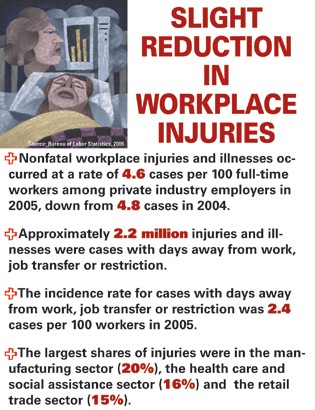
Safety at Work

According to its website, the Bureau of Labor Statisticsis the principal fact-finding agency for the Federal Government in the broad field of labor economics and statistics.” One of its functions is to track the number (and severity) of injuries we suffer while at work:

We don’t know, of course, what’s caused this decline; perhaps our friends at Worker’s Comp Insider will have some insights. Regardless, this seems to me to be good news.

Insurance Dispatch

Employee Assistance Programs, about which we've written here at IB, are the subject of this week's column now posted at The Medical Blog Network.

Friday, November 03, 2006

Your Health or Your Wealth?

We blogged recently on the kinds of benefits most American workers prefer. But a new survey, conducted by the American Payroll Association, went a bit further: they found that most of us apparently prefer increased benefits to increased wages:

In a way, that makes sense: wages are subject to taxes, which dilutes their value; benefits are not, and so retain full value. Over 30,000 folks participated in the survey.

Cavalcade #12 - Submissions Due

Just a reminder that submissions for next week's C of R are due Monday (the 6th). Chris at MedBill Manager would love to see your work. You can submit entries:

■ via email or

■ at Blog Carnival

PLEASE include:

► Your blog's url

► Your post's url

► The trackback url (if applicable)

► A (brief) summary

PS: We're still looking for hosts. If you'd like to host a future edition, just drop us an email.

Thursday, November 02, 2006

Health Wonk Review

Terrific HWR this week, hosted by Jason Shafrin at the Health Care Economist. He includes 16 posts in 5 different categories.
Here at IB, we talk a lot about consumer empowerment, but Social Marketing and Change's Craig Lefebvre warns about the problems of consumer health illiteracy.

Better Late Than Never Department...

Apparently, this week's Carnival of the Capitalists scheduled host went AWOL, and the estimable Jay took up the cause. There are over 40 entries in this edition, each with at least some context. Bravo, Jay, Bravo!
Always a fan of "over the top" thinking, I really enjoyed Long or Short Capital's post on a, um, unique fundraising idea (all for a good cause, of course).