Saturday, June 29, 2013

We're from the Government, and we're...

Well, you know. We're about three months out now from the Exchange roll-outs (maybe), and of course Top Men are making sure that things are proceeding apace.

Or not:

"Guess who has no idea who is going to be running the exchanges in those states?  Or how much a basic policy is going to cost?  Or who is going to be paying the difference between the amount a “low-income” person will have to pay and the cost of the policy? "

Definitely read the whole thing (but first, make sure to take your BP meds).

Friday, June 28, 2013

Hunger Games and the MVNHS©

Sometimes, the headline really is the story:

Nearly 1,200 people have starved to death in NHS hospitals because 'nurses are too busy to feed patients'

On the one hand, this apparently took place over four years, so that (presumably) "only" about 300 Brits per year were killed off this way. Still, death by starvation is no treat:

"Pain in the stomach often quickly develops, then can turn into digestive and waste-related syndromes such as severe and painful constipation followed by uncontrollable diarrhea. Early symptoms of starvation include faintness, weakness, and dizziness. Thirst may also rapidly increase."

Oh, and apparently starvation isn't the only problem facing patients victims of the Much Vaunted National Health Service©:

"[F]or every patient who dies from malnutrition, four more have dehydration mentioned on their death certificate."

No big deal, really: just think of it as a very dry Liverpool.

And speaking of the MVNHS
© and pools, the good news for "aspiring glamour model" Josie Cunningham is that she'll be a knockout in a bikini. That's because the rocket plastic surgeons at the Much Vaunted National Health Service© gave the go-ahead for her "upgrade" to 36DD (and no, that's not her seat number).

The bad news is that these same folks took a pass on "upgrading" 2-year old aspiring walker Oliver Dockerty. Apparently the boobs in charge at the MVNHS
© found Ms Cunningham's case more, ahem, compelling. After all, why would any two-year-old want to walk?

Friday Morning Updates

Updates on a couple of yesterday's items:

■ Unlike Aetna and UHC, Anthem will not be sending out rebate checks to Buckeye State insureds. Via email:

"On June 1, 2013, Anthem filed the required MLR report with Health and Human Services for the 2012 calendar year and met the required loss ratio for all lines of business for 2012. This means no notices will be sent and no rebates will be issued."

Good for them!

■ Hobby Lobby, much like Beckwith Electric, gets a reprieve on implementing the birth control convenience item mandate (Hat Tip: Hot Air):

"The 10th Circuit Court of Appeals moved to reverse a lower court's decision to deny Hobby Lobby Stores Inc.'s quest for an injunction against part of the Affordable Care Act that requires it to cover the cost of emergency contraceptives for some of its employees."

It's not a done deal, though: the case now goes back to the lower court for another round.

Still, some good news heading into the weekend.

Thursday, June 27, 2013

They're baaaack: ObamaWaiver Mania

In fairness, this first item isn't so much an ObamaWaiver as a court-ordered time-out:

"A Largo high-tech engineering firm doesn't have to offer emergency contraception under its medical plan while its case challenging part of the federal health care law is pending in court"

The company's owner is a "devout Southern Baptist" whose religious beliefs [ed: remember when those were protected under the First Amendment? Good times, good times], prohibit abortifacients. Timing is everything, which seems to be working in Mr Beckwith's favor: since his "insurance plan was up for renewal this month, Beckwith could have been required to start covering the contraceptives while the case was under review. U.S. District Judge Elizabeth Kovachevich granted Beckwith a reprieve, saying the company may be due religious protections under federal law."

Whew!

There's no denying, though, that this one is a full-bore ObamaWaiver:

"The Obama administration on Wednesday broadened an exemption for American Indians from the new health care law's [Evil Mandate] ...  tribal advocates are pleased that the administration added an exemption for Native Americans who are eligible for services through an Indian health care provider."

Um, guys? Be careful what you wish for. You might just get it.

MLR: More Loony Results

And the hits just keep on comin'. Last week, LifeHealthPro's Allison Bell reported that "insurers did a better job of meeting the new federal minimum medical loss ratio (MLR) targets in 2012 than in 2011, and they will end up paying fewer rebates to a smaller number of people."

Maybe so, maybe not:

■ FoIB Jeff M tips us that "North Carolina health insurance consumers will receive close to $10 million in [MLR] rebates"

But how will the other 57 states fare?


Via email, we learn that "[b]eginning in June and by August 1st, Aetna is scheduled to mail rebate notices and checks to policyholders and subscribers whose plans are due a rebate ... In this second year of MLR reporting, Aetna's rebates represent 0.2 percent of the premiums we collected"

That's down quite a bit from last year (the first for which MLR "rebates" were due), which the carrier interprets as indicating that they've met their pricing goal.


United Healthcare is also rolling out their 2013 MLR rebate initiative. Via email we learn that:

"In the second Medical Loss Ratio (MLR) Reporting Year, UnitedHealthcare’s results show that 83 Aggregation Sets in total (group and individual combined) qualified to receive premium rebates totaling $149,861,252 for 2012."

That's also down from last year; in fact this year's rebates are less than half of last year's.


  Interestingly, both carriers indicate that the checks will be going to the group (employer) for distribution. Chalk that up as one more accounting and tax headache for businesses.

Guess who pays for that?

Wednesday, June 26, 2013

Punchline: RomneyCare vs The ObamaTax


"A very interesting ACA development is taking place in Massachusetts today as the state that “inspired” Obamacare tries to reconcile its current law with the new federal law ... The amendment that was filed would force President Obama’s good friend Governor Deval Patrick (D), and his Administration, to seek a waiver from certain elements of Obamacare." [emphasis added]

Too. Funny.

Cavalcade of Rick #186 now on line....

Van Mayhall hosts this week's grand collection of risk-related posts, covering everything from the new Insurer Provider Fee to the FHA's stance on mortgage insurance cancellations.

And a friendly reminder to newbies and regulars alike that, while it's not mandatory to give a link back, it’s the way that carnivals work best. If your submitted post has been included in the Cav, please remember to post about it on your blog because it helps us all.

OH! Still looking for a host for the July 10th Cav - how 'bout it?

Flopping and Obamacare

HHS is reaching out to the major sports leagues in hopes of partnering to promote the Patient Protection and Affordable Care Act. So far they have engaged with the NFL and the NBA.

For the NBA this partnership could have mixed outcomes. While it hits a significant part of their fan base, it is also a controversial law that could alienate the part of it's fan base who happen to be the drivers of the financial spend for tickets, concessions, and merchandise. For now.

More importantly it will impact their players. According to data listed on ESPN.com there are 534 players who received compensation during the 2012-2013 season. Of these, 492 earned more than $250,000. This is the magic number for paying the additional Medicare tax of 0.9% when filing as joint married. (I know some players are single but just bear with me)

Total salaries for all players over the threshold come to $2,021,287,266 which means that NBA players will be paying $17,086,835 in new Medicare taxes this year just on their salaries.

When PPACA flops will Joey Crawford be there to make the call? If so, what can the NBA fine HHS and President Obama for their efforts? If so, my guess is it won't come close to $17 million.

Tuesday, June 25, 2013

Oh Good Lord!

Is this really the face they want to put on The ObamaTax?

"General Electric (GE) has enlisted Agent Smith, the villain from "The Matrix" trilogy, to tout its health care technology in a new ad campaign."

Actually, that might make more sense than you'd think, given this:

"[Soon to be former] Sen. Max Baucus ... asked HHS to provide "a complete list of agencies that will interact with the Federal Data Services Hub."

Regular readers may recall that the "data hub -- in laymen's terms, a huge digital warehouse capable of sending information to other online servers -- plays a crucial role in the exchanges"

That innocuous-sounding phrase "sending information to other online servers" actually means more, a lot more. The Hub will be sending information to, and receiving information from, Ms Shecantbeserious and her minions, the IRS, Immigration, even Homeland Security. And of course all of this previously private health care information will be completely secure.

Trust us (they said).

Y'know, if you're going to enlist a villain to promote your evil scheme, I say go big or go home.

Give me your tired, your....uninsured

A few weeks ago, Bob pointed out that, under the pending Senate immigration bill, newly "legalized" immigrants will "have to wait at least 13 years to be able to obtain full citizenship, and it isn’t until then that they could qualify for [the ObamaTax benefits]."

Recent news would seem to confirm not only that, but its implications:

"Those placed on provisional status would become the nation's second-largest population of uninsured, or about 25 percent ... research shows that the older you get, the sicker you become, so these people will be sicker and will be more expensive on the system"

Great.

But at least there's some good news to soften the blow, right?

Um, not so much:

"Immigrants with provisional status may obtain insurance through employers, but many ... tend to work low-wage jobs at small businesses that don't have to provide the benefit under the [ObamaTax]."

And then one has to consider what happens when these larger employers figure out that they can hire these "provisionals" who are not subject to the [Evil] Mandate. How many American citizens will lose their jobs in favor of employees who aren't required to be covered?

Ouch.

Monday, June 24, 2013

Exchange News

Now that we're at less than 100 days until the Exchanges (allegedly) open for business, here's the latest from a select few of the 58 states:

■ First up, New Hampshire  has "achieved a dubious distinction," one that has some folks pretty concerned:

"It is the only state so far with just one health insurer that plans to sell its products in the new online marketplace."

It will surprise no one that that carrier is Anthem Blue Cross/Shield.

■ FoIB Jeff M tips us that North Carolina's public Exchange is faring little better:

"Individuals buying health insurance coverage on new online exchange marketplaces beginning this fall will be choosing from products from only two or three carriers"

And businesses in the Tar Heel State will have similar lack of variety in the small group Marketplace: thus far, only the ubiquitous Blues are on-board.

■ We're doing a bit better here in the Buckeye State:

"Lt. Governor Mary Taylor, who also serves as the Director of the Ohio Department of Insurance, has announced that 14 companies filed 214 products intended to be sold on the federally facilitated insurance exchange in Ohio"

That's the good news. The bad is that these new plans represent "an 88 percent increase over the average cost in 2013"

Ooopsies.

■ And, finally, it looks like Iowa may be tied with New Hampshire for "first/last" place (depending on one's perspective):

"The Iowa state insurance commissioner is urging carriers to get into the exchange while there are still lots of potential policyholders ... However, [insurance commissioner] Gerhart has seen only one carrier — and not even the first- or second-largest — sign up for the partnership exchange"

And that one has chosen - ominously - to remain anonymous.

Wonder why.

This just in...

Via email:

"Effective immediately, Aetna is temporarily suspending new business sales for Aetna Advantage Plans for Individuals, Families and the Self-Employed in Ohio."

These are the carrier's individual major medical plans (PPO, HSA, etc). The email does not say why they're suspending sales, but one can't help but wonder if the ObamaTax holds some clues.

More as this develops.

Another MVNHS© Scandal

Regular readers will be familiar with the on-going shanda at the Much Vaunted National Health System© facility in Mid Staffordshire:

"Almost 3,000 people may have died unnecessarily in just one year at the 14 NHS trusts whose excessive mortality rates were reviewed in the wake of the Mid Staffordshire scandal"

This particular facility has been in the news (and not for its outstanding reputation for delivering quality health care) for quite a while. So one might be forgiven for thinking that the folks who run the MVNHS© might be sensitive to any whiff of impropriety as regards care "Across the Pond."

Unfortunately, it just keeps getting worse:

"[A]fter the revelations of the cover-up over deaths from negligence at Morecambe Bay hospitals, we learned just what happened to Kay Sheldon, a non-executive director at the CQC [Care Quality Commission], when she tried to bring to light failings at the regulator which were putting patients’ lives at risk."

Ms Sheldon made the mistake of believing that the folks who run the Service actually care about the folks they ostensibly serve. This was, of course, a mistake:

"When Ms Sheldon tried to air her concerns that the CQC wasn’t up to the task of uncovering bad practice in hospitals and care homes, her messages to chief executive Cynthia Bower and other board members were not answered, or were stonewalled."

Remember, this is one of the platforms on which the ObamaTax is based, so it's a pretty significant peek into our own future. And it's not pretty:

"As a result, the CQC’s chairman, Dame Jo Williams, wrote to then Health Secretary Andrew Lansley asking him to sack her."

Shoot the messenger! The challenge, of course, is that this won't make the problem go away, and it certainly won't save any lives. But then, that's not the real purpose of the Much Vaunted National Health System© (or the ObamaTax), as can be clearly seen here:

"The ensuing debacle was not just the result of a botched merger: it reflects an NHS culture which is profoundly, systemically and almost certainly irredeemably rotten." [emphasis added]

And it is, in fact, that culture which has been transplanted here. How else to explain the that Donald Berwick was, at one point, in charge of the agency in charge of implementing our train wreck?

And make no mistake, this culture is what leads to:

"[N]eglect and cruelty reached such a pitch that patients drank from flower vases to relieve their thirst ... these failings are not being addressed; because what rules in the NHS, from top to bottom, is a culture of ruthless unaccountability in which the buck stops nowhere."

Ah, that magic phrase: "culture of ruthless unaccountability." What does that remind us of?

[Hat Tip: FoIB Holly R]

Friday, June 21, 2013

Making Bernie Madoff Proud

By golly this minimum loss ratio thingy sure is working well, said every liberal journalist and health insurance company.

CMS released figures yesterday touting that the minimum loss ratio (MLR) requirements under the Patient Protection and Affordable Care Act saved consumers $500 million that must be paid back in the form of rebates. 8.5 million consumers will each receive a portion of the rebate checks which works out to an average of roughly $60 per person. This is down from $1.1 billion that was paid out last year. If hearing this news gives you the "warm and fuzzies" all over then you probably should stop reading here. For the brutal truth please continue.

This is how PPACA planned for MLR to work. Insurance companies must spend 80% of premium dollars they collect on medical claims. The other 20% goes towards operating costs and profit. If the percentage is less than the required amount then the insurance company must rebate customers the difference. If the percentage is higher then the insurance company simply loses out and has to cut their profit margin.

In 2011 the average single premium for health insurance was $5,222 according to the Kaiser Family Foundation. 80% of this figure, $4,178, must be spent on medical claims meaning the insurance company would retain $1,044. For 2012 this number increased to $5,616. 80% equals $4,492 which gives the insurance company $1,124. So, because of MLR, insurance companies were able to retain an additional $80 per insured person in 2012 versus 2011.

The latest figures available (2010 census) state that 195.9 million people are insured through the private market in the United States. Simple math: 195.9 million x $80 = the insurance industry was able to increase their bottom lines by $15,672,000,000!!!

So, why are we celebrating $60 being returned to 8.5 million people when 195.9 million people paid $80 more?

Only in Congress would this be kind of accounting be considered "savings".

Cavalcade of Risk #186: Call for submissions

Van Mayhall hosts next week's Cav. Entries are due by Monday (the 24th).

To submit your risk-related post, just click here to email it.

You'll need to provide:

■ Your post's url and title
■ Your blog's url and name
■ Your name and email
■ A (brief) summary of the post

PLEASE remember: ONLY posts that relate to risk (not personal finance tips and the like). And please only submit if you are willing to link back to the carnival if your submission is accepted.

Thursday, June 20, 2013

New Sponsor Alert

We're pleased to announce that we've teamed up with eHealth to provide free, no obligation quotes for your Medicare Supplement insurance needs. Check out the shiny new widget in the sidebar to see how it works.

Stupid is as stupid does...

Yeah, this will end well:

"Senators Joe Donnelly (D-IN) and Susan Collins (R-ME) introduced a measure Wednesday that would change the definition of a full-time worker under the [ObamaTax]. The proposal is aimed at preventing workers from having their hours scaled back as businesses try to cope with the additional cost of providing insurance"

Um, Joe and Suzie? You can "change the definition" all you wish, but the reality is that employers will simply let employees go, and/or decline to hire new ones. And that means even more hardship for the very people you purport to want to help.

Don't believe me?

Well, then, how about the folks who actually make these decisions?

"[Gallup] determined that as many as a quarter of small business employers were restricting job openings to part-time workers. Nearly half said Obamacare would be bad for their business, compared to only 9 percent who said it would be a good thing"

Can the folks in Capital City even spell "economics?"

The O - H - I.O.U.

Under the Patient Protection and Affordable Care Act a new type of insurance issuer called a CO-OP must be created in every state. These CO-OPs are high-risk ventures: the Office of Budget and Management has projected a default rate for them as high as 43%. Through 2012 over $2 Billion had been distributed by HHS to these start up insurers. 

Last week Mike wrote an excellent post on one of them in New York which you can read here.


This week the Buckeye state announced their list of insurers seeking to play in the CO-OP sandbox. The list includedAetna (Individual only), AultCare, Community (Anthem), Coordinated Health Mutual, Coventry (Individual only), Kaiser Foundation Health Plan (Small Group only), Medical Health Insuring Corporation of OH (MMO), and Summa.

While there may be additional companies announced later, the one that really stands out is a company that may be unfamiliar to agents and consumers, new kid on the block, Coordinated Health Mutual. They are a CO-OP who received a federal grant for $129,225,604 in late 2012. Coordinated Health Plans of Ohio is sponsored by Community Health Solutions of America LLC, which also runs primary care medical homes for state Medicaid programs.

Sounds innocent enough right? Lets connect some dots:


According to filings, Brett Baby, CEO of Coordinated Health, and Community Health Solutions (CHS) of America LLC CEO, Dale F. Schmidt have troubled histories. Baby was the former CEO of Physicians Insurance Company of Ohio. They made it an entire year before going under when regulators shut them down for dropping $5 million in reserves. Schmidt has a longer history including chapter 11 bankruptcy filings in 2006 (including CHS), a 2011 Medicaid overpayment in South Carolina to his firm for $10 million, and back taxes owed in 2012 to the state of Kentucky.


Brett and Dale are just the type of high quality financial gurus we want running an insurance company.


What's most disturbing about the entire CO-OP process is that despite these risks and questionable backgrounds CMS refuses to answer questions about how recipients are chosen or any other information about the program. President Obama and Secretary Sebelius have asked for transparency in health care pricing. Evidently it's too much to ask of them to have transparency in health insurance regulation.

Health Wonk Review: "Is this question rhetorical?" Edition

Sarah Sonies and Jennifer Salopek present an outstanding Health Wonk Review, covering everything from care for undocumented illegal immigrants to neuroscience.

What makes this week's edition so terrific is that it's obvious that Sarah and Jennifer have read all the entries, offering thoughtful context and commentary on each one.

Kudos!

Wednesday, June 19, 2013

Dribbling the ObamaTax

Back in the day, Ms Shecantbeserious had Matlock to Hawk the train-wreck. Fast forward a bit, and she's Cavalierly bringing the Heat in her efforts to work her Wizardly Magic on that Nugget:

"The Obama administration has reportedly tried to enlist the NBA in helping it sell Obamacare"

Whatever works to sell this Maverick idea to the masses, right, Kathy?

But lets give her the benefit of the doubt and presume that this new gimmick will work (hey, it could happen!). Good thing that the Exchanges new Marketplaces will be on their game for the roll-out.

Wait, what?

"Government officials have missed several deadlines in setting up new health-insurance exchanges for small businesses and consumers ... and there is a risk they won't be ready to open on time in October"

Ooopsies.

Looks like those darned Canucks are throwing us under the bus.

The ObamaTax vs City Hall

Regular readers know that one major effect of the train wreck has been reduced hours for part-time employees:

"[E]ven those fortunate enough to keep their current jobs (let alone obtain new employment) may be subject to reduced hours (and thus pay)"

Restaurants and movie theaters, theme parks and community colleges are all slashing employees' hours, if not their jobs. But the private sector isn't the only area feeling the pinch. As we noted last week, folks in Capital City "are so afraid that their health insurance premiums will skyrocket next year thanks to Obamacare that they are thinking about retiring early or just quitting."

What you may not know, though, is that you don't have to travel to DC to find the ripple effects of the ObamaTax:

"[L]ocal governments across the country have been ... cutting part-time hours specifically so they can skirt ObamaCare's costly employer mandate, while complaining about the law in some of the harshest terms anyone has uttered in public."

From California to Virginia, Texas to Michigan, local municipalities are coping with the drastic new regs in one of the few ways still available:

"We feel bad as a city administration and as a council in having to cut hours from 35 to 29," Medina [OH] Mayor Dennis Hanwell said. "We have the budget to pay the people, but we do not have the budget to pay for the health care." If they hadn't made that cut, the city faced up to $1 million in new health costs courtesy of ObamaCare."

For a city like Medina (just shy of 27,000 souls), that's a pretty hefty chunk of change. And when you start multiplying that by all the small towns across the fruited plain, you're talking serious coin. With U6 unemployment in the double digits, it's difficult for smaller cities to keep hitting their citizens with more and more taxes to cover public sector health insurance costs. Shrinking tax bases and increased insurance costs make for a powerful (and dangerous) combination, as we're seeing now.

Methinks it will only get worse.

Tuesday, June 18, 2013

On being careful what we wish for...

By now, most folks know that Sarah Murnaghan got her new lungs, and for that we say "Baruch HaShem" (Praised be G-d). As life is the most precious of gifts, one can't help but be moved by her new-found hope and lease on life.

In Judaism, we are encouraged to consider all facets of a given subject or issue. That is, our job is to find "balance," and so even happy occasions require us to consider the not-so-happy alternatives (eg breaking of the glass at a wedding). And there are plenty of negative aspects to this story, as well.

Let's start with the most obvious: as we noted in our original post on the subject, how do the transplant folks say "no" to the next little boy or girl who wants a shot at adult organs? Has the process, which seemed to be working well and fairly up to now, been irretrievably broken?

I think there's a very strong case to be made that the answer is "yes:" from this point forth, it will be the lawyers, judges and media making life-or-death decisions. Two old saws seem to have been proven right here: "once is always" and "the squeaky wheel gets the grease." That is, the precedent has now been set that the ones with the most photogenic donee and the most money and the best "story" are going to be getting free passes to the front of the queue, leaving those with fewer such resources in the dust, regardless of actual need or physical condition.

Dr. Sander Florman, director of the Mount Sinai Recanati/Miller Transplantation Institute in New York, notes that "we can all sympathize with the plight of a young girl, but maybe a 13-year-old girl waiting for an adult organ is the one who didn't get a transplant."

Indeed.

And that brings us to the next question: what mother or father, or sister or brother, was just condemned to death so that little Sarah might live? And don't be fooled: this is exactly the outcome here. Someone else on the list, presumably much higher on it, in fact, was passed over for that set of lungs, and there's no guarantee that another suitable set will be available in time.

Now, the organization which oversees transplants has added a codicil "that allows for occasional exceptions. These children have to be recommended by their doctors and then have their cases reviewed by a national board before they can actually be exempted;" which is all well and good, until one notices that the criteria seem to be rather self-fulfilling.

And, finally, there's this: the case of Ms Sarah actually serves to underscore that which another (older) Sarah noted with the passage of the ObamaTax: Death Panels. And make no mistake, that is precisely what happened here: a government employee - who, by the way, is not a doctor and apparently has zero medical training - just condemned to death an adult who was not as cute and cuddly as Sarah Murnaghan, and whose family did not have the means and the media to plead their case (if they even knew about it in the first place).

I'll allude back to Mr Chesterton here:
"In the matter of reforming things, as distinct from deforming them, there is one plain and simple principle; a principle which will probably be called a paradox. There exists in such a case a certain institution or law; let us say, for the sake of simplicity, a fence or gate erected across a road. The more modern type of reformer goes gaily up to it and says, “I don’t see the use of this; let us clear it away.” To which the more intelligent type of reformer will do well to answer: “If you don’t see the use of it, I certainly won’t let you clear it away. Go away and think. Then, when you can come back and tell me that you do see the use of it, I may allow you to destroy it.”
[Major Thanks to co-blogger Bob V for the tip to the Yahoo article!]

Life Insurance, Long Term Care, Medicaid and You

Not so sure that this is such a great idea:

"State lawmakers are encouraging elderly residents to use life insurance as a way to pay for long-term care—and lower the Medicaid tab in the process."

The concept seems pretty straightforward: you take an older life insurance policy and sell it ("viaticate" is the technical term), and then use the proceeds to pay for long term care. When the policy's value is used up, one turns to Medicaid for continued long term care funding.

This is not a new idea, but the fact that states are now touting it as a viable LTC funding vehicle is telling: they're running out of money and are desperately looking for ways to slow down the ticking time bomb. Under current Medicaid rules, one is allowed to have some life insurance, but of course, that's an asset that states would very much like to tap.

Another factor is marketability. If there's a sudden glut of life insurance policies hitting the market, then of course the price that they command will be affected. Add in the fact that the key phrase in LTC is long term and potential investors could be waiting many, many years for a payoff. Not a great selling point.

But what I find so disgusting here is the states' apparent disregard for their own previous condemnation of stranger-owned life insurance. If it's morally reprehensible in one circumstance, why is it suddenly noble in this application?

Consider that rhetorical.

[Hat Tip: FoIB Holly R]

Sunday, June 16, 2013

Aetna to exit California's individual insurance market

Both the Wall Street Journal and Reuters reported Friday that Aetna will exit the California individual-insurance market at the end of 2013.

According to Aetna, this decision "will affect only 49,000 of its 1.5 million policyholders in the state."

Although Aetna declined to say why it is taking this action,  it's likely that the reason is California's health exchange rules.  According to Reuters the California Exchange rules apply to all health insurance products sold to individuals in the state, "whether or not they are offered through the exchange."  

Thus any company that decides after analysis that it's not worth the cost for it to participate in the California Exchange, can only avoid that cost by exiting the market  - as Aetna has decided to do.  

Saturday, June 15, 2013

Ain't insurance the greatest thing?

Everyone cashes in.  No one has to pay. 

And what affordable health insurance plan, its hour come round at last,
Slouches towards Washington to be born?

"We have to pass this bill, so that you can . . . "


Today’s Wall Street Journal contains this op-ed piece bySenator Orrin Hatch.

In it, he mentions that the Obamacare tax credits “are both advanceable and refundable”.    In other words, IRS will pay them first and verify the claims for them later, a practice that could be called “pay and pursue.”

I did not know the tax credits are advanceable.  Did you?

So it seems more than three years on after passage of Obamacare, the public is still finding out what is in it.   

And we are continually appalled.

Will this process of Obamacare discovery never end?

Friday, June 14, 2013

Doctors Behaving Badly

As patients, we have all experienced doctors with a bad bed-side manner: gruff in their discussion with you about your issues, leaving you feeling frustrated and angry after the appointment.  While we have been in a fee-for-service type of payment model, this kind of behavior has been tolerated from both patients and administrators, but as medicine moves to payments based on quality, then bad behavior will no longer be tolerated.  This case from 2011 is used as an example in a recent Kaiser Health News article done in conjunction with the Washington Post:
At a critical point in a complex abdominal operation, a surgeon was handed a device that didn't work because it had been loaded incorrectly by a surgical technician. Furious that she couldn't use it, the surgeon slammed it down, accidentally breaking the technician's finger. "I felt pushed beyond my limits," recalled the surgeon, who was suspended for two weeks and told to attend an anger management course for doctors.”
Administrators have often had to apologize for bad behavior in physicians - especially surgeons - to both staff and patients:
For generations, bad behavior by doctors has been explained away as an inevitable product of stress or tacitly accepted by administrators reluctant to take action and risk alienating the medical staff, particularly if the offending doctors generate a lot of revenue.
Physicians understood that they were in charge; they made the money and if they wanted to behave badly, then they could do so without fear of retribution.

In 2009,  the Joint Commission (the body that accredits hospitals) released new guidelines for addressing disruptive and inappropriate behaviors by medical staff.  The Commission recommends that hospitals develop a zero tolerance for intimidating and/or disruptive behaviors.

Medicine has changed, making such behavior not only unacceptable but reckless.  Medicine is a team effort, mandated by government and a natural occurrence that comes with technology and specialization in the medical field.  If a person has a chronic condition, it is not uncommon to have several physicians involved in the care and treatment of the patient.  As more physicians become involved, then more staff, more facilities and more administrators are also involved. And, of course, more potential for personality conflicts.

Quality initiatives are also becoming more important, as hospitals and other care venues are now required to submit quality outcomes to the federal government not only for the purpose of monitoring care but also designating payments. When a physician mistreats a staff member, that staff member has a recourse through labor law which dictates that employees must work in an environment free from hostility or harassment, which could interfere with their job duties and thus patient outcomes.

Fortunately the days of administrators mollycoddling physicians and telling staff that had been verbally harassed “that is how (s)he is, ignore it and go back to work” are ending.  Once payments are based on quality, these physicians will have to change or risk losing money.

Thursday, June 13, 2013

Hey Young Invincible, Can You Afford $6000?

Last week's Ezra Klein interview with Aaron Smith was a doozy. For those who don't know, Mr. Smith is the co-founder of Young Invincibles. The group works to educate and mobilize (their words, not mine) those between 18-34 years of age. For Ezzie it was the same mantra we always hear: rainbows, pots of gold, unicorns, warm and fuzzies, with a whole lot of "free". The reality is much different. Especially for those who are supposed to spread the wealth health risk and enroll in "affordable" insurance.

Much has been said about the so-called Young Invincibles and whether or not they will purchase insurance. A more glaring concern isn't whether they will purchase or what will be subsidized, but rather whether they can afford the high out-of-pocket maximums. Under PPACA the "catastrophic" plan for those 30 and under is alleged to have a deductible of $6000 (or close to it).

The problem for young invincibles isn't insurance premiums, it is their personal finances. Recently there was a post in the Wall Street Journal that showed:
Young people also are likely to have precarious finances and scant savings socked away for emergencies. When asked if they would be able, in one month, to come up with $2,000 for an unexpected expense such as car repairs, 49% of 18-34-year-old respondents said probably not. 
Further, these same invincibles have less discretionary income. Most don't carry insurance because they can't afford the premiums. Paying $100-$150 for the catastrophic plan isn't in the budget. The $20,000-$40,000 they make per year gets completely consumed by rent, car payment, student loans, groceries, cell phone, cable TV, utilities, and cheap beer.

As we approach the deadline of where we are going to force people to buy insurance the biggest question that will remain is: If I have a choice between paying a 1% tax on income OR 3% (minimum) of my income on premiums PLUS a huge out of pocket cost factor should I get sick which one will I choose?

I think you see which way this train is headed.

Just a Minute (Clinic)!

Hard to believe, but we first started covering the "Minute Clinic" phenomenon in the fall of 2005:

"In a little strip mall in San Mateo, California, nestled “between a UPS store and a hair salon” is a new type of doctor’s office ... The office itself is as much coffee shop as medical center: prices for various services and procedures are prominently displayed above a reception desk"

Technically, that story was about QwikHealth, a Minute Clinic fore-runner. But the basic idea was the same: easy access to affordable basic care. We revisited the concept in 2008, when these little beauties started showing up inside Massachusetts "pharmacies and other retailers."

Now, of course, they're ubiquitous, which is both a blessing and a curse: more providers helps meet the increased demand for health care, but it also cuts into more traditional providers' cash-flow. And there's this: "in-store clinics could actually raise overall costs if, by making medical care easier to access, it increased the overall use of services."

Who says more is better?

Actually, it still may be, but then we also need to consider quality of care; that is, is "Dr Nurse" qualified to diagnose and treat what ails ya? It seems safe to presume that for many (most?) common ailments, the answer's probably yes. And for many folks, it may mean the difference between affordable health care and none at all (I'll leave it to the reader to decide if this is a false choice).

[Hat Tip: FoIB Holly R]

California Dreamin': How much is too much?

I find this sad:


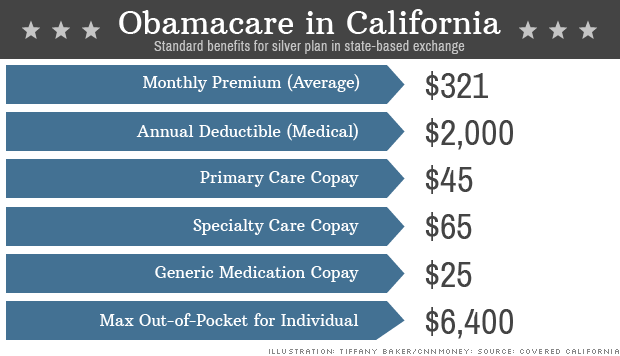
That's a snapshot of how a new ObamaTax "Silver" plan is likely to look (at least in the Golden State). It's sad because it's really no different than how insurance worked before the train-wreck. Too often, individuals focus on the co-pays (for doc visits and meds) without looking at "the big picture." I can't tell you how many times I've presented a High Deductible (HSA) plan only to be asked "what's my co-pay?"

Remember, too, that (for many, perhaps most, folks) any subsidies to which one might be entitled are for the premium which, in this case, represents only about a third of what the total potential out-of-pocket might be. There are few (if any) subsidies for co-pays, deductibles or co-insurance. That's strictly "out-of-wallet."

And even this may vastly understate the problem; as FoIB Jeff M reports, "Kaiser Permanente has offered some of the highest rates in the California health exchanges."

Now why would they do that? The article says that KP itself denies any market-rigging motivation, although it notes that:

"Some experts say Kaiser intentionally bid high to avoid drawing too many customers next year who are sick or who have been uninsured for years and may be costlier to treat."

See, that's just good business sense: we already know that the large majority of folks who actually bother to sign up for (first-time) coverage are those with the most motivation to do so: pent-up needs held back by lack of resources (ie a third party to foot the bill). And who can blame them? On the other hand, had I been the KP spokescritter on this, I would have been sorely tempted to answer the charge with a very simple "d'unh!"

But then, truth often hurts.

Wednesday, June 12, 2013

Some Very Strange Bedfellows


The New York Post reports today (June 12, 2013) that the Freelancers’ Union is seeking relief from Obamacare, and the State of New York may be about to help them.

It seems the Freelancers’ Union – which in 2012 was granted $341 million in Federal loans to set up an insurance CO-OP under Obamacare - has run into a big problem. It’s figured out that Obamacare will seriously damage its insurance business.

Will this damage come from “unexpected” problems encountered by an expert insurance organization blindsided by completely unpredictable insurance requirements?    You can believe that if you like, but I think you would be wrong.

According to the Post, the Freelancers’ Union says that Obamacare’s “onerous regulations and taxes will burden its innovative health insurance model for the self-employed with enormous added costs.”  In other words, Freelancers’ problems are the same Obamacare problems that businesses and other insurance companies have been warning about for the past four years.   They were neither unpredictable nor unexpected.

So what does Freelancers’ want?  It wants authority from the State of New York to convert its health insurance model to a self-funded model.  If it provides self-funded coverage rather than insurance it becomes an issuer of “ERISA Plans” that won’t be subject to Obamacare.

Freelancers’ Union states that Obamacare will cost its members “$38 million a year” which translates into “a per-person premium load of $178 a month”.  That’s the additional amount that would be needed just to pay for the Obamacare load.

Is that devastating?  Well if it is, wouldn't Obamacare be equally devastating to the other insured small group plans in New York – and all across America?

Yet Freelancers’ Union asks the State of New York to step in and spare their successful small-group insurance plan from the devastating effects of the President’s ‘affordable’ health law - but not to spare any OTHER insurance plan from that law.

And say, isn’t it ironic that the Freelancers Union has taken up the conservative cry that Obamacare will hurt more than it can help?  Obamacare is creating some very strange bedfellows.

Remember that 50th employee?

Almost exactly a year ago, we noted the pending demise of 50-employee companies. It now appears that even those fortunate enough to keep their current jobs (let alone obtain new employment) may be subject to reduced hours (and thus pay):

"Under [the ObamaTax], employers' cost to employ workers will climb up to $96.15 per person in the 30th hour they work each week"

That's because of a little-known "feature" of the ObamaTax called "Full Time Equivalent" (FTE). The purpose of FTE's is to discourage employers from hiring too many part-time workers by essentially combining multiple part-timers' hours and calling that one employee. So, for example, an employer with 48 actual full-time employees hires 4 part-timers. The IRS sees not 4 individuals working part time, but 2 working full-time, and that magic 50 employee threshold is reached (thus triggering mandates and fines additional taxes).

But wait, it gets worse (seriously!):

"Employers who offer health coverage that is deemed either too pricey or too skimpy will owe $3,000 for each full-time, 30-hour-per-week, worker who taps ObamaCare subsidies. Because the $3,000 fine is nondeductible, it's equal to $5,000 in deductible wages for a profit-making firm facing a 40% combined federal and state tax rate."

Remember, these are (by definition) small businesses, allegedly the backbone of our economy. Well, they *were* the backbone of our economy.

But wait, it gets murkier:

Co-blogger Bob tipped me to this little gem:

"Under the existing Senate immigration bill, immigrants who have been in the United States illegally can obtain a provisional legal status ... But this population would have to wait at least 13 years to be able to obtain full citizenship, and it isn’t until then that they could qualify for [the ObamaTax benefits]."

The net effect of this little lovely is that employers will have major economic incentives "to hire newly legalized immigrants over American citizens" because the former won't count against them in ObamaTax mandate calculations.

Hooray.

Cavalcade of Risk #185: Lean and (not so) Mean edition

Rebecca Shafer hosts this week's roundup of risk-related blogetry, simple and straightforward, with lots of interesting posts.

Tuesday, June 11, 2013

HSA's vs The ObamaTax: Part XXCVI

As we've previously noted, the survivability of Health Savings Accounts (HSA's)  and High Deductible Health Plans (HDHPs) under the ObamaTax has been questionable. The challenge is that the train-wreck limits one's total out-of-pocket costs and, as important, Exchange-qualified plan designs themselves.

Still, there's no denying the appeal of a plan that offers (potentially) lower premiums coupled with the ability to sock away tax-advantaged dollars to help offset those out-of-pocket costs. While I still have my doubts as to whether these plans will survive unscathed, the folks at Life Health Pro firmly believe that this will be the case:
"Whether your clients fear direct premium increases or higher annual deductibles, their out-of-pocket costs can be slashed using a tax-preferred vehicle that has been on the market for years: the health savings account (HSA) ... For 2013 and 2014, an HDHP is a plan with an annual deductible of not less than $1,250 for self-only coverage or $2,500 for family coverage."
And of course, there may be additional coinsurance that increases one's potential out-of-pocket liability. There are two major obstacles here:

First, Exchange-qualified plans are standardized. That is, there are pre-approved plan designs (often referred to as "metal plans" due to their names - "gold," "silver," etc). I have yet to see one called "aluminum."

Second, plans must meet stringent actuarial value standards, some of which have yet to be finalized. So while I'm hopeful that these plans will, in fact, continue to be available after full ObamaTax implementation, I'm not holding my breath.

Monday, June 10, 2013

IRS - Birth Control - Government Monitoring

To don my tin foil hat for a moment....

The IRS has been in the news for tough grilling of conservative groups seeking tax exempt status, asking for donors, what was discussed, material, etc etc and some claim using that info to target audits.

The IRS is about to start enforcing the birth control mandate.

If you're an agent, any second thoughts on discussing ways to circumvent this regulation or minimize it if your client asks? Sounds crazy, but then so did the idea they would target groups teaching the constitution or speaking up for honest elections. Would you risk being excluded from selling exchange policies? With the new licensing organizations at a national level is it really a jump to think the government might not want to work with agents not working the products they want?

Monday Morning ObamaTax Alert

■ FoIB Holly R alerts us to this breaking news that the ObamaTax will leave some 30 million Americans without health insurance. The whole article is well worth the read.

■ And leave it to Tar Heel State FoIB Jeff M to bring this Buckeye State news to our attention:

"Ohio’s insurance regulators are warning that some health policy premiums may skyrocket next year because of the [ObamaTax] ... The department’s initial analysis of the proposed rates show consumers will have fewer choices and pay much higher premiums for their health insurance starting in 2014.”

But that can't be right: we were assured that premiums would, in fact, fall by over 3000%.

■ Update from Friday's item on renewal dates. We had noted that:

"[A]t least one carrier ... is offering a special, one-time deal to existing client groups to "avoid the effects of adjusted community rating until 12/01/2014"

Since then, we've gotten a bit more detail. What they're offering is the "opportunity" to have two 2013 renewal dates: their original one, and a new 12/1/13 one. The idea is that even though a group would then have two premium increases (despite ObamaTax protestations to the contrary, they're not going down this year) the change would enable them to put off the potentially catastrophic 2014 rate increases.

Interesting gamble.

Friday, June 07, 2013

Friday ObamaTax Miscellany

■ First, a word on "strategery:" Got snail-mail from United Health One (UHC's individual medical outlet), alerting folks that plans "with an effective date up through December 31, 2013 ... can feel secure knowing that their plan/benefits will stay the same until the end of 2014."

The carrier is pretty insistent that plans with 2013 effective dates will see their benefits remain the same until the end of next year. Note, though, that they don't make the same promise about rates.

I have a problem with this: as we noted in April, there's simply no way to know what Ms Shecantbeserious will do with in-force plans.

■ Along similar lines, FoIB Beth D alerts us that at least one carrier (UHC, perhaps not coincidentally) is offering a special, one-time deal to existing client groups to "avoid the effects of adjusted community rating until 12/01/2014"

She helpfully sends along an "Attestation Form" that the group would complete and submit in the next week or so requesting that their effective (renewal) date be changed to December 1rst.

I expect to see similar efforts from other carriers shortly.

■ Finally, The Wall Street Journal finally figures out what we've been saying all along:

"But Chris Angelo, a second-generation owner ... doesn't expect a groundswell of enrollments next year from lower-wage workers ... They'd rather have the cash than pay the employee portion of the premium."

Hunh.

This has ripple effects, of course:

"[E]mployers may struggle to figure out how many of their low-wage workers will opt in for employer coverage in 2014. By the same token, it suggests that many low-wage workers could remain uninsured next year, despite the law's subsidies and penalties."

Where's my free insurance?

Cavalcade of Risk #185: Call for submissions

Rebecca Shafer hosts next week's Cav. Entries are due by Monday (the 10th).

To submit your risk-related post, just click here to email it.

You'll need to provide:

■ Your post's url and title
■ Your blog's url and name
■ Your name and email
■ A (brief) summary of the post

PLEASE remember: ONLY posts that relate to risk (not personal finance tips and the like). And please only submit if you are willing to link back to the carnival if your submission is accepted.

Thursday, June 06, 2013

LICERA (Large Insurance Company Expense Relief Act) out of Committee

Well, technically it's the "National Association of Registered Agents and Brokers Reform Act (of 2013)," but as we noted a few short months ago, its stated purpose and it's actual 'raison d'etre' are quite different.

According to the folks in Capital City, the legislation "before you today represents over a decade worth of effort and ... will finally achieve the goals ... that ensures that regulators can continue to protect consumers"

Lofty words.

Now let's run them through the Capital City Sunshine Removal Filter:

"The NARAB would not only duplicate many (most?) of the functions of the existing NIPR, but it would afford these large carriers a welcome break in their cost of doing business ...  it's industry-funded, which means a non-trivial portion will be borne by smaller, regional carriers to subsidize their larger competitors"

Doesn't have quite the same ring, though, does it?

On the other hand, it does have the value of being, you know, accurate.

Tri-State ObamaTax Roundup

So, news from 3 of the 58 states today.

■ First up, Vermont deals a blow to an ObamaTax co-op:

"A Vermont regulator said today organizers of a proposed Obamacare health insurance co-op who claimed last week they were "blindsided" were told "from the beginning" of problems with their application to operate in the state."

Oops. As we've noted before, co-ops "are nonprofit, customer-owned health plans, designed to compete against the major for-profit insurers." And, as we've also noted, they don't seem likely to fare very well. Screwing up the initial paperwork is probably not a good sign for Green Mountain State co-op wannabes.

■ Next, news from Oklahoma (okay!):

"Oklahoma attorney general Scott Pruitt has found an ingenious way to call a halt to the Obamacare project: Hold the federal government to the letter of that misbegotten law."

Turns out, the Sooner State is sticking by its guns in its federal lawsuit challenging the train-wreck's (sorry, Max!) constitutionality. As one of the 33 states that took a pass on creating its own Exchange, its citizens stand to get hit with tax penalties that seem pretty blatantly illegal.

'Course, they're only illegal if SCOTUS Chief Roberts says they're illegal.

■ Finally, the Natural State (really!) is trying out a bold new Medicaid experiment:

"Arkansas appears poised to move ahead with a plan that will bring private coverage to a population very close to the poverty level while defanging [the ObamaTax's] controversial Medicaid expansion ... that would allow — if the federal government grants a waiver — those for whom the Medicaid expansion was intended to buy private health insurance through the Arkansas health insurance exchange or marketplace."

If you "get" vouchers, then you'll "get" this: instead of an expensive and ineffectual bureaucracy, you give folks the means to purchase their own coverage, which also reinforces the basic (but recently all but extinct) concept of personal responsibility.

Win-win.

Health Wonk Review: I'll Take Health Care for $600, Alex edition

My favorite (health) econ blogger, Jason Shafrin, hosts this week's intriguing round-up of interesting health care policy posts. Don't put yourself in Double Jeopardy, click on over!

Wednesday, June 05, 2013

Who ARE those guys? A bunch of outtacontrol frat boys?

From Buzzfeed via Gateway Pundit:

IRS confirmed that two employees have been placed on administrative leave — which is paid — and have begun the process of removing them . . . The IRS informed congressional staff investigating the agency that Fred Schindler had been put on leave for accepting the gifts. A second unnamed staffer in the division was also put on leave for accepting the gifts . . ."

So just another case of graft in IRS, right?

Well, not exactly

Schindler is the deputy for Sarah Hall Ingram, who is heading up implementation of the Affordable Care Act for the IRS. Ingram has come under scrutiny recently because she oversaw the division of the IRS which targeted conservative organizations seeking nonprofit status.

Madre de dios