Thursday, January 31, 2013

Look for the Union Label (ObamaTax Schadenfreude Part Deux)

Politically astute readers already know that The ObamaTax had major Union backing, both financially and manpower-wise. Now that it's in full-swing, though, those same folks are experiencing a bit of buyer's remorse:

"Union leaders say many of the law's requirements will drive up the costs for their health-care plans and make unionized workers less competitive"

Ya think?

They're counting on their lower-paid member having access to the much-touted "subsidies" that promise to lower their net cost. But as Bob pointed out earlier today, these subsidies are often elusive, meaning that the very folks that The ObamaTax was ostensibly designed to help may feel its pinch the worst.

So what's a Union to do?

Ah, so glad you asked:

"A handful of unions say they already have examined whether it makes sense to shift workers off their current plans and onto private coverage subsidized by the government."

Here's a free clue, fellas: Yes, yes it does.

But the winner of the coveted "Rocket Surgeon Union Honcho" has to be John Wilhelm, the leader of Unite Here Health, who:

"recalls standing next to Barack Obama at a rally in Nevada when he was a 2008 presidential candidate.
"I heard him say, 'If you like your health plan, you can keep it,' " Mr. Wilhelm recalled. Mr. Wilhelm said he expects the administration will craft a solution so that employer health-care plans won't be hurt. "If I'm wrong, and the president does not intend to keep his word, I would have severe second thoughts about the law."

Might want to clean those specs, Mr W.

Health Wonk Review - Waste, Warnings and the Future

Maggie Mahar hosts this week's roundup of wonky posts. Lots of material, well laid-out. Do stop by.

Truth AND Consequences

So, the ObamaTax Mandate is scheduled to take full effect in 11 short months.

Or is it?

"The Obama administration took new steps ... toward implementing the individual mandate ... downplaying the scope of the unpopular provision by stressing rules that allow exemptions from the requirement to purchase insurance."

Hmm, now where have we heard that before?

Oh yeah: ObamaWaiver Mania.

Aside from the fact that the mandate itself has no teeth (well, unless one is expecting a tax refund), what's the point?

Or, as HHS Secretary Shecantbeserious opines:

"The mandate penalty "applies only to the limited group of taxpayers who choose to spend a substantial period of time without coverage despite having ready access to affordable coverage"

Of course, since plans will be guaranteed issue, community rated and required to cover pre-existing conditions, wouldn't this apply to every policy? And if, according to their own calculations, fewer than 2% of us will have to pay any penalty, then what's the point?

And then there's this:

"Some families could get priced out of health insurance due to what's being called a [feature of the ObamaTax] ... families that can't afford the employer coverage that they are offered on the job will not be able to get financial assistance from the government to buy private health insurance on their own."

So they face a selectively enforced mandate that requires them to purchase insurance they can't afford but for which they're ineligible for subsidies. What could possibly go wrong?

Free money?

It's that time of year again: various tax services touting "maximum refund," sundry retailers with "suggestions" on how to spend those rebates, and the annual Flight of the W-2's as employers inform us how much we got paid last year.

Oh, and something new this year: Box 12.

"What the heck's a Box 12" you ask?

Thanks to The ObamaTax, it's how your employer informs you how much you paid for your health insurance last year.

"Now wait a gosh-darned minute there, Henry. I know how much I paid - I saw it coming out each week."

Um, no: that's how much you paid in addition to Box 12.

What, you thought your employer paid for any of your health insurance? Not paying attention, I see.

Bet you thought he paid those unemployment premiums and Social Security taxes, too. Now you know.

[Hat Tip: FoIB Holly R]

Wednesday, January 30, 2013

Is there no virtue among us?

The difficult and heartbreaking public discussion continues over how to unravel the Newtown catastrophe and respond effectively.  Everyone has ideas. Some of the ideas make sense to me, others do not, including the notion that increased regulation of mental health insurance benefits is a necessary part of the response. 

More generally, politicians seem to think  - and exhort the public to believe – that additional regulation or a new law is always the remedy for every problem.  I think that mind-set needs examination.

Here’s an example of what I mean:  In the Greater NY section of the WSJ this morning there’s an 18-paragraph article entitled “Conn. Ponders Mental Health.” [$link at this time] The article reports on progress of the state’s commission on mental health, appointed after Newtown.  It observes that Connecticut “is moving toward sweeping changes” to its mental health laws including additional insurance mandates.

This movement is happening despite reported testimony of the chief psychiatrist at Hartford Hospital and a State Commission member, that because of privacy laws, it is impossible to ascertain whether the Newtown shooter was ever treated for mental illness and therefore “with nothing confirmed it is really impossible to say how changes in the mental health system could address his specific circumstances.”

As usual, telling information is buried at the end of the article.  In the 16th paragraph we read:  “Experts say the mental health parity laws [intended to force insurers to equalize benefits for mental health and physical health] aren’t adequately enforced.”  In the 17th paragraph, an attorney notes that “we are supposed to have [mental health] parity, but it just doesn’t seem to play out in practice.”  Is there any reason the public can expect that new laws or new regulations will be more strictly enforced?  No.  There is no reason.

Yet our politicians propose sweeping changes to mental health laws?  Go figure.

In a better world, more of our so-called leaders would take the time to think rather than rush to enact even more laws that will be poorly-enforced and accomplish little (aside from attaching their names to bravely-titled, wordy, but ultimately worthless documents.)

So what’s to be done?  I wish I knew.  But I believe this is as true now as when it was first said more than 200 years ago:

“Is there no virtue among us? If there be not, we are in a wretched situation. No theoretical checks-no form of government can render us secure. To suppose that any form of government will secure liberty or happiness without any virtue in the people, is a chimerical idea”

--James Madison

Ch-ch-changes, HRA-style

The ObamaTax promises to touch just about anything and everything health insurance-related. A recent email informed us about the latest on The ObamaTax 's impact on Health Reimbursement Arrangements (HRAs):

"The preamble to [The ObamaTax] distinguished between HRAs that are "integrated" with a group health plan and HRAs that are "stand-alone." ... The question has been whether a stand-alone HRA can be quilted with individual health insurance coverage (not employer-sponsored group coverage) to satisfy the requirements."

I turned to our on-call Alternative Benefits Guru, Lou G, who explained that "there have been employers who would provide an HRA benefit to their employees who are not covered by the group health plan (they have individual coverage, or coverage through a spouse, no coverage at all etc).  The IRS is saying that this is no longer allowed.

In order to have an HRA you must be enrolled in the group health plan, the concept of a "stand alone" HRA will not be permitted
."

In other words, if you're not on the group plan, you don't get access to those sweet, sweet HRA dollars. But remember: if you like your health plan, you can keep your health plan.

[Hat Tip: Angela F and FoIB Jeff M]

MiniMed Maelstrom [UPDATED]

It had appeared that so-called MiniMed (aka "limited benefit") plans would be (for the most part) exempt from ObamaTax requirements. The ObamaTax itself seems to say that, but it's not really that simple (these things rarely are):

"[HHS Secretary Shecantbeserious] said the agency PPACA regulations include a number of rules governing when an indemnity policy included in an employer benefits package falls outside the PPACA framework."

The problem isn't necessarily with the plans themselves, but how they're integrated (or not) with employer-sponsored plans. There must be a fairly visible (if virtual) "wall of separation" between the traditional group plan and any MiniMeds that are purchased, and there have to be completely separate accounting and payroll deduction processes, which of course add to the employer's admin costs.

The plan must also be an indemnity-only configuration; that is, it "must pay a fixed dollar amount per day (or per other period) of hospitalization or illness (for example, $100 per day) regardless of the amount of expenses incurred." The problem comes from whether these benefits are calculated "per claim" or "per period." So, for example, if the plan reimburses $40 for a doctor's office visit, rather than $40 per day that you had medical services performed, there's a problem. Since this describes the bulk of plans that I've seen, this could be a big issue for employers that offer both "regular" and "limited benefit" type plans.

What's not clear to me right now (and I'll update this post as appropriate) is whether these rules apply to plans purchased by individual outside an employer rubric. If so, this could be a real problem for a lot of MiniMed marketers.

UPDATE: Perusing the linked FAQ, I see MiniMeds ("indemnity plans") referenced only in the context of an employer-sponsored plan:

"Fixed indemnity coverage under a group health plan meeting the conditions outlined in the Departments' regulations(3) is an excepted benefit"

and

"The Departments' regulations provide that a hospital indemnity or other fixed indemnity insurance policy under a group health plan provides excepted benefits" [emphasis added]

By the way, I think this:

"When a policy pays on a per-service basis as opposed to on a per-period basis, it is in practice a form of health coverage instead of an income replacement policy. Accordingly, it does not meet the conditions for excepted benefits."

is pure hokum. In a just world, Ms Shecantbeserious and her minions would find themselves in deep doo-doo for overstepping their regulatory bounds.

Fat chance of that, of course.

Tuesday, January 29, 2013

Pancreatic Cancer: Good News and Bad

It appears that a high-school student may have come up with an inexpensive, accurate and early method for detecting pancreatic cancer:


This is pretty important stuff: the disease kills over 95% of its victims, usually because it's difficult to detect in its early (more treatable) stages. Being able to catch it early on would be a real boon.

That's the good news.

The bad news, of course, is that The ObamaTax promises to severely limit additional research, let alone development of this new tech:


And since we're already seeing med-tech companies rapidly downsizing as a result of that tax, it's no sure thing that young Jack's new invention will ever see the light of day.

Too bad, that.

Cannon Fire!

FoIB (and Cato Institute director of health policy studies) Michael Cannon fires another volley across the bow of ObamaTax advocates:

Monday, January 28, 2013

Unfortunate Agent Tricks - An Update

Oy, where to begin? One supposes that the beginning would be a good place:

"[Insurance agent] Mark String Sr pleaded not guilty to 59 counts of promotion of prostitution"

Generally speaking, this would not be auspicious. And, of course, it wasn't.

Now fast-forward a few months, and we learn about the latest "doings" in The Pine Tree State:

"The defense and the judge aren't happy with delays in the trial of the business partner in a prostitution scandal ... Prosecutors aren't happy, either, after the judge dismissed nearly four dozen charges."

And the jurors - sequestered for days on end - aren't exactly happy campers, either. Proceedings screeched to a halt late last week when Justice Nancy Mills "dismissed 46 of 59 counts" against Mr Strong. The latter, by the way, vehemently denies any untoward sexual contact between himself and Ms Zumba (or Zoomba - I've heard it both ways).

We'll continue to stay on top of the story as best we can.

Oh, Pew!

Bob noted this morning that folks who choose to engage in risky behavior (smoking, over-eating, etc) end up paying more for health insurance. But as (presumably responsible) adults are we doing enough to mitigate those very risks?

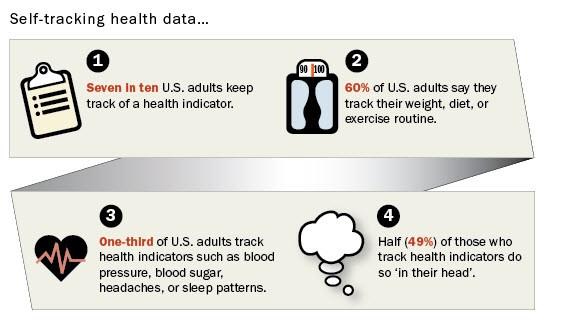
FoIB Holly R tips us to this Pew Research graphic, according to which we're making some strides:

 
Frankly, though, I have to call BS on at least some of this. My guess is that what's really happening is that "60% of US adults CLAIM they track..."

And, of course, "tracking" doesn't necessarily lead to "doing something about it."

Friday, January 25, 2013

A very expensive butt

No, not that kind; this kind:

"Millions of smokers could be priced out of health insurance because of tobacco penalties in [The ObamaTax] ... allows health insurers to charge smokers buying individual policies up to 50 percent higher premiums"

This is hysterically funny.

First, since health insurance plans will be guaranteed issue, pre-existing conditions covered almost immediately, and insurers are essentially prohibited from cancelling for anything short of failing to pay the premium, what possible penalty could there be for lying on the enrollment form?

[Since plans are guaranteed issue, they're not applications]

But wait, it gets better:

"[G]overnment tax credits that will be available to help pay premiums cannot be used to offset the cost of penalties for smokers."

So again, why would anyone disclose tobacco use?

But wait, it gets even better:

"For a 55-year-old smoker, the penalty could reach nearly $4,250 a year."

That's in addition to the underlying premium, which is already inflated due to - you guessed it - guaranteed issue and community rating requirements. A very realistic annual premium, then, would be north of $10,000. But the penalty tax for going bare is a fraction of that. So again, why would this poor smoker even bother to purchase insurance until the very last minute?

The mind boggles.

Thursday, January 24, 2013

Cute, but naive: LTCi and DNA

Long Term Care insurance is one of the two most complicated products we sell. There are a lot of "moving parts," and underwriting is especially important. These plans represent a tremendous risk for carriers (and are priced to reflect this, of course). One factor upon which they rely is ones' family history and, sometimes, one's actual genetic predisposition.

As we've discussed previously, the use of genetic information in insurance underwriting is - to put it mildly - controversial. Under the Genetic Information Nondiscrimination Act (which dates back to 2008), health insurance carriers are proscribed from its use. But LTCi has not been considered "health insurance" and so was exempt from this prohibition.

Now, HHS Secretary Shecantbeserious is weighing the possibility of unilaterally changing that.

In a post at LifeHealthPro, actuary and LTCi wholesaler Claude Thau makes the case against her doing so, but undermines himself from almost the very start:

"A belief on the part of HHS that it has the right to unilaterally expand GINA would be similar to HHS’s position on the CLASS Act ...  The separation of powers  is the genius of the U.S. Constitution and it would be scary to me to see the Executive Branch undermine the constitution in that regard"

Cue laughtrack.

Since when has Madame Kathy cared a whit about overstepping her authority? Perhaps Mr Thau should consult with the owners of Domino's and Hobby Lobby about "unilateral expansion." Heck, she even offers advice on how insureds should defraud their carriers. Does he really think there are depths to which she wouldn't willingly plunge?

I sure don't.

Why you need Disability Insurance

Because, well:

Wednesday, January 23, 2013

Network Numbness

From email I received this morning:

"Kettering Anesthesia Associates, which serves [various providers in the Dayton, OH area], has chosen to terminate its provider contract with Anthem ... Consequently, Anthem members may be billed by Kettering Anesthesia Associates for any balance not covered by Anthem"

This is SOP when dealing with network-based plans: with some exceptions, providers are  barred from "balance billing" their patients for amounts written off as discounts. The big problem here is that PARE providers generally have an exclusive relationship with hospitals; that is, if you're going to be "put under" at (for example) Kettering Hospital, you don't have a choice of gas-passers. If they're not in-network, they can bill you pretty much anything they want, and you're on the hook.

[As an aside, I was quite surprised to learn that KAA was even in a network: that's highly unusual]

On the plus side, I must commend Anthem for recognizing this:

"[S]ince our members do not have a choice of anesthesiologists for surgeries performed at Kettering Medical Center, Anthem will apply the equivalent of any member liability amounts such as co-payments, deductibles, etc., at the member’s in-network level (rather than the out-of-network benefit level equivalent). In most circumstances, payment for services will be issued to the member"

Two things of interest here: first, that they'll essentially continue to treat these claims as in-network, so as not to penalize their members. Second, I love that they're going to send that balance due amount directly to the insured. This accomplishes several things: it increases patients' awareness of just how much their health care costs, and it also puts the onus on the provider to collect whatever's due (something we mentioned almost 7 years ago).

Kudos to Anthem on a clever and effective solution to what could have been a major snafu.

[Hat Tip: Beth D]

Health insurance? Aisle 12

[Oy - scooped AGAIN! Still, mine is a bit different take on the subject. HGS]

This may start in the Golden State, but don't doubt for a New York minute that it won't catch on across the country:

"The California Health Benefit Exchange board is hoping to get retail stores to provide in-store enrollment assistance for the state's [ObamaExchange] ... Members of the ... team believe that retail stores are good vehicles for reaching uninsured residents"

In theory, these "trained and certified" employees would be able to help you choose a melon and a health plan. I have my doubts: one doesn't see a lot of rocket surgeons wearing those bright blue or red, pin-emblazoned vests. On the other hand, given how The ObamaTax policies must be structured, it wouldn't take a rocket surgeon to explain them, either.

Perhaps the model isn't the guy stocking the shelves, but the butcher or pharmacist behind a counter. That seems to me a bit more workable: someone tasked with handling the insurance questions, not where one can find the canned soups.

And I can't help but think that this is doomed to failure: after all, how would the store make money on this deal? They can "provide Tier 2 marketing support, by helping with marketing, education and referral activities, but not with actual enrollment services," but why would they? After all, they're taking all the risk (what if their advice is bad and they're sued or fined?) for zero financial reward.

Of course real, professional agents won't be much better off if they agree to become ObamaExchange Navigators, since "they cannot get compensation from the insurers selling products through a state's PPACA exchange program."

I know - we'll make up for it in volume!

John Kerry on How to Kill Medicare

Medicare has always been a failure measured by what it was supposed to accomplish: protect Grandma from losing the shirt off her back, and cost. But it was a very popular failure. Conservatives have wondered for years how to rid the nation of this albatross. Thankfully John Kerry has struck the first blow for freedom:

"Meanwhile, John Kerry found another way to raid the health care system. The Senator from Massachusetts did what diligent Senators do; he added a provision to the Affordable Care Act to allow his state’s hospitals to increase their Medicare reimbursements by a factor of ten:
Here’s how Massachusetts gets extra money: Hospitals in urban areas have to be paid at least the same amount as rural hospitals. Massachusetts only has one rural hospital—a 19-bed facility on Nantucket island. So, the Nantucket Cottage Hospital sets the floor for every hospital in the state.
But because Nantucket is so wealthy, its cost of living is high—and thus so are its Medicare payments. That drives up the payments for every other hospital in the state. And under Kerry’s provision in the Affordable Care Act, hospital payments come from a nationwide pool.
If the provision remains in place, Massachusetts’s payments will rise over the next decade from $367 million to about $3.5 billion. The pool operates on a zero-sum basis, so all the money the Bay State gets will be funded by cutbacks from other states."

MA is a small State, it took some chutzpah to pull this off. Other states and hospitals are obviously not going to stand for this. Luckily for the taxpayers we are broke, so they can't just give every hospital a 10-fold pay raise. The more states fight over the small pot of blood money and more games like this the politicians play the sooner the public will see this for the failure it is and get rid of it.

Well Duh! then how much higher?

Bob discussed a WSJ blog explaining why rates are going to go up. Forbes has a hint just how bad it might be and early discussion of pushing back some of the expensive parts:


"A California insurance broker, who sells health plans to individuals and small businesses, told me that she’s prepping her clients for a sticker shock. Her local carriers are hinting to her that premiums may triple this fall, when the plans unveil how they’ll billet the full brunt of Obamacare’s new regulations and mandates."

"There’s buzz in Washington that to ease the price hikes, the Obama team may slow down some of the most expensive regulations. This might include the law’s mandatory community rating. One approach they’re said to be considering is allowing some of the historically based underwriting to stay in place for a time."

Obama already started most of the taxes after his reelection; who would be surprised that in order to protect his legacy he pushes the worst parts of ACA onto the next President? Let them figure out how to fulfill his promises or take the blame for repealing Obamacare,  all he cares about is getting credit for covering 30 million people and fixing healthcare. Neither of those things have to actually happen: the MSM has already credited him with accomplishing these goals

It will be amusing to watch Obama and the Media dance their way out of this way. Plenty more to come.

Cavalcade of Risk #175: A Lighter Side of Risk

Julie Ferguson hosts a light-hearted edition of our bi-weekly collection of risky posts. There's little risk that you won't be amused and enlightened.

So drop by for a laugh, and stay for an insight (or three).

Tuesday, January 22, 2013

Schooling the ObamaTax

As we reported in November, higher education employment opportunities are on the chopping block thanks to the ObamaTax. In just a few short months, the ripple effect has continued to grow:

"A handful of schools, including Community College of Allegheny County in Pennsylvania and Youngstown State University in Ohio, have curbed the number of classes that adjuncts can teach in the current spring semester to limit the schools' exposure to the health-insurance requirement."

Interesting choice of words: "handful." Kinda minimizes the problem, doesn't it? Well maybe for the "ins," but not so much for folks like instructor Robert Balla, who "faces a new cap on the number of hours he can teach at Stark State College. In a Dec. 6 letter, the North Canton school told him that "in order to avoid penalties under the Affordable Care Act…employees with part-time or adjunct status will not be assigned more than an average of 29 hours per week."

Mr Balla, it should be noted, teaches (among other things) technical writing, and is well thought-of by his students. But that doesn't matter under the ObamaTax, and now his students (and prospective students) are worse off for it.

On the other hand, he's apparently bought into the popular (yet erroneous) assumption that the ObamaTax would result in lower costs and better coverage:

"In education, we're working for the public good, we are public employees at a public institution; we should be the first ones to uphold the law, to set the example."

No, you're providing a service for a fee, much like health care providers. Perhaps we need to mandate a college education, as well. What could possibly go wrong?

[Hat Tip: FoIB Holly R]

Monday, January 21, 2013

More ObamaTaxes

And in case you were wondering about your W-2: no, it's not just your withholding that'll be affecting your take-home, it's the ObamaTax at work, as well:

"Beginning for the 2012 calendar year, certain employers are required to report in Box 12 of the IRS Form W-2 provided to their employees, the aggregate cost of employer-provided health care coverages."

That's just one of a litany of new tax-related rules that took affect 3 weeks ago. Courtesy of Assurant Health, an easy-to-follow recap of the new W-2 rules and regs is available for download here.

Get 'em while they're hot (or not).

Shecantbeserious hits bottom, keeps digging

[UPDATE: Looks like Nate has scooped me!]

Words fail:

"When patients pay for medical care out of pocket, they should be able to keep doctors and hospitals from telling their health insurers about the care."

This advice is just part of a new, 560+ page compendium of final rules and regs just released by Madame Secretary and her minions. Masochistic readers may peruse them at their leisure here. Oh, and in case you're wondering, the initial projected cost of implementing these new rules is up to $225 million, and up to $43 million annually after that. I think that's low-balling it.

Among the many wonderful new rules are more onerous compliance requirements on private health info, while at the same time expanding school vaccination programs and the sending of a deceased's health information (he's dead, Jim) to survivors.

But the most egregious part is this little gem:

"[A]nother provision restricts "disclosures to health plan concerning treatment for which  the individual has paid out of pocket in full"

The problem is that this hinders insurance carriers from accurately pricing the risk, and it's going to be a major problem for in-network providers, whose contracts generally include this kind of disclosure. Not to mention, how does the doc (or his office staff) know which info to pass along, and which not?


As usual, the rocket surgeons now running our health care system leave a lot to be desired.


ADDENDUM: Our resident Medical Office Manager, Kelley B, noticed something, um, odd:

This is the dumbest thing I have read today:

"Commenters also asked what providers should do when patients said they would pay for sensitive care out of pocket but failed to pay for it"

Uh, if the patient presents at checkout and states he will pay for the service, he does not want it billed, then the money is collected right there, there is no billing the patient, as there is no electronic billing.  If he says, "oh I didn't know you would want my money now," then we tell the patient, too bad, so sad, but now we will bill insurance.

HHS Codifies Insurance Fraud

I would love to see a list of which other industrialized nations with healthcare spending half ours has laws like this;

http://www.lifehealthpro.com/2010/07/08/hhs-doctors-can-help-patients-hide-care-from-plans

"If, for example, a patient received care for asthma and for diabetes from the same physicians and paid for the diabetes-related care out of pocket, the patient could keep the physicians from telling the health plan about the diabetes, officials say.

The health care provider or other covered entity could still contact the health plan if the patient did not really pay the full out-of-pocket costs for the care. If, for example, a patient's check bounced, a provider could contact the health plan for payment, officials say."

So hiding information from your healthplan who is being told to better manage health and cost is going to be law, sounds counter productive.

Plans have filing limits, if the doctor waits until the patient doesn't pay they might miss the time they have to file for reimbursement under the plan, or will plans now also be required to extend the time to file claims based on employees wanting to hide information form them. Not to mention the mess that makes of reinsurance contracts.

My advice to clients, this is reason 328 to go back to reimbursement plans. Dump the PPO and assignment of benefits and let members submit claims and be reimbursed at plan allowable. Solve not only this issue but excessive provider cost as well.

An after thought, employee suffers some condition related to smoking which they lie and tell their healthplan they do not do in order to get the lower premium. In order to continue paying the lower premium they hide any claims related to smoking. Until they get major claim at which time they let the plan pay. 

Friday, January 18, 2013

On Medicare and The ObamaTax

A friend of mine just posted this on his FaceSpace page:

"Participating in one of my favorite annual activities (not)........trying to determine why Medicare cannot accurately, efficiently bill me for my premium! Starting my second year on Medicare, and premium for February is different than January. Same thing happened last year. Last year it took three months for Medicare rep's to give an explanation of why my premium changed during my first quarter on Medicare. Good thing I have a sense of humor."

And folks think that these same bureauweenies can run the rest of our health care system any better?

Finally: Some good news from the Much Vaunted National Health System©

It appears that a significant number of providers have had enough with treating illegal immigrants:

"While [MVNHS©] hospitals are allowed to charge foreign patients for treatment if they do not come from a country with a reciprocal arrangement, GPs are forced to take on people without charging."

What to do, what to do?

Ah:

"A survey of GPs has found that the majority think this is too generous and the rules should be changed."

The docs claim that the rules themselves are quite confusing, and reimbursement levels for illegals is significantly reduced. They even manage to work in medical tourism as a potential culprit. In an eerily prescient statement, Dr Paul Roblin, who chairs the Berkshire, Buckinghamshire and Oxfordshire Local Medical Committee, notes:

"GPs are expected to practice with limited healthcare funding and if we are using that money for treating visitors, the taxpayer loses out."

On this side of The Pond, we call that The ObamaTax.

Cavalcade of Risk #175: Call for submissions

Julie Ferguson hosts next week's Cav. Entries are due by Monday (the 21st).

To submit your risk-related post, just click here to email it.

You'll need to provide:

■ Your post's url and title
■ Your blog's url and name
■ Your name and email
■ A (brief) summary of the post

PLEASE remember: ONLY posts that relate to risk (not personal finance tips and the like). And please only submit if you are willing to link back to the carnival if your submission is accepted.

Thursday, January 17, 2013

Health Wonk Review: 2nd Inauguration edition

Chris Fleming hosts this week's historic roundup of interesting and provocative posts from around the wonkosphere.

What's so great about Chris's efforts is that he's woven a lot of disparate posts into a cohesive narrative - no easy feat.

They ain't birthin' no more babies

In case you missed it, another ObamaTax domino has fallen. Pregnant women in southwestern Pennsylvania don't get to keep their doctors, after all:

"The Windber Medical Center will stop delivering babies after March 31 because its obstetricians are either leaving or refocusing their practices, and because hospital officials believe they can't afford it based on projected reimbursements under looming federal health care reforms." [emphasis added]

That's a big problem with the ObamaTax: at the same time as it (purportedly) expands the number of insured folks - either in the marketplace or on Medicaid - the actual amount that docs can expect to earn from them is dropping. Kind of reminds me of those crazy car commercials of yesteryear, "sure we lose $100 on each sale, but we make it up in volume!"

Or, as this case so vividly illustrates, not.

[Hat Tip: FoIB Jeff M]

Wednesday, January 16, 2013

Mental Health and "Gun Control"

This is a strange confluence of two seemingly unrelated items. Yesterday, the New York legislature passed a far-ranging "gun control" agenda, one portion of which apparently requires "mental health professionals to report patients they believe could harm themselves or others."

As we learned yesterday, HIPAA privacy regs don't seem to prohibit this, but that doesn't really address the underlying problem: just because we can do something doesn't (necessarily) mean that we should. In 2002's "Minority Report," the police can arrest a potential perp under the concept of "pre-crime." While that's an interesting sci-fi "hook," is that really where we want to be?

On the one hand, there's no question that mentally unstable folks could pose a threat, but I think it's more nuanced than that: are we really going to lock people up because they might become dangerous? I realize that there's a difference between "reporting" and arresting, but what would be the point of the former if the latter wasn't a potential outcome? I have an issue with this – it’s related to our discussion the other day about the young lady having the double mastectomy because she might get breast cancer someday. In that case, though, it’s her choice. This one is the state (“government”) deciding. Not exactly a slam-dunk.

We talk a lot here at IB about "risk," and that's appropriate (after all, insurance is all about risk - or at least it used to be). So we have the risk that a mentally unstable person could commit violent crimes, versus the risk that society (or its duly appointed agents) might abuse an individual's rights. To paraphrase another iconic movie, do the needs of the many outweigh the needs of the few?

Or the one?

[Hat Tip: FoIB Holly R]

Tuesday, January 15, 2013

HIPAA vs "Gun Control"

HIPAA (the Health Insurance Portability and Accountability Act; note that, unlike the ObamaTax, there was no pretense regarding affordability) is a widely misunderstood piece of legislation. But it's in its application that we often find the most trouble.

Tomorrow, President Obama is threatening promising to release a slew of Executive Orders to more rigidly control legal access to firearms:

"Actions the president could take on his own are likely to include ... compelling federal agencies to improve sharing of mental health records"

Now, there's been some chatter on the internets that this would be a flagrant violation of HIPAA privacy rules. The thinking seems to be that signing a HIPAA privacy form prohibits health care professionals from releasing information to, for example, federal authorities without prior authorization.

This would be untrue:

"5b.9

(1) Except as provided in paragraph (b) of this section authorizing disclosures of records without consent, no disclosure of a record will be made without the consent of the subject individual.

(b) Disclosures without the consent of the subject individual. The disclosures listed in this paragraph may be made without the consent of the subject individual. Such disclosures are:
(7) To another government agency or to an instrumentality of any governmental jurisdiction within or under the control of the United States for a civil or criminal law enforcement activity if the activity is authorized by law"

So like it or not, HIPAA offers no "safe harbor" in this scenario.

How not to play poker

The New York Times reports that the White House says it will give states more time to comply with the new health care law after finding that many states lag in setting up markets where millions of Americans are expected to buy subsidized private health insurance.

We've heard this before.

Sebelius is just bluffing.  She's bluffing because she holds no winning cards.

By law, the Exchanges must be fully operational by January 1, 2014, and must be able to accept & process enrollments by October 1, 2013.  By law, HHS must set up and operate the Exchange in any State that does not set up its own.

As of now, there are about 30 refusenik states.  Sebelius knows HHS doesn't have the resources, does not have the time even if it did have the resources, and therefore cannot fulfill its obligation to set up Exchanges for all the states that refuse to set up their own Exchange.  This is a slow-motion disaster that now appears impossible to prevent - and it will take place on her watch.

We know - and Sebelius knows - that Obama will instantly blame her for this failure.  (Without, of course, ever reflecting on why his plan failed).  She's desperate and and that explains why she's bluffing.  But bluffing never works when everyone in the game knows you hold losing cards.

MassMutual vs College Debt

The ObamaTax placed the administration of student loans under the (benign?) authority of HHS Secretary Shecantbeserious. What student loans and "affordable health care" have to do with each other is anybody's guess, but there you are. Partly as a result of this, student loan debt is at record levels, threatening the future solvency of our best and brightest (among others). MassMutual, about which we lauded their innovative LifeBridge program last Fall, wants to help out:

"[S]tudent loans in the U.S. has topped $1 trillion, surpassing both credit card and auto loan debt. The 90-day serious delinquency rate is also higher than credit cards. One-in-five households are affected by student debt with the average graduate having about $20,000 in loans."

And that's the average - seems to me that a lot of our young people have already accumulated debt well into the 6-figures (how wise that may have been is another matter).

"In an effort to provide Millennials with the support they need, MassMutual [has] launched a new initiative – “Down with Debt” - aimed at addressing the student debt crisis by providing helpful financial tips and offering a $20,000 reward for the most creative strategy to pay down debt."

I like it: creative thinking with a potential reward. Just click here for details (and perhaps to sign up).

[Hat Tip: Caitlin Bricker]

RELATED: United Home Life Insurance asks "What do Twinkies, Flu Shots and Cabbage Patch Kids have in common?"

That would be Econ 101: supply and demand. At one time or another, each of those items has been in scarce supply (and Twinkies continue to be - alas!).

There's a follow-up question, too: "What's that got to do with life insurance?"

Fair question; after all, when was the last time you saw lines around the corner of people clamoring to buy life insurance?

But as UHL points out, our time here is uncertain and scarce - it can run out any moment. The longer we wait, the more expensive life insurance becomes. And consumers urgently need to protect their lives - and their loved ones - NOW, while there's still time.

A friend of mine likes to point out that we don't buy life insurance with our wallets, we buy it with our health. LifeHealthPro's Corey Dahl asks, "what’s more uncertain and scarce than our time here, the seconds and minutes of which are rapidly ticking away and could be set to run out … now … or now … or now. No one knows for certain when his number is going to get called, so doesn’t it make sense to get a life policy for loved ones — without delay?"

Indeed.

Monday, January 14, 2013

Early January Alzheimer's Update

We haven't really discussed Alzheimer's since this past Fall, but there's some potentially hopeful news coming from the folks at Rensselaer Polytech in New York:

"Antibodies developed by researchers at Rensselaer Polytechnic Institute are unusually effective at preventing the formation of toxic protein particles linked to Alzheimer’s disease and Parkinson’s disease"

And these little guys are apparently helpful in the fight against Type II diabetes, as well. They're able to "target" certain cells (or clumps of cells) to proactively shut down the bad ones.

It's apparently still pretty new, but appears promising.

[Hat Tip: Ace of Spades]

PCIP Turnabout

Over the years, we've lamented the poor participation rates and stupid eligibility rules for the Pre-existing Condition Insurance Plan, aka PCIP. Now comes word that HHS Secretary Shecantbeserious is in a spitting contest with Ohio Insurance Commish Taylor. Perhaps the most interesting part is whose side each of these fine ladies are on:

"[Ms Shecantbeserious] has ordered 14 people to be dropped from Ohio’s temporary high-risk pool for the chronically uninsured ... after determining they had previous coverage that disqualified them from enrolling."

Yup, one of those stupid eligibility rules is that one must not have had "creditable" insurance coverage for the preceding six-months.  A while back, we investigated just what comprised "creditable" coverage, and were left pretty confused. In theory, only major medical plans counted; so-called "mini-med" (or limited benefit) plans did not.

But there's no actual verbiage which specifies this, it's all inference. It seems that Ms Taylor's position is that "lousy" coverage is, in fact, not creditable, and therefore passes the PCIP "smell test." It's an interesting theory, but one which is open to lots of interpretation. On the other hand, Ms Shecantbeserious contends that the quality of the previous insurance (if any) is immaterial, it's enough that the person had any coverage.

Medical Mutual, the carrier tasked with implementing the Buckeye State's PCIP program, has gone to court asking for clarification. Of course, it's most likely a moot point: by the time a decision is reached, The ObamaTax will be in full implementation mode and the plan itself will be a memory.

Too bad, really, coulda been interesting.

[Hat Tip: FoIB Patrick P]

Flu insurance

The good news is that I spent a chunk of the weekend replenishing the supply of Jewish penicillin for friends and family. The bad news is that the nation is in the grips of a "flu epidemic," caught shorthanded on vaccines:

"We're hearing of spot shortages," said Dr. Thomas Frieden, director of the Centers for Disease Control and Prevention ... manufacturers already have shipped nearly 130 million doses to doctors' offices, drugstores and wholesalers, out of the 135 million doses they had planned to make for this year's flu season."

Ideally, you got your shot a month or two ago, and are sitting pretty. If not, all is not (necessarily) lost:

"Health insurers are trying to do their part to keep the current U.S. influenza outbreak from becoming anything to write home about ... Massachusetts Blue [Cross] gives advice about preventing the flu from spreading, treating flu at home, seeking professional medical attention for flu symptoms, and insurance coverage for flu vaccination shots."

Many plans cover flu shots, sometimes at 100% (YMMV). We got ours at the nearest chain drugstore, and it was quick and (relatively) painless. And it's not just about your own health, either. As one insurer notes:

"You could infect other people even if you don't get that sick yourself, especially those at high risk such as infants, nursing home residents and people with chronic conditions"

The bug seems to be especially hard on our seasoned citizens, with "about 90 percent of flu-related deaths and more than half of flu-related hospitalizations occur[ing] in people ages 65 and older." So if you (or someone you know) is in that age cohort, seriously consider tracking down a dose or two.

Oh, and: gesundheit!

Sunday, January 13, 2013

Sunny in Malaysia

While it's easy to forget that this is indeed a global economy, sometimes the news has a way of reminding us:

"Canada's Sun Life Financial and Malaysian state investor Khazanah have agreed to buy Aviva's Malaysian [life] insurance ... Britain's No.2 insurer Aviva is exiting marginal markets across the world with the aim of boosting its underperforming share price"

Whoa, they're concerned about profits? How provincial of them.

Friday, January 11, 2013

Suck it up, Buttercup

New York's Nanny Mayor Bloomberg has a message for folks in pain:

"[M]ost public hospital patients will no longer be able to get more than three days’ worth of narcotic painkillers like Vicodin and Percocet."

And of course, no 16oz Big Gulps to wash 'em down with, either.

This flies in the face of President Obama's promise that all Grandma (and, presumably, other hospitalized folks) needs is a little pill.

Now, it's easy to treat this as a bit humorous, but there's a serious element here: these are government-run health care facilities, deciding unilaterally - without regard to providers' recommendations or patients' needs - what will and won't be provided. As the city's the one paying the piper, it has every right to call the tune. But it should give us all pause to consider the ramifications of this thinking as it applies to The ObamaTax (and it most certainly does).

Blue pill or red, which will it be?

[Hat Tip: Ace of Spades]

Making a clean breast: An Ethical Conundrum

First, let me say that I admire this young woman's courage and dedication, and of course this is her choice, her decision.

Having said that, I am troubled by the message she's apparently trying to send about young women and breast cancer:

"Win or lose Saturday, Miss America contestant Allyn Rose will have conveyed a message about breast cancer prevention using her primary tool as a beauty queen: her body. The 24-year-old Miss DC plans to undergo a double mastectomy ... removing both breasts as a preventative measure to reduce her chances of developing the disease that killed her mother, grandmother and great aunt."

Here's the thing: while there's sufficient evidence linking genetics and predisposition to certain cancers (such as of the breast), it's not a certainty that she'll ever develop the disease. The problem is the message that she's sending to millions of other young women about preemptive mutilation (regardless of the underlying risk).

As a husband, and the proud (if harried) father of two lovely daughters, I'm concerned about this message. I certainly wish Ms Rose good health and long life, but remain unconvinced that this is an ideal route.

What say you, dear reader?

Do you think Ms Rose's decision sends a helpful message to other young women?
  
pollcode.com free polls 

Gray Lady Joke of the Day: EHR D'unh!

From Nate's post last Fall:

"[I]n reality, the move to electronic health records may be contributing to billions of dollars in higher costs for Medicare, private insurers and patients by making it easier for hospitals and physicians to bill more for their services, whether or not they provide additional care."

And from yesterday's New York Times:

"The conversion to electronic health records has failed so far to produce the hoped-for savings in health care costs"

Nice that the Gray Lady is finally catching up to us.

ADDENDUM: As Mike points out in the comments, he made the EHR cost/benefit connection in the Fall of 2011:

"Last week the UK announced that it will scrap its 9-year-old Information Technology (IT) project intended to digitize all National Health Service patient records and link all parts of the enormous NHS together ... Perhaps more important is the global impact on thinking about health IT. For example US policymakers hope that IT will save scads, tons, bundles, oodles of money in the delivery of medical care."

The key (but inoperative) word being "hope."

RELATED: From the Dayton Daily News this morning:

"Health insurance premiums are rising this year for many Ohioans, and some pretty much everyone  will see larger double-digit percent increases than they’ve seen before"

Fixed that for ya, DDN.

[Hat Tip: FoIB Holly R]

Giving Obama his credit when due

I have recently hired three workers and expect to hire at least a couple more in the next month or two. As much as I would like to take credit for this success that would not be fair. In large part, just like Obama said, I did not build this.

Myriad regulations and notices have scared employers into hiring a new company I created called Compliance & Regulation Administrators to assist them in staying out of trouble.

New laws treating a company with 49 workers different then one with 51 has created a booming market in counting employees, or equivalent employees, or seasonal unless they aren't seasonal based on a self selected standard measurement period employees.

Expensive new coverage requirements like unlimited lifetime maximums, minimum essential benefits, and "free" preventative care have driven employers to me searching for alternative and affordable ways to fund these mandates. 

These are just a few of the ways Obama helped me build this. And for that, with just a slight touch of sincerity, I would like to thank him.

Thursday, January 10, 2013

Monthly billing: Is this something? [UPDATED]

Got email today from Anthem (Blue Cross/Shield) announcing that they're doing away with billing modes other than monthly:

"All Individual under 65 members who currently pay their premiums on other than a monthly basis (quarterly, semi-annually or annually where available) will be changed to monthly billing"

There's never been a really good reason for choosing other options, anyway (other than, perhaps, convenience) because - unlike most other forms of life and health insurance - there were no premium discounts for paying ahead.

Still, it's interesting, so I've reached out to our Anthem field rep to see if she can shed some light on the subject. I'll update as appropriate. And if you have any thoughts on why they're going this route, we'd love to discuss them in the comments.

UPDATE [1/11/13]: Well, that was fast. Our intrepid field rep got back to me this morning. In her email, she explained that:

"Of course it all has to do with [the ObamaTax]. We will only offer monthly billing in 2014 and by changing our billing mode now, it will remove one additional change that members will have to experience at that time. Additionally, there will be new systems and having to move “pre-paid” money from current system to new system next year could create billing problems and money not being credited.  In a nutshell that sums it up."

Thanks!

The ObamaTax shooting blanks?

This is odd:


According to the video, the ObamaTax specifically prohibits collecting info on legally owned guns and ammo. But you know us: we couldn't just take the media's word on this. So, off to our copy of The ObamaTax we went. And, just like that famous pasta sauce, it's in there:

"None of the authorities provided to the Secretary under the Patient Protection and Affordable Care Act or an amendment made by that Act shall be construed to authorize or may be used for the collection of any information relating to (A) the lawful ownership or possession of a firearm or ammunition; (B) the lawful use of a firearm or ammunition; or (C) the lawful storage of a firearm or ammunition."

Now, one may wonder what this has to do with "affordable" health care, but then, what do college loans have to do with it, either?

Too bad no one read it before they passed it.

[Hat Tip: Hot Air]

Wednesday, January 09, 2013

Biting the hand... [UPDATED & BUMPED]

[Originally posted January 8, 2013]

Last we looked, insurance behemoth American International Group (AIG) had been the recipient of almost $200 billion in American taxpayer largesse. The good news is that they've (apparently) re-paid all of this, plus interest.


The not-so-good news is that, in a very strange twist of fate, they're contemplating suing the very taxpayers that bailed them out:

"[T]he insurance company is actually thinking about suing the U.S. government over the bailout that saved it ... The lawsuit does not argue that government help was not needed"

Wait, what?

"[The lawsuit] contends that the onerous nature of the rescue ... deprived shareholders of tens of billions of dollars and violated the Fifth Amendment."

Heh.

For the record, we noted the unconstitutional nature of the bailout in 2009; and Harvard law professor Laurence Tribe (an Obama campaign advisor) agreed. Interesting times, indeed.

UPDATE: Well, that didn't take long:

"American International Group won’t join or take over a lawsuit  ... alleging that the government acted punitively against its shareholders when it acted to bail out AIG starting in September 2008."

Shall we all now breathe a sigh of relief?