Showing posts sorted by relevance for query p&c. Sort by date Show all posts

Monday, March 16, 2020

From the P&C Files: CV-19 Exclusions

The other day, we learned that Business Interruption coverage is unlikely to extend to business that (temporarily) close their doors while the pandemic plays out. Turns out, there's likely a few more lines of coverage that will likely exclude CV-1-related claims.

Our good friend (and P&C guru) Bill M tips us to this item:

"U.S. P&C insurers face 'limited exposures' from coronavirus"

"While the virus will undoubtedly impact the health and life insurance markets, the U.S. property & casualty (P&C) sector may emerge relatively unscathed once the pandemic subsides."

Okay, I'll bite: why is that?

Well, it comes back to something we've seen before:

"Bill taught me a new phrase, and suggested I use it whenever I'm looking at these kinds of (potential) claims: "cause of loss." That is, which circumstances are specifically covered, and which are specifically excluded."

And here's where that phrase comes into play, CV-19-wise:

"However, if a factory closes because of fears that an infected worker contaminated equipment, BI coverage could be triggered. “But even in this case,” Fitch says, “claim exposures would likely be limited by policy sub-limits.”

This is different from the situation we discussed this past Friday: in this case, there seems to be an actual physical cause; but again, even that claim will probably be limited in scope.

This would also apply, for example, to supply chain disruptions and even travel interruption plans.

We  discussed this a couple of weeks ago:

"Plans where the Cancel for Any Reason upgrade has been purchased allows travelers to decide for themselves whether to travel or cancel their trip according to the terms of the plan."

One can imagine there's been a substantial uptick in interest in those kinds of plans, but as the article notes, "the adverse impact insurers will likely face will be from a decrease in demand" as folks decide to maybe trade in a staycation for that cruise (at least for the nonce). And it doesn't have to be international travel, either:

A colleague told me the other day about a friend of his who had tickets for the A-10 (?) basketball tourney in New York. He cabbed from the airport to his hotel, checked in, and learned that the event ha been canceled. Okay, disappointing, but we'll just take in a show, right?

Ummm:

"Broadway Shuts Down: Performances Canceled Through April 12 Due to COVID-19 Pandemic"

/sigh

Now, one area where carriers may see specific exposure is event cancellation (see above). When basketball and now even golf tournaments are canceled (or postponed), there may well be valid claims, depending on what type of coverage the organizers bought (if any). For example, "if the Olympics were to be canceled, Moody’s asserts that “losses could become material for some insurers,” with industry experts estimating insurance coverage for the games to be around $2 billion."

That's a lot of gold.

Monday, July 09, 2007

It's Cool to be PC (P&C, that is)

A while back, I stumbled on a P&C (property and casualty) related blog, run by fellow insurance agent Aaron Wallrich of Wisconsin. I've been following it for a while, and find it just fascinating: a fellow cynic when it comes to carriers, with a quirky, pleasant sense of humor and self-deprecation ("Very interesting stuff for an insurance nerd like me").
If you've got an interest in seeing the P&C side of "the biz," Swift Rate is the place to go.

Saturday, July 07, 2007

Flooding across the Pond

From time to time, we like to dabble a bit in the P&C (property and casualty) side of "the biz." This includes items like auto, home and liability insurance, as opposed to our regular fare of life and health.

About two years ago, we participated in the blogosphere's efforts to help victims of Hurricane Katrina (which project, apparently, was more successful than our own gummint's). And while that was a terrifically satisfying endeavor, we never underestimated the vast reserves and dedication of the P&C "cat" teams who slogged through the devastation, dispensing help and, more importantly, cash.

At the other end of the spectrum, Britain's NHS (National Health System) has been the target of more than a few of our posts, and rightly so. But our English cousins haven't (yet) nationalized their P&C industry, which is now trying to cope with floods that compare to that which we saw in NOLA. Apparently, the Brits' carriers are up to the task, but an interesting question arises:

"So why do one in four people, almost a third in Scotland and London, take a risk and not insure their contents?"

That's a lot of uninsured folks, many of whom now face financial ruin, displacement and worse. Some, of course, are just natural risk-takers, and we have many of our own of this ilk here in the 'States. For others, it's a matter of economics: if you can barely afford to eat, then insurance premiums are probably not high on your list of necessary purchases. I'm not sure I entirely buy that: the premium quoted in the Times article, £200 (about $400) a year, works out to less than $10 a week, which doesn't seem overwhelming.

Which gives rise to the real questions:

"Should we save them when the floodwater rises? Or do we stand purse-lipped at their lack of providence, as the loss adjuster with his clipboard sanctions our new suite?"

Tough choices. What was that about stiff upper lips?

Wednesday, July 02, 2008

Can't Win for Losing: Another Tale from the P&C Side

Our primary focus hear at IB is on life and health insurance (mostly health), but from time to time, we find interesting/infuriating stories from or about our P&C colleagues. For example:
While calamities such as Hurricane Katrina make the news even years later, it's the day to day, season to season losses that really rack up the big dollars, and losses. On our side of the biz, new underwriting tools like genetic testing cause major controversy; likewise, a new program called "Computerized Catastrophe Modeling" promises to cause a comparable uproar on the P&C side.
CCM uses advanced computer modeling to predict real-world events, and then to extrapolate losses. Of course, it's not the only tool that actuaries and underwriters use to assess the scope of the risk, but it has apparently become a very useful and productive one.
Critics, on the other hand, charge that CCM predictions have led to ever-increasing insurance rates, forcing some folks to move to more user-friendly climes. They also have a problem with one of the underlying premises of CCM programs: that water temperatures are rising and thus triggering more frequent and powerful storms.
It's interesting reading for those of us in flyover country: we hardly ever get any hurricanes here. But it's literally life and death on the coasts, and could have far-reaching economic impact, as well.
Thought-provoking.

Wednesday, January 04, 2006

A Time for Renewal...

UPDATE: Well, that's interesting. It appears that this issue has gone into hibernation, as we have been unable to find anything substantive on it newer than 2003. There have been some state laws prohibiting reunderwriting, and [the carrier] cited in the WSJ story has ceased the practice, as well. I've decided to leave this posted, for the purpose of eliciting discussion about the nature of the health insurance renewal process.
Normally, when we think of “renewal,” we think of Springtime. But one’s health insurance renewal, particularly if one has an individual plan, is (usually) the anniversary date, which could be any time.
Now, for as long as I can recall, I’ve explained to my clients that their rates will go up at renewal time (no, it’s not actually a law that that they must go up, it just seems like it), but that the increase is based primarily on the experience of the group of folks who own such policies, not on one’s own particular claims.
Apparently, though, that’s changed. And not necessarily for the better:
I’ve redacted the name of the insurer not to protect the innocent, but because it is not the only one currently engaged in this practice. The justification for “reunderwriting” is that rate increases are "based on an individual's experience, just like auto or homeowners' insurance. If the risk changes, the premiums change."
Some regulators and industry pundits claim that this is specious: “(D)rivers and homeowners have more control over the likelihood of having a claim than people have over their health. Some state regulators also view health insurance differently because the stakes are higher. They note that reunderwriting could price people out of the market, leaving them uninsured and unable to afford medical care when they need it most.
It’s true that auto and homeowners insurance (called P&C in industry jargon) are treated differently than health insurance: rates are more closely regulated by the states, and coverage itself is generally required by the law or the lender.
But just because health and P&C are treated differently doesn’t mean that they are different: they are both based on an insurance principle called “indemnity.” Briefly, indemnity means that that one is “put whole:” If your car gets dinged, the insurance pays the repair shop to fix it. Likewise, if you get sick, the insurance pays your doctor to treat you. Of course, there are significant differences in how each type of policy works, but the underlying principles are the same.
So, if you have a ticket or an accident, then your car insurance will go up at the next renewal; the nature of the risk has changed, and therefore the underlying assumptions (upon which your premiums are based) must change as well.
So, if the principles undergirding P&C and health are the same, why shouldn’t the consequences be the same, as well?

Monday, April 09, 2007

Hi Speed Hijinx (from the P&C files)

A while back, we learned about chutzpah and insurance. In the latest gambit towards inveigling an insurance company to pay up, we learn that, while crime may not pay, it seems that some folks who commit crimes want their insurer to pay:

"That seems to be the case of a Marietta, Ga., father who not only was willing to forgive his then 19-year-old daughter for leading police on a high-speed chase while she was high on drugs, but also figured she wasn't responsible when cops were forced to smash in the car's windows to make an arrest."

Yup, little Jennifer took Daddy's beautiful new Lexus SUV, got herself stoned, and then took off on a high speed chase, which ended in some policemen having to break the vehicle's windows in order to arrest the miscreant. Not to mention the other damage done when the forces of law and order had to literally ram Daddy's car to keep little Jennifer from perhaps killing anyone that got in her way.

And Daddy expects his insurance company to pay for the damage.

Because I'm not a P&C expert (nor do I play one on the telly), I asked my colleague for his expert opinion. When he'd finished laughing, he shrugged and said "with the courts, who knows?" Still, he explained that, although Daddy apparently gave little Jennifer permission to use his car, this wouldn't have extended to felony counts. In other words, assuming Progressive (the carrier) chooses to fight this, it seems that Daddy will have to eat the damages.

Good.

Thursday, July 26, 2012

From the P&C Files: Iran, Shipping, Insurance and Oil

Although we primarily concern ourselves with life and health insurance, we're certainly no strangers to the Property and Casualty side of the biz. This item in the Washington Free Bacon Beacon (oops, sorry), piqued my interest:

"The insurance industry and ... lawmakers are attempting to water down a new Iran sanctions bill that would penalize any company that underwrites Iranian affiliates"

Since this is rather outside my bailiwick, I turned (again) to our resident on-call P&C guru, Bill M, who helped me get my head around it.

Here goes:

Acme Industries, which ships oil-drilling equipment to Iran, calls AIG (hey, it's called American International Group for a reason) for a quote. AIG asks all the pertinent questions (including what's being shipped, from where, to where, etc) and generates a quote. Acme likes what it sees, and purchases the policy.

Six months later, Acme is sanctioned for "bolstering the Iranian oil industry."

Under the bill currently wending its way through the House, AIG would then also be sanctioned.

The "prominent lawmakers" mentioned above would prefer to let AIG (or whomever) off the hook.

This item raises a number of questions:

First, would it have mattered if Acme had already been sanctioned before seeking that AIG quote? Are "sanctions" to this process what speeding tickets are to auto insurance?

Second, what if Acme had bought the policy from a broker in London? After all, it's not unreasonable to presume that a carrier might have offices in other countries in addition to a presence here.

If you have experience in this market, we'd appreciate any thoughts you might have on this.

Thursday, February 16, 2017

From the P&C Files: A Very Big Deal, Indeed

For want of a nail, so the story goes, a kingdom was lost. In this case, the "kingdom" may well be the Sunshine State's homeowner's insurance market:

"An Ohio insurance-rating company has warned that recent court rulings and skyrocketing losses ... have created an "uncertain operating environment" for Florida's property insurers and that it will downgrade the financial stability of 10 to 15 Florida-based companies."

So what's the deal?

As usual when we consider the Property/Casualty side of the business, I turn to our P&C Guru, Bill M. Here's the scoop:

When one has (for example) a roof damage claim, there's an "assignment of benefits" where the insured actually assigns the claim itself to the contractor.

In 2006, Florida carriers paid out about 400 of these claims.

In 2016, they paid out 28,000 of them.

Gulp.

As a result, a number of these carriers are really hurting, and that's about to create a rather serious ripple effect:

Homeowners who have their mortgages financed by Fannie Mae or Freddie Mac are required to not only have insurance on their homes, but the carriers they use must be at least A-rated. But now that the aforementioned ratings company has downgraded a number of these insurers, those mortgages are going to be in default. Now, in normal times, it'd be easy enough to just say "oh well, a-shopping I will go," but when you're talking thousands, or perhaps tens of thousands, of policyholders now flooding the market, well, that's going to be a problem. At the very least, agents are going to be very busy quoting and binding coverage.

But there's another potential problem lurking below the surface: capacity. That is, at any given time, there are only so many carriers who can take on only so much (additional) risk. Normally, that's not an issue, since there are lots of companies out there. But there aren't necessarily that many A-rated ones, and hence the problem.

Bill confirmed to me that, at the best of times, homeowners insurance in Florida is a challenge; now things promise to get "interesting."

Gee, thanks.

[Hat Tip: @JeremyWallace]

Thursday, June 04, 2020

Sigh: Another Riot-related P&C Post

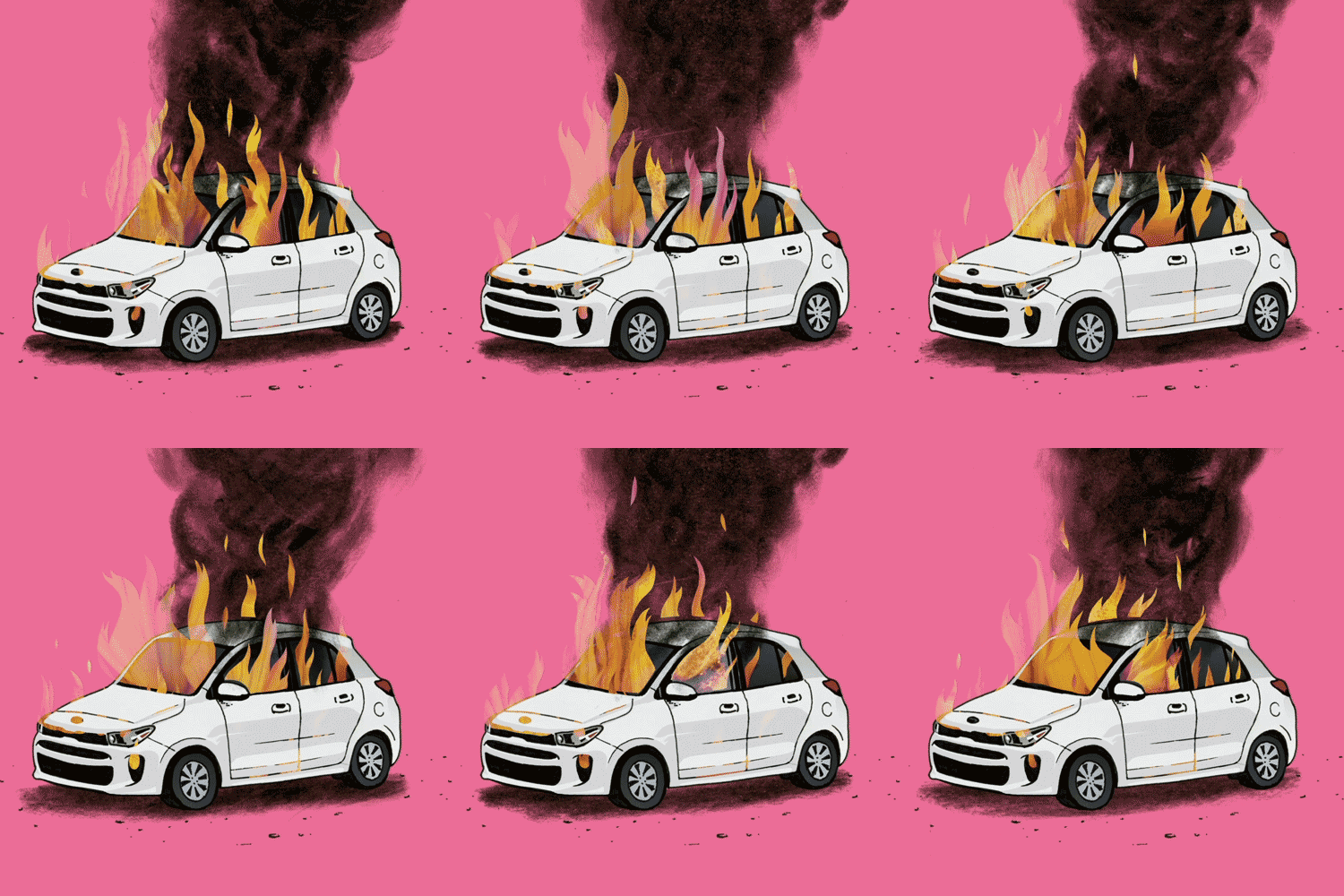
So we know that our homeowner's and business insurance policies likely cover damage from the on-going riots, but what about all those cars we've seen being bashed and burned?

Well, we reached out to FoIB (and P&C Guru) Bill M for the skinny on that:

First, this is a covered claim, assuming that you have comprehensive coverage (comp, as opposed to collision or liability), and of course subject to the deductible.

And I found this interesting: if you have rental reimbursement coverage on the vehicle, that comes into play, as well, so that you're not even further inconvenienced.

Bill also confirmed that a business auto policy would also cover this, as long as one had the aforementioned comp coverage.

If the damage appears to be minor, it may make sense to get an estimate before turning in a claim, especially oif it's under (or just over) your deductible.

Thanks, Bill!

Thursday, October 28, 2010

ObamaCare© vs Health Care (Costs, that is)

In our Medicare Shanda post yesterday, we explored how ObamaCare© really doesn't do much to actually rein in costs, focusing on how little transparency there is in allocating Medicare funding. But there's another facet we've previously explored, that of whether or not regulating insurance rates would actually help rein in the cost of health care.

As we suspected, not so much:

"Consumers, by and large, cannot be made better off with insurance rate suppression and other forms of insurance regulation according to a new report released today by the Pacific Research Institute."

[ed: The PRI is a California-based think-tank]

Now, this study focused on regulation of Property and Casualty insurance, but as regular readers know, P&C and health insurance are very similar, since they're both based on the principle of "indemnification." So it's not really a stretch to use the P&C lens to examine ObamaCare©'s draconian efforts to control health insurance costs (rates):

Regulatory efforts to suppress rates are likely to yield consequences that would increase costs and reduce consumer welfare.

Rate suppression is analogous to a tax imposed upon the market, which must be borne by someone; most likely not the insurers.

"(I)ncrease costs and reduce consumer welfare?" Check.

"(Tax) imposed upon the market?" Also check.

Pretty much spot-on, I'd say.

Wednesday, September 19, 2012

B&B Insurance News

While the subject is a bit outside our wheelhouse (my new favorite expression), we're big fans of the Bed & Breakfast phenomenon. As regular readers know, we're not P&C agents, so we often turn to our on-call P&C guru, Bill M. As it turns out, we're not the only ones.

In this month's issue of National Underwriter:

[click picture to embiggen]
Kudos, Bill!

Tuesday, March 24, 2020

From the P&C Files: More CV-19 News

I think we've had more P&C-related posts the past week or so than the past year combined. But it is Insureblog, so...

■ From one of our carriers (and, I'm sure, we'll see others following suit):
"Billing

Policyholders are understandably concerned about their ability to pay premiums as government mandated closures continue to increase. To help, we’re suspending all property casualty cancellations due to nonpayment from March 16 to April 30 – or later if required by an individual state.

While we hope that most policyholders can stick with their current payment arrangements, if you have a standard lines commercial, personal or life policyholder asking about alternative payment arrangements our billing associates are authorized to adjust the customer’s current bill and to waive any late fees for any premium payments due between March 16 and April 30. This is not a waiver of payments during the suspension period, but an extension or grace period for those directly impacted by this pandemic. Please have them contact our billing departments"

■ We've discussed Special Event coverage before:

"World Furniture Mall "promised that if the Bears shut out the Packers in the season opener at Lambeau Field in Green Bay, Labor Day weekend shoppers would get their furniture free."

And of course there's so-called 'Hole-in-one' cover and the like, as well.

Typically, these cover unforeseen issues like weather or the like, but what about the current situation? Well, our friends at the Ohio Insurance Agents association offer this heads' up:

"Read the policy language. Every policy is different. Prepare yourself by reading the policy language and specific exclusions on the Special Event Policies that you have issued. In addition, contact your underwriters for clarification on the exclusions to ensure you have a thorough understanding and will be able to communicate it back to your clients."

Always good advice.

Monday, August 25, 2014

Two Timely P&C Notes

■ Now that things seem to have down a bit in Ferguson, it's worth noting that the clean-up from all the looting and rioting will take some time, but that it's unlikely any of the damage will be covered by business owners' insurance policies.

According to P&C Guru Teresa S, "riots are not covered, therefore anything resulting from a riot is not covered.  It usually goes back to the government.  Looting, I would say is not covered due to it being part of the rioting."

So of course, you and I will become the insurers.

■ Now that school's starting back up, lots of student athletes will also be warming up on and off the field. Some of them, though, will become injured, perhaps bad enough to effectively end their college sports career - and scholarships.

Never fear, though,  California-based EPIC Insurance Brokers is now marketing their Education Protector plan:

"[T]he first of its kind policy that provides funds for tuition reimbursement in the event a student athlete is injured between receiving a verbal offer for an athletic scholarship or grant and signing a Letter of Intent, which binds the athletic scholarship or grant."

Apparently, they've done their homework [ed: heh] and determined that over 126,000 student athletes are expected to receive some $2 billion in scholarship money. That's a lot of cash at risk.

Cool idea.

Thursday, January 20, 2011

Silly Interweb Insurance Info

So I log off email, and see this link on the home page: "Seven Insurance Policies That Aren't Worth the Money." Intrigued, I click over, curious to see what profound wisdom is to be had.

Turns out, not much.

Here are the 7 policy types, a brief description of each, the author's take, and my own:

1. "Mini-Med" Insurance

The agent quoted here is not a fan of these policies, claiming that "(b)uyers should know that these policies are best used for minor cuts and scrapes." While I know that there are some cases where this is true, I think this brief and arrogant dismissal misses the mark: for some people, this may be the only kind of coverage for which they qualify or that they can afford.

2. Accidental Death and Dismemberment

I agree with the article that these are - at best - a waste of money. I'd also add that the AD&D rider on life insurance policies has never made sense to me, either: dead is dead, regardless of cause. And how does it make sense that your wife needs more cash if you're hit by a bus than if you die of cancer?

3. Divorce Insurance

The article's agin it; I've never even heard of it. Of course, I hadn't heard of virginity insurance before, either. The idea is that a couple buys the policy and, if they get divorced after 4 years, they get some quick cash. Uh-hunh.

4. Comprehensive or Collision Coverage for Old Cars

I'm not a P&C guy, so I asked my friend Bill M for his take. Bill's a 30+ year industry veteran, a CIC and independent agent. Here's his take:

"I advise customers to consider dropping comp and collision when the value of the vehicle hits $ 3,000 or less. At that point a minor fender bender can total your car. You also need to look at the premium charged versus the potential benefit in that decision."

5. Car Rental Insurance

Again, we turn to P&C guru Bill M:

"As far as the car rental insurance goes, you need to check your rental contract to see if you are responsible for loss of use or diminished value, two items not normally cover by your own auto insurance.

If you are going out of the country you need to check that your coverage extends to where you are going.

All of these items should be discussed with your insurance agent about your specific policy."

6. Term Life Insurance

Is term insurance really a "big waste of money" as the article claims? No more than auto, home or health insurance are: none of those pay off if you don't have a claim, either. I agree that it's often not the best choice ("permanent needs require permanent solutions" as my own mentor used to say), but if you think it's really just money down the rat-hole, consider a Return of Premium plan.

7. Mortgage Insurance

First, there is no such thing as "mortgage insurance." That's simply a marketing wrapper for folks who don't want to buy "life insurance." Second, there's no industry-standard definition of what one means by the term. The article uses it to describe a term plan that's payable to the lender. But you can make any insurance policy payable to pretty much anyone you want to. Back in the day, "mortgage insurance" was a euphemism for "decreasing term life;" that is, the face amount ostensibly declined along with one's mortgage. The premium stayed the same, though, meaning the coverage got more and more expensive with each passing year.

As they say, YMMV.

Monday, November 24, 2008

From the Mailbag: We'll Have a Gay Ol' Time!

[Welcome Industry Radar readers!]
We get some interesting, often provocative email here at IB. For example, we're constantly bombarded with offers to host advertising links for various products and services (which we always decline). We also get a lot of "insider info" from various politicos and lobbying organizations, some of which make good blog-fodder.
Today's mail, however, brought something completely different:
"Market to the Gay Friendly Insurance Agents Community-One of the fastest growing market today.
...They would also like to secure the services of all the professionals who are a part of the process in securing and protecting their dream home...We don't request an exorbitant premium to be listed on our directory, nor do we demand a portion of your commissions, like some other gay sites do."
Frankly, I think this is a tremendous idea: while this isn't a new market, per se, it seems to me that it's most likely an underserved one. The email seems to imply that they're really looking for P&C agents as opposed to life and health, although that would certainly be an interesting niche, as well.
As noted above, we'll decline this offer (because we do no paid advertising here), but if there are any P&C agents who'd like to know more about it, just drop me a line and I'll send you the site's info.

Friday, September 23, 2011

UARS Update: Are you covered?

As we watch (not without trepidation) the descent of the UARS satellite, it's becoming increasingly likely that it will land in an American backyard or, worse, living room.

So, is that a covered exposure?

It's not an Act of War or G-d, but it's not your typical hail- or windstorm, either. So, as with most things P&C, I turned to FoIB (and P&C Guru), Bill M.

With the usual caveats (including "read your policy!") Bill's "reasonably certain they'd pay for that."

So now you know.

Thursday, July 06, 2017

Bad news: A P&C case study

Our friend Jeff M sent along the link to this sad story:

"Owners and renters in North Carolina say they were left in the dark after a beach condominium community suddenly shut down. The condos were condemned Friday, after an engineering report found that the property has dangerous structural issues."

It's not clear whether the owners will be allowed to retrieve their personal property.

Okay Henry, that is a sad story, but what's the insurance angle?

Well, Jeff asked if the owners' condo policies would cover this situation. As usual in these cases, I turned to our good friend (and P&C guru) Bill M. Now keep in mind that his answers are specific to Ohio, but that it's likely that they'd also apply in other states.

Basically, the owners are out of luck.

Now, why is that?

Well, Bill taught me a new phrase, and suggested I use it whenever I'm looking at these kinds of (potential) claims: "cause of loss." That is, which circumstances are specifically covered, and which are specifically excluded.

So here's the relevant exclusion:
(4) (a) wear and tear, marring, scratching or deterioration; (emphasis added)
So the "cause of loss" is specifically excluded. Which is a double whammy: the owner now has no place to live, but the bank still wants their mortgage paid off, and there's not going to be a check from the insurance company to pay off the old place, or pay for a new one.

But what about their personal property (clothes, appliances, furniture, etc)? Well, they're likely outta luck there,  too:
(1) Enforcement of any ordinance or law regulating the construction, repair or demolition of a building or other structure, unless specifically provided under this policy
The "cause of loss" here would be the government forbidding the owners to retrieve their belongings. So again, no insurance to pay for replacing them.

Yikes.

Sunday, January 20, 2008

Silly Candidate Tricks: P&C Version

A few months ago, we reported on Sen Edwards' empty threat to strip congressgritters of their elite medical coverage. Lest folks believe that we only ding the Democrats, we bring you the latest goofball idea from the Republican side:

"Rudy Giuliani is trying to edge out his fellow Republican presidential contenders by pledging to make homeowners insurance more affordable in high-risk areas - a key issue in this hurricane belt state."

On the one hand, it's comforting to know that our P&C brethren aren't immune from folks looking for gummint solutions to private sector challenges. But if such schemes are unworkable with regard to health insurance, why would this be a good idea for homeowners cover? After all, they share many characteristics.

Indeed, as we reported back in November, the Sunshine State already has a gummint-run insurance plan. And that one is in the hole by almost $400 billion (with a "b"). So what's Rudy's plan?

"(A) federal "backstop" fund to spread insurance risks associated with hurricanes and other disasters."

Essentially, he's proposing to make the Feds a sort of hyper-reinsurer. There's precedence for this, of course (cf: 9/11 victims fund), but is it a good idea? Yes, this may prove quite popular in Florida, where homeowner's insurance tends to run high, but why (other than for vote-pandering reasons) would someone propose making that a permanent fixture, with untold billions of future liabilities?

Oh, looks like I answered myself.

Wednesday, April 15, 2020

Winners from the P&C World

One of the side effects of the forced shut-down is that folks are driving less - a lot less. And this, in turn, has given auto insurers a good reason to refund at least some of our premiums (less driving = fewer accidents). As we've noted previously, some carriers have been pretty good about this:

"Allstate and American Family Insurance have begun discounting car insurance premiums since many drivers aren’t using their cars as much due to stay-at-home policies aimed at slowing the spread of the coronavirus."

But they're not the only ones and, in fact, some are even better about how they're handling this opportunity. FoIB (and P&C Guru) Bill M tips us to this list of the 10 Best such:

"In general, insurers that represent four out of five auto insurance policies sold in the United States have offered to refund some portion of driver premiums."

Nice!

Leading off in the #10 spot is MapFre, a carrier I've only recently heard of (our eldest is insured with, and speaks very highly of, them). I definitely recommend clicking through to see if your carrier is listed (and in what spot).

Friday, August 18, 2017

From the P&C Files: I have issues

As regular readers know, I tend to be a purist when it comes to insurance. So I've railed on medical necessity as regards health insurance; the whole point is risk management.

And specifically the concept of Frequency vs Severity.

For example, it's unlikely that any one person will contract cancer (frequency), but those who do face some pretty steep bills (severity).

Or, closer to home, what are the odds that a 9 month old puppy will need expensive (and multiple) knee surgery? Again, not often, but a true pain-in-the-checkbook.

One more thing: insurance is (or ought to be) more about covering the unexpected, which is why your auto policy doesn't pay for oil changes or new wiper blades.

On the other hand, birth control convenience items are generally bought fairly often, but at a very nominal cost, so: frequency, but not severity, so not really appropriate to insure.

But insurance has a cousin: warranties. Typically, one purchases these to cover things like dishwashers and refrigerators and the like. But again, these aren't insurance (notice they never use the words "risk" or "premium"). Nothing wrong with that, and I'm not aware of any company offering these plans that claim to be.

Wish I could say the same for the insurance industry.

Our longtime guru of all things P&C, Bill M, asked me the other day if I'd heard about the newest trend in his side of the biz: equipment breakdown and service line coverage.

The equipment breakdown rider "covers the perils of mechanical, electrical and pressure systems breakdown," such as A/C units, TV's, even kitchen appliances. And service line coverage is for coverage "provides protection against a leak, break, tear, rupture, collapse or arcing of a covered service line," such as water and sewer lines, even from ordinary wear and tear.

How in the wide world of sports are any of these insurable risks? Well, obviously, now they all are, which offends my sensibility as an insurance purist.

But now I want to add both of those to my own policy.

Go figure.

Interested for yourself? As always, ask your agent (or seek out a local, independent one).