Monday, August 29, 2016

Bad News for Obamacare in Ohio

Ohio’s individual health insurance market is failing. In less than 12 months we have seen HealthSpan, InHealth, United Health Care, and Aetna exit the Obamacare Marketplace. Another insurer local to Northwest Ohio, Paramount, is reducing its footprint for their HMO products. Now comes official word that Medical Mutual will be eliminating all PPO products and will no longer participate in 65% of the state.

For people living in 19 counties choice is no longer an option. Anthem will be the sole insurer they can purchase a plan from. In 28 counties there will only be two insurance carriers to choose from – Anthem and one other. These 47 counties make up more than half the state of Ohio. This is a far cry from 2016 when Ohio boasted of having at least four insurers in every county.

MMO’s PPO plan elimination is even more important for those it will still serve. Their largest number of insured members were enrolled in a PPO product. The PPO network was very robust and allowed members to utilize several hospital systems and specialists. That choice is gone. Going in to 2017 the remaining insurers all utilize narrow networks. For consumers in some counties this means that they cannot have services from the local community hospital that serves them. For others it means that they will have to find new cardiologists or oncologists. This will be especially problematic for outlying communities.

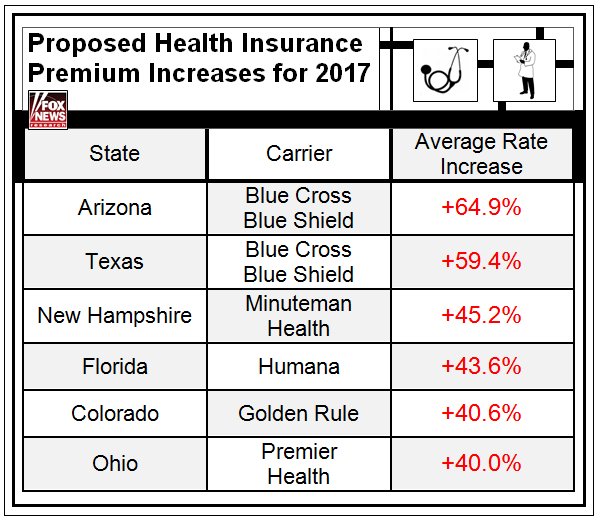
The bad news doesn’t stop there. In addition to less choice, rate increases are estimated to rise nearly 13%. As the only statewide insurer, Anthem is seeking a 9.9% average increase for their plans. Overall this is less than the average but it is relevant to point out that they already had some of the highest rates in the state. Other insurers such as Medicaid managed care providers Caresource and Premier are seeking increases of 13.5% and 39% respectively. Now they will be taking on the additional risk coming from insurers who are losing their shorts in the Obamacare marketplace.

Higher rates, less insurers, and fewer providers. Exactly the opposite of what Obamacare promised.

Friday, August 26, 2016

Breaking Tar Heel State BX News [Updated]

As if North Carolina Blue Cross hasn't put itself in enough hot water, FoIB Jeff M tips us that the carrier has decided it doesn't really need (want?) a lot of new business:

Effective for the 2017 plan year (Open Enrollment '16), NC BX is paying $0 commission on new business coming from other carriers, $0 commission on BX re-writes, and a whopping 1% for newly insured folks.


More on this as it develops.

Oh! David Williams has an excellent counterpoint to conventional wisdom on the current EpiPen kerfluffle.

Thursday, August 25, 2016

STOLI: Lagniappe

We first blogged on "Dead Peasant" life insurance over 10 years ago:

"Stranger Owned Life Insurance (SOLI) is part of the “premium financing” phenomenon."

The concept certainly had its drawbacks: for one thing, it created (or could potentially create) a "moral hazard," tempting impatient beneficiaries with no familial or other personal connection to the insured.

But it had its uses, too: it enabled businesses to recover financially from the loss of key (or other) personnel. And there was this:

"Florida Atlantic University ... pays the premiums on life insurance policies for select boosters, who then name the university as beneficiary. The booster eventually shuffles off this mortal coil, leaving behind an endowed chair"

So, win-win.

But eventually the tide changed, and STOLI plans were outlawed. Which would have been the end of it, except for a nagging question: if all these plans are forced to go away through no fault of those who bought them, who gets all those premium dollars? On the one hand, the carrier assumed the risk in good faith, and (presumably) paid out one or more claims over the years. On the other, the folks who bought them certainly believed that the plans would eventually pay out, and didn't cancel them along the way.

On the gripping hand, "[t]wo federal appellate courts have affirmed, on different grounds, the cancellation of large life insurance policies ... permitting the issuing insurers to retain the premium paid for the policies."

Which is good news for the carriers, which had the use of the money for years, and now get to keep it completely risk free.

One wonders if there are any tax consequences to this.

Contrary to popular myth: The EpiPen story

Over at The Grey lady, Aaron Carroll (professor of pediatrics at Indiana University School of Medicine) has a helpful explication of how the current EpiPen kerfluffle came about. He outlines the history of how the EpiPen came into being, and its subsequent history. He notes that, although the active ingrecdient is relatively inexpensive, it's also "inherently unstable. Research shows that it degrades pretty quickly over time, and it’s recommended that EpiPens be replaced every year."

Which makes sense, and I'm generally in favor of keeping med's up-to-date, and of market forces to keep the price of said med's within reach. But as we saw with the Daraprim controversy, sometimes bad actors cause market distortions, and heartache.

We'll come back to that.

But first, it's important to note that Prof Carroll goes to great pains to lay out the timeline, and regulatory issues, which have ultimately lead to a relatively inexpensive - but indispensable - treatment fast becoming out of reach for everyday folks. It's a tale of government recalcitrance and provider avarice, but mostly government recalcitrance:

"[I]n 2010, federal guidelines changed to recommend that two EpiPens be sold in a package instead of one ... In 2013, the government went further. It passed a law that gave funding preferences for asthma treatment grants to states that maintained an emergency supply of EpiPens. As the near sole supplier of the devices, Mylan stood to make even more money."

Which is fine, but then the good Professor concludes:

"EpiPens are a perfect example of a health care nightmare. They’re also just a typical example of the dysfunction of the American health care system."

No, sir, it is most decidedly not that.

And how does your humble correspondent know this?

Well, when one digs a bit deeper, which Prof Carroll apparently did not do, one finds this little gem:

"If lawmakers follow the usual script, Bresch could get called up to Capitol Hill next month to explain her company’s justification for raising the price on the life-saving allergy shot. But that could be awkward, since she’s the daughter of Democratic Senator Joe Manchin of West Virginia."

So what Prof Carroll characterizes as an indictment of the (admittedly dysfunctional) health care system is really just a very simple, sordid example of rent-seeking, enabled by the powerful relative of the manufacturer's CEO.

Case closed.

Wednesday, August 24, 2016

More "Interesting" UL News

A few months ago we blogged on a lawsuit against TransAmerica Life regarding the cost of insurance (COI) in their Universal Life products. At the time, we noted that this was most likely an uphill battle, seeing as how every single UL contract specifically says that they can charge the maximum COI as stated in the policy.

Now, perhaps inspired by the TA litigation, policyholders of other carriers are also suing their insurers, citing much the same legal reasoning. Obviously, I'm sympathetic to their plight, but I'm also in favor of the rule of law, and contractual law in this case specifically.

The problem is this little phrase:

"[O]n top of the contract’s guaranteed maximum rates, express or implied contractual limitations serve as a check on discretion, prohibiting the insurer from considering factors other than mortality experience."

That is, carriers are constrained from using poor investment results as justification for increasing internal insurance costs. And I tend to agree with this: certainly, carriers should look to their portfolio's performance when deciding how much interest to credit, but this has nothing to do with mortality costs (that is, how many of their insureds died the previous year). It seems to me that if interest rates were driving mortality rates, we've got much bigger problems going on here.

No jumping out of windows, please.

Blogging for The Pelican State

Longtime readers may recall the extraordinary outpouring of support for those hit by Katrina; we were glad to help raise much needed funds for those most deeply affected.

Flash forward 11 years, and folks in Louisiana are once again facing devastating losses. I reached out to my old Cavalcade of Risk roster to see if any of those fine folks could help with an updated version of that 2005 project.

Thankfully, 'Ironman' came through, and has set up a page with all kinds of ways to help out:

"We've also selected a handful of charitable organizations that are focused on providing disaster relief across Acadiana, which are tied to national organizations that have been ranked highly by Consumer Reports and the Christian Science Monitor for their effectiveness in putting donated funds into real relief efforts."

This is just an outstanding response, and I would urge IB readers to head on over - Thank you, Ironman!

Tuesday, August 23, 2016

Death, Accidentally

So, working on a new (to me) group client, and one of the things we're looking at is the group term life insurance. They're currently with a carrier that's not known for this product (they tend to more individually-tailored plans), and so I asked about the rates. The client gave me the number, and I asked if that included Accidental Death and Dismemberment (AD&D), as well. She told me "I wish but it does not."

Which is fine, and helps me keep things in order (and perspective) as I'm putting together the quote. But it reminded me of a philosophical conundrum I've occasionally pondered: what's the deal with AD&D [ed: channeling Seinfeld, are we?]?

I ask because here's the premise of that product:

"So you're telling me that my widow/widower needs twice as much money if I get hit by a bus and die instantly than if I get cancer and endure a long, expensive death?"

Again, I don't think there's anything inherently wrong, evil or fattening about this type of coverage; I just don't understand why folks would pay extra for it. Now, if there was a rider that paid double for getting cancer or having a stroke...

But that's another post.

Monday, August 22, 2016

Nothing new under the Sun

We've been writing about Balance Billing and "PARE" claims for almost 11 years (here for example). Briefly, the issue is that there is essentially a class of providers who, although they may ply their trade inside a network-approved facility, are nonetheless not contracted with a given (or any). network. Thus, even if you carefully choose an in-network facility and surgeon (for example), odds are your anesthesiologist and radiologist are not in-network, and can charge you pretty much whatever they wish.

It's not a new problem, but that doesn't stop some folks from lamenting that it's just the latest way for providers to ding patients:

"It’s getting harder and harder to keep medical costs within your insurance network—even during a single hospital stay."

And they've coined a new term for the practice: "drive-by doctoring." This of course makes zero sense: generally, such providers are well-established, with good reputations and solid credentials. They've just figured out a sweet deal: become the only pathologist in a given hospital, refuse to join any network, and bill away. Now, whether or not this is "right" or moral or "fair" is up for discussion, but that it's a new phenomenon isn't.

To be fair, Slate does point out that some states (Pennsylvania, for instance) have protections against such practices (and we discussed the current state of the law nationally here).

There's really not a lot one can do about this, other than to just be aware, and then try to negotiate a better price (which may be difficult, seeing as how the services have already been delivered).

Cause & Effect (or Bye-Bye Choice): George Hamilton edition

Back in Aught '11, Bob noted that the ACA's "tanning bed tax" was slated to bring in some $200 million per year. Even 5 years ago, the reality fell far short:

"The first 9 months of 2011 has generated only $54 million which means the expected revenue will be less than half what was expected."

But that was then, and this is now:

"Tanning industry blames 10,000 salon closings on ObamaCare"

Naturally, shuttering over half of these businesses is going to further reduce the numbers projected by O'care enthusiasts. And tan-seekers aren't the only folks losing choice:


[Map Courtesy of New York Times - click to embiggen]

 "In many parts of the country, Obamacare customers will be down to one insurer when they go to sign up for coverage next year on the public exchanges."

As FoIB Reed Abelson reports, almost one-in-five victims O'Care participants will have (at most) one carrier from which to "choose." Kind of like Model T color choices, no?

Adding insult to injury, a handful of entire states will likely be down to a single carrier. So much for competition and bending the cost curve down. And so much for "choice."

Friday, August 19, 2016

More on Flood Insurance

"It won't happen to me"

Yeah, about that:


Courtesy of the Insurance Information Institute

End of the Week Miscellany

In no particular order:

■ We last noted how The Centennial State's move towards a Single Payer option threatened to send that state's budget "off a financial cliff." Well it turns out that there's one group in particular dead set agin' it. FoIB Holly R alerts us that "liberal group ProgressNow Colorado held a news conference ... to announce its opposition to the measure."

As I've repeatedly said, I'm all in favor of 58 individual state laboratories trying out new models. Seems to me a great way to get a sense of which ones hold promise, and which ones don't.

■ Aetna's bailing on huge swaths of the individual major medical market has had a devastating affect on at least one small Arizona community:

"People in Pinal County are at risk of a health insurance problem that hasn't happened anywhere else in the country: no companies offering marketplace health insurance"

Turns out, Aetna was the only carrier left standing in that area. And an overwhelming majority of those with plans qualified for a subsidy. Unfortunately, there seems to be nowhere to spend it.

■ And this is an interesting, if odd, little story from Across the Pond:

"There's an app that lets you buy restaurants' leftovers ... saving the good food from going to waste"

Here's how it works:


Why mention it? Well, it would seem like this idea might be very attractive here in the US, but it's likely liability concerns (not to mention health department rules) would be insurmountable.

Too bad, really.

Thursday, August 18, 2016

1,000 Words on LTCi: Providers


Courtesy of LifeHeathPro, where folks 85 and up receive long-term care services:


Health Wonk Review: Short & Sweet edition

Our favorite healthcare economist, Jason Shafrin, hosts this week's eclectic collection of health care policy and polity.

Methinks Jason sells himself short, though: it's full of great content.

Wednesday, August 17, 2016

Speaking of Flood Insurance

Courtesy of Jeanne Salvatore:
 

And more on how Flood Insurance works here.

Tacklin' the Toughies [UPDATED]

My favorite cases are the "tough" ones. It's not that I deliberately seek out difficult-to-write clients, they just seem to gravitate to me. The thing I like most about these is the opportunity to learn something new.

For several years now, colleagues (and marketers) have been urging me to offer Critical Illness (CI) plans. The problem was, I really could just never get my head around how to quote them, nor really "get" why I should. It's not that I had any ethical issues with these plans, I just had a mental block regarding them.

I was recently referred to a couple looking for Long Term Care insurance. As a result of the pre-screen process we use, it was pretty clear that Doug wouldn't qualify, but Denise would. My gurus at the Long Term Care Agency recommended a Critical Illness plan for Doug, and as soon as I saw the quote they emailed, I could feel the lightbulb over my head begin to glow: I 'got' it!

Here's why: For many years, I've used a bucket metaphor to explain how Universal Life plans work. The LTC Agency folks use it to explain CI plans:


As soon as I saw this, it became crystal clear. The plan pays a monthly benefit for folks who end up with cancer, stroke, even Alzheimer's (which is important: remember, we're talking about Long Term Care insurance alternatives here). And the plan's Guaranteed Issue, so we don't have to worry about Doug passing underwriting Well this is disappointing: the gentleman who recommended this plan to me, and whose agency I've been using for quite a few years as my primary LTCi resource, just told me that "oh, yeah, it's a voluntary benefit, have to have at least (so many) employees. And it's guaranteed issue if he gets past the knockout questions."

Um, Randy? Then it's not Guaranteed Issue. And now I look like an idiot. Good bye.


There are other features, as well (for example, alert readers may be wondering about that $216,000 benefit pool), but my point is that I seem to have found at least one more way to help folks with health issues fund potential Long Term Care expenses.

And I'd call that a win.

[Special IB Thanks to Randy G]

Sharing & Caring: A Veteran's Perspective

Once again, reader Brian J brings helpful insights, this time about health care sharing ministries and the VA: 

All those caveats about the "healthcare sharing ministry" are eerily reminiscent of what it’s like to be a military veteran with non-service-connected non-emergency medical needs.

If you’re a military veteran – and enrolled in the VA healthcare system (which does meet the minimum essential coverage standard) – you’re disqualified from obtaining subsidized medical coverage through the Obamacare marketplace. (If you’re married, the marketplace will give your non-veteran spouse coverage with a subsidy, but you – being enrolled in the VA healthcare system – would have to pay the full [unsubsidized] amount for ACA health insurance coverage.)

Now, one might ask why is that a bad thing? If the veteran already is enrolled in VA coverage that provides care that meets the minimum essential standard for health care coverage, why would the veteran be concerned about obtaining health insurance outside of the VA?

The reason is that (1) VA health coverage is not considered to be “health insurance” and (2) because of the healthcare eligibility “Priority Group” that the VA assigns a veteran when that veteran enrolls.

Years ago, when the VA realized that budgets were tight, they began a system of rationing health care, so that the veterans who needed health care assistance the most – and the ones who had made the greatest military sacrifice – obtained priority in coverage (and were assigned to higher “priority groups”). I think that was an appropriate and reasonable decision.

Here’s a link to a pamphlet that is produced by the VA that describes those priority groups.

But, what that means is that those veterans who do not qualify to a higher priority group based on their (lesser) military sacrifice are assigned to lower priority groups and are enrolled (and obtain coverage) determined by the amount of money Congress gives the VA each year, which then determines the amount of co-pay the veteran has to pay, and affects the healthcare services and benefits made available to the veterans in those lower priority groups. (If you’re assigned to Priority Group #7, you’re near the bottom of the list.)


I think there's a disconnect between what the ACA considers to be minimum coverage in the VA healthcare system and what healthcare benefits a veteran enrolled in one of the lower Priority Groups might actually be entitled to and paying for. (Basically, if you have a non-service-connected non-life-threatening injury – say, you get the sniffles or stub your toe and go to your primary care physician down the street -- the VA is not likely to pay for that treatment.)

The VA warns (advises) veterans to keep their private health insurance – if they have it – due to the risks of being in one of the lower priority groups. See the section titled “Risks of Giving Up Your Private Insurance” in this VA pamphlet.

Many low-income military veterans with non-service-connected medical needs are dis-enrolling from the VA Healthcare System in order to be eligible for enrollment in the ACA (Obamacare) and obtain subsidized coverage for themselves and their spouses. (At least until they become Medicare-eligible -- then, they're re-enrolling into the VA Healthcare system.)

Thanks again, Brian!

Tuesday, August 16, 2016

Is Medical Mutual of Ohio Losing or Winning?

Medical Mutual of Ohio, one of the largest insurers in the state, announced that with the 2017 open enrollment they will discontinue to offer PPO plans both on and off exchange. This has significant ramifications to Ohio's Obamacare marketplace with the biggest impact being that eliminating these plans reduces the counties that Medical Mutual will participate in from all 88 down to 31.

This is not what Medical Mutual wants to do, but is necessary to continue selling individual plans.

Overall this decision will eliminate insurance to 25% of their membership and cause an unknown (guessing very large) percentage of their membership to have to switch from a PPO plan to an HMO or POS plan. The POS plans will only be available in the Cleveland market while all other regions will be migrated to HMO plans.

Beside losing plans, members will also lose access to providers and facilities. At the top of the list of facilities no longer available is Cleveland Clinic. Unless you fall in one of the nine counties surrounding Cleveland (POS plans) you are out of luck. What if you want the James Cancer Center at OSU? Not if you are outside of Columbus. How about Bowling Green, Ohio's Wood County hospital? Sorry, they aren't even in the HMO networks available. The list goes on and on and we haven't even mentioned the potential loss of primary doctors and specialists.

The decision came down to survival. For 2014 and 2015 Medical Mutual lost a combined $175 million. Even with reinsurance payments of $125 million it still leaves them $50 million in the hole. Obamacare supporters and insurers expected to see claims slow down and the market to stabilize. Neither of these things have happened. Add to the mix reinsurance is ending, and insurers like Medical Mutual see that it is impossible for them to continue the same strategy in the marketplace.

The new strategy is simple. Limiting network choice and limiting where to do business is bound to reduce the unhealthy risk while also eliminating providers who are unwilling to lower their reimbursement rates.

Instead of Medical Mutual rolling out 45% increases to members they will send them cancellation notices. Those in the 31 counties where HMO's will be offered will see renewals that map them to new plans. These renewals will vary based on rating regions. For those going from PPO to POS (Cleveland area) they will see increases in the low teens. Those already in HMO products will see increases in single digits. The winners will be those going from PPO to HMO where significant rate decreases will be given.

It's the financial winners that will be the focal point. Obamacare supporters will point to the rate reductions as a product of the law working. Never mind the fact that it is only "working" by limiting the providers of care that are essential to the health of those Obamacare was supposed to protect the most.


If you like your plan: RIP

With all the news today about Aetna bailing on most on-Exchange individual health insurance business, this news is falling under the radar:

"Important Changes to Medical Mutual’s 2017 Individual Products


While Medical Mutual is firmly committed to Ohio and the Individual ACA market both on and off exchange, it is necessary for us to make changes to our 2017 individual health insurance products."

The regional carrier goes on to announce that, effective with the 2017 plan year, they're completely abandoning 57 of Ohio's 88 counties (almost 2/3's) altogether, and "mapping most of those remaining from PPO plans to the stricter HMO model.

The good news (such as it is) is that grandmothered and grandfathered plans aren't subject to these changes.

Co-blogger Patrick wonders:
1. How many people do they have covered on the exchange and off the exchange?
2. How many people will lose coverage?
3. How many people will lose their PPO plan but be able to migrate over to an HMO option?
MedMutual is hosting another webinar later this month, perhaps we'll have those answers then.

But remember:


UPDATE: Pat has more details on this breaking story.

Monday, August 15, 2016

Is Sharing (Really) Caring?

I was recently invited to represent a so-called "health care sharing ministry." These plans (about which Bob has written, most recently here) are considered ACA-"exempted" plans, meaning that although they don't meet the stringent ACA coverage requirements, they are nonetheless deemed "kosher" [ed: Heh] for ObamaTax purposes.

These plans essentially rely on the kindness of others to help folks pay for care. What's different (and somewhat appealing) with this one, offered by Altrua Healthshare is that it seems more structured than the ones I've seen previously, and from an agent's point of view, more attractive:
• Broad Network
• EXEMPT from Affordable Care Act
• Purchase all year, not just during open enrollment
• Very affordable memberships
• Available in all 50 states
• Pays great commissions

That last is important, as carriers continue withholding commissions, especially for "off-season" enrollments.

There are several things I do like about this particular iteration: first, they are non-denominational, meaning that they are open to different "flavors" of Christianity. Of course, this leaves folks like yours truly out in the cold as far as actually joining, but it may be attractive to my Christian clients (which most are, of course).

I also like that they set things up to mirror ACA metallic tier plans: Gold, Silver, Bronze. And it seems affordable, with rates for even "Gold" level plans available in the low $200's (per month). This is at least partially due to the fact that it's medically underwritten:

"Some individuals may not be eligible or have a membership limitation due to certain past or present medical conditions."

Of course, I have some significant reservations, the most important of which is that this is not insurance (and to be fair, they make this perfectly clear up front):

"Altrua HealthShare members understand that Altrua HealthShare is NOT an insurance company and each member remains self-pay" [emphasis in original]

This presents a problem for me as an agent: if I recommend it, and the client blows past the $1 million lifetime maximum, or the plan fails to pay as set forth, then it seems to me that I've opened myself up to quite the E&O (Errors and Omissions) claim. It's rather like the argument about going "bare" in that I walk a very thin line between understanding a client's financial situation and recommending a potentially risky alternative.

A couple other thoughts from Bob:

First, the Idaho DOI shut down Altrua in the Gem State in 2011. It's not clear to me whether that's been resolved [ed: although the fact that it's touted as being available in "all 50 states" certainly implies that].

Second, he says "I like the concept, but hate the upside risk to client and and agent. I've suggested them in the past with caveats. A few have enrolled in a plan but none have really tested one yet."

And there's this:

"All low price insurance (and non-insurance) is great until you really need it."

Indeed.


[Hat Tip: Cornerstone]

Interesting UL "News"

I've long been a critic of first and second generation Universal Life plans. Which is not to say that they didn't have a role to play, just that I think they required more "hands-on" attention by insureds than they were really prepared (or encouraged) to take on.

One of the biggest challenges to older plans is that they often become "upside-down;" that is, the internal costs far exceed the premium and interest credited, and they quickly become very expensive. Compounding this are IRS rules that effectively quash any hope of recovery by limiting premiums to a level where the policy just can't sustain itself.

The problem is that, if one doesn't really "goose" the cash value the first few years, then by the time the problem (insufficient cash value) becomes clear, it's too late to correct.

Or so I thought.

Turns out that although carriers can't illustrate level premiums sufficient to carry the policy forward, there's a stipulation in the tax code that if a policy violates IRS guidelines, once the cash value has been drained you can pay the premium needed to cover the monthly cost of insurance deductions/expenses. You just can't build a significant amount of cash value.  So, you'd need to increase the premium each year as the cost of insurance deductions increase.

[ed: Link to relevant code is here, scroll down to 7702 f 6]

So, problem solved? Eh, to the extent that one can continue to pump cash into a quickly expiring insurance policy. The question then becomes whether that's really a good idea. Or it may be that this is the time to seriously consider selling the policy. Still, it's always nice to have options.

[Hat Tip: FoIB Sara S]

Friday, August 12, 2016

$plitting Dollars

It's hard to believe, but in over 11 years of blogging, we've never talked about the 'split dollar' life insurance funding technique:

"A split dollar plan allows an executive to obtain life insurance coverage using employer funds. The investment by your business in the plan is fully secured. If the insured employee dies or his or her employment is terminated, your business is reimbursed from the policy proceeds for its payment of premiums."

Now, why would an employer want to offer this? Well, it's a way to reward valuable employees (executives, key supervisors and the like) in a way that, unlike most benefits, doesn't require offering the same deal to everyone. Basically, the two parties (employer and employee) split the cost of coverage using whatever permanent type of coverage is appropriate (Universal or whole Life, for example).

It's an economical way to help a favored employee afford more long term coverage, and acts as "golden handcuffs" to entice him to stay. The concept itself has been used successfully for many years, and is generally well-accepted by the IRS.

But one can "up the ante" a bit by adding an "Inter-Generational" twist. These arrangements are generally family-directed. For example:

An elderly and permanently incapacitated mother acquired, on a lump-sum basis, life insurance on each of her three sons. The Tax Court was asked if this "would
be deemed a taxable gift to the extent that the premium payment exceeds the value of current life insurance protection."

That is, since the death benefit of the insurance policies would always be greater than the (one-time) premium paid, would that premium be taxable? The Court actually ended up ruling that it wouldn't.

Now, why is this interesting to those of us who don't have extremely wealthy (and desperately ill) parents? Because it reaffirms the basic value of the split dollar concept itself and, who knows, perhaps you'll one day be that wealthy orderly parent.

Not to mention that emphasizing the need for well-thought-out estate planning.

A Philosophical Conundrum:

A month ago, I blogged on a client whose premium was jumping from about $700 a month to $1,000. One of the options we discussed was "going bare;" that is, declining to buy any insurance. Now, he could have potentially then become subject to the ObamaTax, but even that is a small fraction of what that increase represents.

He ultimately chose to keep his existing coverage (since he'd already met his annual deductible and was anticipating some additional expenses), but our discussion really brought me up short.

It wasn't that long ago that I castigated the subject of a newspaper article for making the choice to roll the dice by deciding not to be insured.

So what changed?

Everything, really: under the UnAfforable Care Act, it seems to me that choosing not to buy insurance is a rational choice. Although I would never advise going this route (cf: E&O coverage) there are certainly circumstances in which I don't argue very forcefully on its behalf.

Let's take Max: his current plan comes with a (low, by today's standards) deductible, after which covered expenses are paid at 100%. If renewal wasn't an option, he would likely be looking at a $4,000 deductible plan with a monthly premium of $852. Which means paying out over $14,000 (on an annual basis) before the insurance paid penny one.

Well, that's not quite true, either: the first dollar benefits include an annual checkup, which is worth some small fraction of that $14 large. Oh, and birth control and maternity, as well. For a 64 year old guy.

He'd save about $700 in ObamaTax penalties, as well.

But you see where this is going, right? It's absolutely a reasonable, rational choice to take a pass on an ObamaPlan altogether. And I hate that I not only see this, but (reluctantly, to be sure) agree with it.

/sigh

Thursday, August 11, 2016

ObamaCare #Winning

It will come as no surprise to those who've been paying attention that the (Un)Affordable Care Act has been an unmitigated disaster. But it may surprise some to learn of the scope of said disaster:

"While clear evidence that the law was expanding coverage, the soaring enrollment numbers have created a fiscal nightmare for insurers which, in turn, has serious consequences for customers."

I might take issue with the assertion that more folks are insured since the train-wreck passed, but that's for another post. The key is the make-up of those newly-insured:

"A majority of new enrollees are considered high risk, meaning insurers will have to spend more money on people in poor health and requiring expensive  care."

This just makes sense, since when one is in dire need of health care it's human nature to seek out ways to help pay for that care. The problem is that there's no truly effective way to cushion that by enticing healthy folks to play along, except to keep moving inexorably toward a nationalized, government-run system (aka Single Payer).

Which works out so well.

MVNHS© Update

It's been a while since we've checked in with those fun-loving rascals running the Much Vaunted National Health Service©. Last time we checked, those silly pranksters were busy ignoring the desperate pleas of a woman left to die by her "caregivers."

But that was then, and this is now, and they've moved on to much more productive things.

Such as denying necessary (if not urgent) surgeries, including hip replacements and cataract procedures. It's not they're they're being intentionally negligent, it's just that - get this - they've run out of money.

Hunh.

If you're a government-run health care system and you go broke, that's a problem, no?

But no worry, it'll never happen here.


But it's not just "routine" procedures getting tanked, ER's are taking hits, too:

"Shortage in emergency doctors leading to A&E crisis ... We have reached a crisis point"

So say the folks in charge of United Lincolnshire Hospitals.

Oh, those rascally nationalized health "care" schemes.

[[Hat Tip: FoIB Holly R]

Wednesday, August 10, 2016

So Much Stupid: A Love Story

One of the most significant problems with ObamaCare is that, at its heart, it's not really 'insurance.' The definition of insurance is that it's a method for assessing, and then minimizing, the pain of risk. And yet, the Rocket Surgeons in DC© who designed it managed to remove all but one risk factor (tobacco use). Couple that with the fact that folks with subsidies aren't even paying their own premiums (a necessary pre-condition of "spreading the risk") and, well, you can begin to appreciate the scope of the problem.

But it gets worse: plans also include any number of so-called "first dollar" benefits: services and products that are paid for regardless of whether one has met the out-of-pocket limit (thus "free"). These include, for example, mammograms and birth control convenience items, pap smears and the like.

Notice, though, that there is not one single male-oriented bennie to be found. Zip, zero, nada.

And yet the Top Brains at The Commonwealth Fund have the audacity to claim that ObamaCare hasn't really been that great for women:

"[G]aps in women’s health coverage persist. Insurers often exclude health services that women are likely to need."

Right.

Here's my favorite:

"Six types of services are frequently excluded from insurance coverage: treatment of conditions resulting from noncovered services"

Are you kidding me?!

What part of "noncovered services" do you not understand. Of course noncovered services aren't ... covered.

And the rest of this drivel goes on in similar vein.

My friend and colleague David W offered this assessment:

"Start with the idea of "insurance" is to pay for everything. That's not insurance, that's an entitlement or a prepaid health plan[ed: as noted above]. Move on to what that costs, when insurance is already too expensive and going up, and when you move to specifics, note that 5 of the 6 "uncovered" procedures were covered by 80% of the plans, and 6th by 60% of plans. Finally, consider "choice" vs "control" and understand that, at its core, this is a pathetic attempt to force other people to pay for services that they want - they just don't want to pay for them."

Indeed.

About that end game

Shot:
Chaser:

Single-Payer Healthcare System Projected to Send Colorado Off a Financial Cliff 

[Hat Tip: FoIB Holly R]


Tuesday, August 09, 2016

And now for something completely different: Gaming edition


Our friends at Fat Dragon Games have partnered with Bundle of Holding to offer some incredible discounts on industry-leading FDG terrain sets! Part of your payment will be donated to Doctors Without Borders as well, so get some awesome terrain for your game at an amazingly low price, and help a wonderful charity, too!

Reverse Robin Hood: Obamacare's Transitional Reinsurance Program

Written in Obamacare, transitional reinsurance is a fee disguised as a levy on insurance companies that is passed through to all consumers. It is a temporary program that cost each covered person a set annual dollar amount. In 2014 every insured person was charged $63. This reduced to $44 in 2015 and is set for $27 in 2016.

All group plans - self funded and fully insured - as well as individual plans pay this fee. But, the only ones who benefit from the fee are insurers who have high claimants in Obamacare compliant individual plans.

The original design assumed consumers would pay $12 Billion in 2014, $8 Billion in 2015 and projects for $6 Billion in 2016. $10 Billion would pay off insurance companies who incurred loses and $2 Billion would go to the U.S. Treasury to reduce debt. In 2015 there would be $6 Billion to pay off insurers and another $2 Billion for the U.S. Treasury. For this year there would be $4 Billion to fund insurance company losses and $1 Billion to the Treasury.

The way that insurers would get money back was based on a formula for large claims. The government determined a base dollar amount and a cap they would pay for claims an insurance company incurred. There was also a coinsurance percentage associated with it. The original floor for claims was set at $60,000 ($75,000 in 2015 and $90,000 in 2016)
with a cap of $250,000. The coinsurance was set for 80% in 2014 and 50% in 2015.

Here's an example of how the program should have worked. Assume an insurer has a large claim of $210,000. They pay the first $60,000. The remaining $150,000 would be split with the insurer paying $30,000 (20%) and the government paying the insurer $120,000 of money you paid into the reinsurance program. Once all of the claims were paid out the remainder would go as a payment to the U.S. Treasury for debt reduction.

The outcome is much different. Like most government programs, this one over-promised and is under-delivering.

First, the actual collection numbers were $9.7 Billion in 2014 and $6.5 Billion in 2015 - more than 20% lower than projected. While this is an important development, it is what the Obama administration did next that really cheats you as a taxpayer.

Insurers only requested payments of $7.9 Billion for 2014. At a coinsurance rate of 80% the amount that HHS should have distributed was $6.3 Billion. This would have left $3.4 Billion and resulted in the U.S. Treasury receiving their $2 Billion contribution and allowed the program to carry over $1.4 Billion.

What happened? The Obama administration chose to "change" the law in final regulations. They lowered the floor (attachment point) to $45,000, down from $60,000. Then, instead of a coinsurance rate of 80% they upped the ante to 100%. Doing so gave insurers an additional $1.6 Billion in payments leaving $1.7 Billion which one would assume would be a payment to the Treasury. Except they didn't. They took the full $1.7 Billion and rolled it into the 2015 program leaving the U.S. Treasury with nothing.

Which brings us to now.

CMS recently released the 2015 payments and data. The first interesting point was the increase in payment requests. The requests totaled $14.3 Billion. Yet HHS estimates on reinsurance payments projected it would go down as the years go forward. They believed that the first year would be the worst and then the market would correct itself. Obviously that's not happening and it appears that it is getting worse. The collections total $6.5 Billion. Taking the current $6.5 billion and adding the $1.7 Billion that rolled over gives HHS a cool $8.1 Billion to play with for this year.

At a coinsurance rate 50% on $14.3 Billion in requests the CMS should be paying out $7.1 Billion and give the Treasury $1 Billion. But of course they didn't. Instead they upped the coinsurance rate to 55.1% and paid out $7.8 Billion. The remaining amount of roughly $500 Million is going to the Treasury.

The first two years is proof that there is no method to the Obama administration's madness. They simply do what they want regardless of their responsibility to follow the rules of a law they championed.

The Obama administration lied and stole from you the taxpayer. All for the benefit of the insurance companies - who were supposed to be the ones paying the tab.

(ED NOTE: Image above is a summary of Transitional Reinsurance Program before and after)


Monday, August 08, 2016

Aetna Does Self-Funding

Patrick's had a couple recent posts on "alternative arrangements" such as MEWAs and self-funded plans (here and here), and I thought I'd throw in my 2¢ on the matter.

[ed: click here for a more detailed explanation of self-funding under the ACA]

Recently, Aetna's been pushing its version pretty hard, with emails like this:

"Are your clients looking for more options? Think bigger with Aetna Funding Advantage ... Aetna Funding Advantage plans are self-funded, which means they aren’t subject to all of the same rules as an ACA plan. And, they could help save your clients as much as 24%*."

That little * is to alert one to the fact that YMMV.

Be that as it may, it's pretty interesting that carriers are finally developing these products for the small group market (although they're literally 10 years late to the game). One presumes that this is simply recognition that there really is a market for these products, as employers struggle to stay afloat while offering (and helping pay for) group health plans.

And speaking of which, they didn't just scale down a large group product, but apparently built one specifically for smaller companies. From their online toolkit:

"Aetna Funding Advantage [is] similar to the self-funded plans traditionally offered to larger companies, but designed with smaller clients in mind."

They even have a helpful video to help explain the benefits and process of self-funding for smaller groups.

Very cool.

Saturday, August 06, 2016

Empire State Skyrockets

Those 3000% rate decreases keep on comin':

"The Cuomo administration on Friday announced that health insurance rates on the individual market would increase by a weighted average of 16.6 percent ... Rates in the small group market will increase by a weighted average of 8.3 percent"

That individual plan hike, by the way, represents "the largest individual market hike since the [Un]Affordable Care Act began"

It's what happens when regulators try to impose caps on rates for years on end, until (eventually) the lid comes off.

It's simple physics, really.

Friday, August 05, 2016

ObamaCare #Fail?

The headline is inviting:

"ObamaCare Is Failing Exactly The Way Critics Said It Would"

And for those that are focused on the (long since broken) promises of "if you like your plan" and "3000% rate decreases" there's no small measure of satisfaction seeing "Aetna's decision to abandon its ObamaCare expansion plans" and "UnitedHealth Group's decision to leave most ObamaCare markets" and the like.

One of the great lies touted by ObamaCare supporters is that 20 million previously uninsured folks now have coverage. The lie of omission is that it fails to take into account all the folks that have lost (and who are about to lose) their coverage, and those who can't afford to use the coverage they now have.

But I would argue that these are all very tangible ObamaCare successess if one understands that the entire point of the exercise was to usher in Single Payer (ie Government-run) health care. You know, to be run by the same competent, friendly, prompt folks who run the DMV and IRS.

You're welcome.

[Hat Tip: Holly R]

Welcome to Walmart, ObamaCare-style

Via email from The Rocket Surgeons in DC©:

"Last year during Open Enrollment 2016, agents and brokers enrolled consumers in Marketplace plans at a variety of retail locations, including Walmart stores across the country. The opportunity to be in Walmart stores will be available again this year during Open Enrollment for 2017"

Can't wait.

From the agent's perspective, this may make some sense: Walmart provides the overhead (literally and figuratively) and the foot traffic. And since ObamaPlans are guaranteed issue, there's no field underwriting problem. From Walmart's point of view, it's space they already own, and having agents on-site may be a draw, bringing in folks looking for more than just a policy.

From the government's viewpoint it's also win-win: there's zero cost to HHS, and the potential for signing up additional victims insureds.

If you're a licensed agent who's completed the 2017 Marketplace training and would like more info just click here.

Oh, and please pick me up a pack of paper towels. Thanks!

Thursday, August 04, 2016

The Obamacare Cheese and Meat Plate

Obamacare promised us government cheese.

New customers would get huge subsidies for insurance from the government which would give insurers millions of new paying customers. Customers would be able to keep their plans and doctors and insurers would be protected from excessive losses. The best part of all, Obamacare won't add "one dime" to the federal deficit.


Obamacare delivered us unicorn meat. 

Customers are receiving huge subsidies but premiums are rising. Many "would be" customers are still have trouble affording insurance. They can't keep their plans and in many cases they aren't able to keep their doctors either. It's been a nightmare for insurers too. They haven't been able to avoid excessive losses, even with the beloved 3 R's trying to help. The worst part of all, not one dime turned in to billions increasing the deficit.

From the Mailbag: Rules for Thee, Not for Me

Reader Brian J offers some interesting insights into the double standard between those who toil in government and ourselves:

On a related topic about this failure of taxpayer-subsidized health insurance (i.e., Obamacare), I’m surprised that no one has brought up the fact that everyone in the U.S. who is employed by the federal government – from the President, Congress, Supreme Court, and all-related branches, all the way down to the local federal civil-service worker – has affordable taxpayer-subsidized health insurance;  everyone who is employed by State governments, County governments, local governments, defense contractors, anyone retired from any of those afore-mentioned levels of government/contractors, and every company (that offers health insurance) doing any type of work for any level of government, all have taxpayer-subsidized health insurance.  (Not to mention tens of millions of more people covered under Medicare, Medicaid, etc.)

With all these employers/entities – with their grand total of many scores of millions of covered employees – providing affordable taxpayer-subsidized health insurance, how is the individual person/small business owner to seek out -- in what’s left of our so-called “free market” -- affordable health insurance coverage on his/her own?


How, indeed?

Thanks, Brian!

Wednesday, August 03, 2016

ObamaTax #Fail (Part 2,693)

Context:


Counterpoints:

■ "Illinois Insurers to Increase Premiums as High as 45%"

The Prairie State's Blue Cross affiliate (by far the most popular - for certain values of "popular") is asking for rate increases from the low 20's to the mid-40's (no word on the windchill factor).

And Coventry Health Care is seeking a 21% rate hike.

■ "Health plans sold on Michigan's insurance exchange could see an average 17.3% increase next year"

Wolverine State denizens must use the 404Care.gov site to purchase on-exchange plans; folks who buy from carriers directly (and/or through agents) should also expect to dig deeper in '17.

■ "America’s Third-Largest Health Insurer Says It Is Losing $300 Million A Year On Obamacare"

Aetna, still in the thralls of the latest merger mania kerfluffle, is seriously considering curtailing its 2017 Exchange offerings. Instead of expanding them, the carrier's now looking at seriously reducing its participation nationwide.

#Winning!

[Hat Tip: Ace of Spades]

Tuesday, August 02, 2016

Costly Carrier Tricks

We've written before about the 'contestability clause ' in life insurance contracts. Briefly, these allow the insurer a (brief) window of time to "review a recently approved policy to see if there were any misstatements or misrepresentations, or if relevant information was omitted." Recently, the Principal National Life Insurance Company (PNL) was "caught out" on the invocation of this clause:

"A Connecticut federal judge has ruled that it was wrong for an insurer to refuse to pay out a $10 million life insurance policy on a Hartford lawyer who died of brain cancer."

Contestability clauses generally run for the first two years of a policy (carriers may choose a shorter run); in this case, the poor fellow expired only 15 months in, from a rare but aggressive cancer. When the beneficiary (in this case, a trust) submitted the claim, the carrier chose (as is its right) to invoke the clause. This offered them the opportunity to make sure that all the i's were properly dotted, and the t's properly crossed.

What they found, though, was a bit of an issue:

"Principal learned that Coassin had seen an ear, nose and throat specialist who treated his dizziness symptoms at a visit only nine days before they issued Coassin the life insurance policy. Principal did not know about this visit when they [it]."

So they denied the claim, and the legal fireworks took off.

Here's the rub: as FoIB (and carrier rep) Brian D points out, "even for The Principal a $10 million policy takes more than 9 days to underwrite. Therefore the appointment was probably conducted while the policy was in underwriting. There was no diagnosis that was troubling. What did he lie about on the app?"

Indeed. The decision really rested on the fact that none of the doc's Mr Coassin had seen had any inkling about the cancer [ed: as an aside, one wonders when the malpractice suits will be filed]. Since the doc's didn't know, they couldn't inform Mr C, and thus he didn't materially misrepresent (aka "lie") about his health, and so the judge ordered PNL to pony up.

Lagniappe: There's also a little-discussed practice called "statement of good health" that is often required when delivering a policy that's been in underwriting a long time. Basically, it's a form the insured signs upon delivery of the policy stating that there's been no change in health, nor any doctor's visits, during that time. The article doesn't speak to this, so one presumes it wasn't utilized here, but one wonders if things might have turned out differently for PNL if they had required one to be signed and returned.

Monday, August 01, 2016

Debt of Gratitude

I spent the past week out-of-town and effectively offline, and as usual, my co-bloggers stepped up in a big way to make sure there was new content all week long. In case you missed them, Patrick wrote about how he helped a 1st time small group client navigate the twists and turns of ObamaCare, and Mike alerted us to some major changes underway in the Feds' long term care insurance plan.

Bob had several wonderful posts, including two extremely Medicare-related ones (here and here).

I continue to be blessed with the very best co-bloggers, and am extremely grateful to them for holding down the fort.