Thursday, November 30, 2006

Health Wonk Review is up

Absolutely terrific HWR this week, courtesy of Mike Cannon at the Cato Institute's blog. He presents some 16 interesting entries, all with helpful (and often humorous) context.
Bryan Caplan, who hosts the EconLog, has a quick and effective takedown of Ezra Klein's assertion that HSA's won't do much to bring down the cost of health care. Who knew economics could be fun?

One Doc "Gets It"

My TMBN colleague, Dr Rob Lamberts, has an interesting post on his practice’s answer to “doc in the box” clinics. Instead of decrying the drain it might represent on traditional practices, he welcomes such services as a call for physicians to “think outside the box.”
In fact, Dr Rob writes, “patients are sick of how doctors run their offices.” And so his office has found ways to streamline the delivery of health care. Left unsaid, but certainly implicit in this model, is whether this results in cost savings to either (or both) the doc’s or their patients.
Worth reading in full.

Tuesday, November 28, 2006

Big Brother, or Good Risk Management?

Although we tend to focus on the life and health side of the insurance business, we are InsureBlog, so we sometimes stray into P & C (that's Property and Casualty) territory, as well.
Did you know that more teens are killed in auto accidents than by any other cause? Neither did I, but as the father of two teenage daughters, this story got me thinking about it:
There are a number of such devices on the market now, and as more become available, and as their use spreads, prices should come down somewhat. I spoke with some of my P&C colleagues about these widgets, to see if any carriers were offering discounts to folks who had them installed. Apparently, though, this tech is still under the radar.
I'm ambivalent about the idea: on the one hand, I do worry about my kids. On the other, I trust them, as well.
Any thoughts from IB readers?

Grand Rounds...

Dr R W presents an outstanding edition of 'Rounds, boasting 31 entries. Each one has a helpful summary. Bravo, Doc!
The Grunt Doc has a (short) story that illustrates what we don't mean by Consumer Driven Health Care.

Monday, November 27, 2006

Medical Tourism: A New Twist

I must confess to being a bit apprehensive about this post. We've touched on IVF in the past, as it relates (or not) to risk. And we've discussed medical tourism, as well.
Remember the old Reese's Cup commercials? "You got chocolate in my peanut butter! "No, you got peanut butter in my chocolate!"
That's right, English lasses are trading in their scones for "a Danish." (Or maybe, a Dane). Turns out, the Brits have all but outlawed anonymous sperm donations, which has caused their supply to, um, dry up. Stoking the flames is the fact that a sample of less than half a milliliter (less than a teaspoon) can fetch as much as $32.
Different strokes, I guess.

Carnival Time!

Overachiever My Financial Journey hosts this week's Carnival of Personal Finance. With almost 50 entries, he still managed to get it out a day early (nothing wrong with that!), and with helpful context, to boot. Kudos!
Kristine at Beacon Financial Tips has some, well, tips about how to stay in-budget this holiday season.
This week's Carnival of the Capitalists can be found at Bargaineering. Over 30 posts, many with context (but alas, not all).
One Man Band blog's cehwiedel (not a typo) sounds an early warning bell about a new California universal health-insurance initiative.

Sunday, November 26, 2006

Insurance Dispatch

Would you spend 2% of your income to protect 70% of it? In this week's column, we look at a recent survey that holds some surprising answers.

Check it out at The Medical Blog Network.

Saturday, November 25, 2006

Is Fair, Fair?

According to a recent study in the Health Affairs Journal, almost two thirds of those surveyed believe that smokers should have to pay more for health insurance; about a third felt that obese folks should, as well.

We talk a lot about personal responsibility here at IB, but have so far shied away from this particular controversy (mostly because it’s been somewhat under the radar). But we have discussed the importance of “risk” many times, and this would seem to fall squarely in that milieu.

Longtime readers may recall the IVF kerfluffle some time back: we sometimes forget that behavior choices have consequences. Certainly smoking falls under that heading: I’m aware of no medically-approved treatment plan that mandates one to “light up” (medical marijuana use notwithstanding). Smoking has been linked to any number of health risks, and of course smokers are subject to an increasing number of restrictions on their behavior.

Weight is another such issue: obesity can increase one’s chances for heart attacks, diabetes, and other dread diseases. Overweight folks might argue that they are subject to metabolic challenges that affect their condition, and there is probably some justification for that. Nevertheless, their condition does affect their health; underwriters are less interested in the why than in the fact.

In the life insurance and individual medical markets, smoking status and weight have long been used in assessing one’s rates. In the group market, though, these issues receive considerably less play. Generally, group plan underwriters look at the results of the behavior (cancer, diabetes, stroke, etc) when determining final rates for a group. I haven’t (yet) seen a group screening questionnaire that asks about smoking status of employees; likewise, there’s been no evidence that the behavior itself plays any part in the underwriters’ decisions.

But, if there’s enough of a demand, the industry will most likely respond. At some point, some carrier will announce a special discount for smoke-free groups, or some other program along those lines. It will be interesting to see when (not if) that happens.

Thursday, November 23, 2006

How to Insure a Great Thanksgiving

According to the South Carolina Insurance Department, there are over 4,000 fires every year on Thanksgiving. They cause 15 deaths and dozens of injuries, not to mention over $25 million in property damage. And that's not just the folks who fry their birds.

Speaking of fryers (the cooking technique, not the variety), the U.S. Consumer Product Safety Commission reports that over a seven year period (ending last year), there were over 100 "incidents" related to turkey frying, mostly by folks who lit up their birds (metaphorically, we hope) and then just wandered away for a bit.

Never having been bitten by the frying bug, I think our family's (relatively) safe. One tip: if you've never brined your bird, this year's a great time to start. There's no better way to insure a moist and tender tom.

And speaking of turkeys, our friends in Massachusettes may well cry "fowl!" According to a Bay State bond filing, it appears that the state's new MassHealth plan will end up costing its taxpayers twice what had been anticipated. Talk about 3rd degree burns!

Have a great, and safe, Thanksgiving.

BONUS: A blast from the past. Enjoy!

Wednesday, November 22, 2006

The Cavalcade of Risk #13...

Just in time for Thanksgiving, Dr Alex Kavokin has a terrific roundup of posts from around the blogosphere. Each entry has a summary, and most have interesting commentary, as well.

I was intrigued by Car Geeks' report on the dangers of electric cars. While they may get terrific mileage, they've got some major safety problems, too.

Tuesday, November 21, 2006

Younger and Younger…

When we talk about Long Term Care insurance (LTCi), we most often think about “seasoned citizens:” retired folks who’ve put in their time, parents and grandparents, Bob Dole and Andy Rooney. And certainly that’s the most obvious demographic when considering the type of condition that would necessitate a nursing home (or home home) stay.
Remember Superman?
Well, Christopher Reeves, really; a young man, in his prime, thrown by a horse and confined to a wheelchair. He was the “poster child” for a number of causes, but it seems to me that the most appropriate of these might have been LTCi.
And your point, Professor?
Well, in reviewing their claims data from 1989 through this year, UnumProvident (one of the bigger LTCi carriers) found that almost 60% of their long term claims were from folks under age 65. And some of the causes surprised me (although they really shouldn’t have): obesity and diabetes (related, to be sure, but not the same), cancer and strokes, of course, car accidents and even dementia. In fact, the average age of these “preemies” is 53, hardly an old fogey. One in seven is 45. Who knew?
Something else to consider when you’re working on your financial plans.

Grand Rounds...

Dr Anonymous hosts this week's compendium of the best of the "medblogosphere." He's compiled some 45 entries, including 27 of his "best of the best."

And speaking of Thanksgiving [ed: hunh?!], Dr Paul Auerbach has some handy tips for avoiding shark attacks.

Monday, November 20, 2006

Monday Money...

Very cool Carnival of the Capitalists this week. Host Brian Gongol has done an outstanding job, herding almost 60 posts into an easily sorted spreadsheet format, complete with comments and even ratings. Very cool!
Joe Kristan, at Roth & Co, has a unique tribute to the late Milton Friedman. Recommended.
Over at the Carnival of Personal Finance, you'll find a familiar (if unexpected) site: a used car salesman. Oops, sorry! A pre-owned automobile broker. Either way, an interesting metaphor for the topic. With over 60 entries, this is one huge lot!
Since we recently blogged on FSA's, you might also want to check out Jenna's advice on them over at Money Bucks Cafe.

Sunday, November 19, 2006

Insurance Dispatch

In this week's column, we learn about using annual bonuses as a powerful new way to fund Health Savings Accounts.

Check it out at The Medical Blog Network.

Friday, November 17, 2006

Cavalcade #13 - Submissions Due

Just a reminder that submissions for next week's C of R are due Monday (the 20th). Alex at RDoctor would love to see your work.
You can submit entries:
■ via email or
PLEASE include:
► Your blog's url
► Your post's url
► The trackback url (if applicable)
► A (brief) summary
PS: We're still looking for hosts. If you'd like to host a future edition, just drop us an email.

Thursday, November 16, 2006

The Best Laid Plans of Mice and Men...

An electronic health records management system being rolled out by Kaiser Foundation Health Plan/Hospitals has been nothing short of an IT project gone awry, according to sources at the company and an internal report detailing problems with the HealthConnect system.

Questions about the project arose last week at about the same time Cliff Dodd, the company's CIO, resigned. Dodd stepped down last Monday after another Kaiser employee, Justen Deal, sent a memo to every company worker
(n.b. all 180,000 of them!) warning of technological and financial repercussions related to the rollout of the nearly $4 billion system.

Kaiser is reportedly spending $76,920 per physician on the project. The full ComputerWorld article is here. There's another good article in eWeek.

For those not in the electronics industry, the 99.5% uptime mentioned in the eWeek article may sound good, but a system like this should have enough software scaling ability and redundant computer horsepower to be running at 99.99+%. The power failures that the CEO cites should never affect system availability.

CDHC: Smaller Increases?


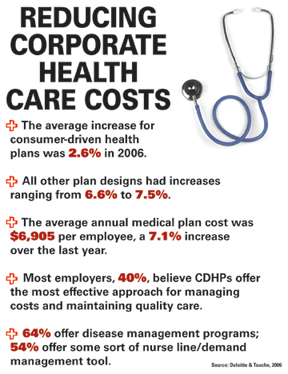
Deloitte Consulting recently surveyed about 150 large employer groups, and found that Consumer Driven plans (CDHP) experienced lower rate increases than their "generic" cousins. Now, this was on "large" groups, which probably included quite a few self-funded plans; I'm not comfortable (yet) extrapolating from this survey to small groups. Still, it shows a definite trend, which is good news.
Among the other findings in this survey:
■ the rising cost of health care benefits was a primary factor driving respondents' health care strategy
■ extensive plan designs, increased utilization and cat claims were cited as having major impact on medical plan costs
■ most employers believe that CDHP offers the most effective approach for managing costs and maintaining quality care
One of the challenges cited by folks who are wary of CDHC is the perception that it's all about shifting cost onto employees. Obviously, there is some truth to this: higher deductibles (even with lower total out of pocket exposure) means that folks need to become more involved in their health care decision-making. On the other hand, encouraging employees to become better health care consumers, along with wellness programs and disease management programs, were cited by 38% of the respondents as important, which would seem to mitigate this. That's almost double the percentage of just 3 years ago, when only 21 percent of respondents gave that answer.
Now that's progress.

Health Wonk Review at HBB

David Williams hosts another great HWR, this time with 18 interesting entries. I know I sound like a broken record [ed: or a scratched CD], but I really like the informative context David has for each one.
I was unaware that of this Kaiser brouhaha, in which an employee blew the whistle on some EMR problems. HIStalk has an interview with the whistleblower (and if you're in the mood for some interesting geekspeak, check out the comments, too).

Wednesday, November 15, 2006

Life Insurance, for FREE?!

Stupid Carrier Tricks ™ are a virtual staple here at IB, so when a carrier actually does something right, it’s only fair to recognize that, as well:
Apparently, MM introduced LifeBridge about 4 years ago, in an effort to help “the working poor” with life insurance protection. Eligible families can opt to insure either Mom or Dad (but not both), with $50,000 of term life insurance, at no cost.
I like the fact that, to qualify, both parents must be permanent, legal residents of the US. They must also be working, and bringing home between $10k to $40k a year.
Another unique aspect of the plan is that it doesn’t pay a benefit to the kids (or surviving spouse); rather it’s a scholarship (of sorts) that’s paid directly to the childrens’ school.
Oh, and it’s not just Florida, either:
Kudos to MassMutual!

Tuesday, November 14, 2006

Grand Rounds is up...

It's a Python 'Rounds this week, hosted by Topher at the Rumors Were True blog. Although he received over 60 submissions (WoW!), he selected only 26 for publication. In an interesting twist, he plugged in my recent Insurance Dispatch column, instead of the one I'd submitted, but I can't get mad about that.
Achoo! Ever wondered about the "correct" etiquette for sneezing? Shinga, posting at Breath Spa for Kids, has the answer.