Monday, June 17, 2019

When is a QSEHRA *not* a QSEHRA?

Regular readers may recall our post last year on the debacle that was Qualified Small Employer Health Reimbursement Arrangements (QSEHRAs):

"Their reaction, once learning about the caveats and limitations, has been a resounding /crickets ... the devil truly is in the details."

In other words: a dud.

But that was then, and this is now:

"The Health and Human Services, Labor and Treasury Departments joined forces on a new initiative intended to provide affordable health careOpens a New Window.  coverage ... The legislation will expand the use health reimbursement arrangements (HRAs), allowing employees use pre-tax health arrangements to buy insurance."

First impressions:


This sounds great on paper (maybe), but what differentiates this new effort from last year's failed version?

I reached out to our gurus of all thing FSA/HRA/HSA for their initial take, asking if this was just a QSEHRA re-hash. They graciously responded that it is not last year's iteration, but a new alphabet soup, almost 500 pages long, with a lot of details. They also pointed out that the original QSEHRA was a flop because of all of the rules, and that this version may be as well.

 
I would add something else that seems to have slipped under the radar in both instances:

Group plans have participation requirements; that is, a minimum percentage of employees must be on the group plan or it will go away (I've had this happen, and it's not pretty). To be fair, it's not usually enforced that rigidly, but I suspect that would change if carriers saw their groups suddenly shedding participants willy-nilly.

Now, as one who would ultimately like to see health insurance de-coupled from employment, this is not unappealing. But as a realist, I think this is playing a little too close to the edge of the envelope.

And there's this: pretty much all group plans are built on the PPO model (coverage in- and out-of-network). But all of the individual plans I've seen the past two cycles (and I have no reason to think this won't continue to be the case) are HMO's, meaning that there is essentially zero OON coverage.

What's that worth?

Oh, and one more thing: if your employer offers a group plan, then you likely won't qualify for a subsidy on that individual major med. And since ACA plans include pretty much all the things that make group coverage so expensive (guaranteed issue, pre-ex and maternity cover, for example) plus often (usually?) have much higher out-of-pocket limits, not seeing the savings.

Time will tell.


Friday, June 14, 2019

From the P&C Files: ProActive CyberCover

A few weeks ago, we blogged on active shooter insurance cover:

"Beyond the obvious (wrongful death and medical and funeral expenses), there's counseling, biohazard cleanup, and destruction of property; in some cases, relocation and rebuilding expenses might also come into play."

And of course the list went on.

An active shooter in the workplace is obviously a deadly physical threat, but there are other attacks that can wreak significant damage (and also threaten lives). I recently received an email from an outfit called JGS Insurance, which offers what looks to be pretty comprehensive cybercrime coverage.

Um, what the heck is "cybercrime," Henry?

Well, Techopedia defines it as:

"[A] crime in which a computer is the object of the crime (hacking, phishing, spamming) or is used as a tool to commit an offense (child pornography, hate crimes). Cybercriminals may use computer technology to access personal information, business trade secrets or use the internet for exploitative or malicious purposes."

This is a fairly broad brush, but seems to pretty much sum up the phenomenon.

So, back to that "cyber warfare" coverage.

The JGS program identifies two specific parties:

First Party coverage includes response and other immediate costs, including legal and regulatory, as well as unauthorized funds transfer, plus system damage and even business interruption.

Third Party coverage would be for risks like network security and privacy liability (think of all the various database breeches we hear about, with personal and credit card info being stolen), media liability and even technology errors and omissions.

Yikes.

Something I really appreciated was this checklist of why businesses ought to be considering this type of plan:
• Cyber crime is the fastest growing crime in the world, but most attacks are not covered by standard property or crime insurance policies.
• Systems are critical to operating your day to day business but their downtime is not covered by standard business interruption insurance.
• Data is one of your most important assets yet it is not covered by standard property insurance policies.
And quite a few others, including penalties for loss or theft of data and the compliance costs of notifying those affected.

Scary, but interesting, and worth considering.

Oh!

They also point out that it's "it's not just big businesses being targeted by hackers, but lots of small ones, too."

Indeed.

Thursday, June 13, 2019

Gibson vs Oberlin: Update (Breaking)

Yesterday, we wrote about the unfortunate case of the college versus the bakery:

"A jury has awarded Gibson’s Bakery and its owners $11 million in compensatory damages against Oberlin College, for libel, intentional interference with business, and intentional infliction of emotional distress."

We noted that the trial to determine whether (and for how much) punitive damages had started, and that these could amount to a tripling of the original amount.

We noted at the time that it's unlikely that these would be covered, should it come about.

Well, we're about to find out:

"Oberlin College hit with maximum PUNITIVE DAMAGES (capped at $22 million by law) in Gibson’s Bakery case"

That's gonna leave a mark.

Click the link for details.

La Plus Ca Change

Saw this on Twitter:
Hunh:

"What if, instead of focusing on "consumer driven" or "people powered" health care, we turned our efforts instead to "Open Source Health Care?"

[ed: note the date]
 
What if, indeed?

Wednesday, June 12, 2019

Oberlin Gets Schooled

As you may have seen, Oberlin College (a private liberal arts school in northeast Ohio) was recently successfully sued for trying very hard to put a local bakery out of business:

"A jury has awarded Gibson’s Bakery and its owners $11 million in compensatory damages against Oberlin College, for libel, intentional interference with business, and intentional infliction of emotional distress."

So how did this come about? Well, a couple years ago some yutes ... er ... underage Oberlin students tried to buy adult beverages, and when they failed to produce proper ID, decided to just help themselves. Even though they were arrested and eventually pled guilty, the college bureauweenies decided that this was obviously racially motivated by the shop's owners, and proceeded to act accordingly:

By passing out fliers accusing the business of racism, and urging customers to take their business elsewhere (the flyers helpfully included suggestions as to alternate merchants, aka competitors). In fact, at least one administrator was actively handing out these flyers.

The store sued the college, and has won a judgment of $11 million; yesterday saw the start of a hearing for an additional 22 million in punitive damages.

Okay, that's very interesting, Henry, but what the heck does it have to do with insurance?

I'm so glad you asked.

Turns out, at least one of the school's insurance carriers is likely to deny coverage:

"[I]t appears that the insurer, Lexington Insurance Company, is likely to disclaim coverage for the intentional torts which gave rise to the verdict."

Lexington had issued a commercial liability umbrella policy, which (as is typical of these plans), "does not provide coverage for “bodily injury” or “property damage” intentionally caused by defendants."

Think of it like this:

As we've pointed put before, one's homeowner’s policy is unlikely to cover the shooting of someone, even if that shooting was entirely lawful. It's that whole "intentional act" issue. And, as our guru of P&C Bill M points out, it doesn’t get more "intentional" than having your vice president and dean of students deliberately undermining a local establishment while calling its owners racist.

Bill also pointed out that coverage for the (expected) punitive damages may be in doubt, as well, since these are generally excluded.

R'unh r'oh.

Bill and I were also curious about the underlying coverage, which was not through Lexington, but by the "College Risk Retention Group, Inc. (“CRRG”) and an Educator’s Liability policy issued by United Educators (“UE”)."

Turns out, CRRG is "a privately held company in Burlington, VT and is a Single Location business."

How enlightening.

And what about UE?

Well, they provide "liability insurance and risk management services to more than 1,600 members representing schools, colleges, and universities throughout the United States."

No word yet on whether that includes intentionally sabotaging a local business.

Tuesday, June 11, 2019

It's Deja Vu All Over Again

Shot:
Chaser (from 2012):

"Many of those who refuse, or are unable, to prove they are citizens will receive free insurance paid for by those who are forced to buy insurance because they are citizens."


Heh.

Monday, June 10, 2019

Skin in the Game?

So, saw this the other day:
I've had a few cases over the years where there was either current or a history of skin cancers (usually benign), but wanted to confirm this claim.

So I reached out to the ever-helpful folks at Issue Insurance (our local experts on difficult cases), and FoIB Tana H replied:

"Certain types of skin cancers can be an issue, especially, malignant melanoma. There are definitely a lot of variable’s involved, such as size, level, stage, etc.  Most can be written standard or with a flat extra for so many years."

The more you know....

Monday Transparency

Price transparency in health care has long been a recurring theme here at IB, going back to our earliest days:

"Recently, I had the opportunity to interview Dr Dexter Campinha-Bacote, Aetna Medical Director. He’s the “go to guy” for Aetna’s new transparency pilot program ... employers asked Aetna to develop tools that their employees could use to make “better informed decisions.” One of these tools is the pilot transparency program."

But we also know that for transparency to work, there has to be buy-in from health care providers, as well. And so:

"Makary is part of a movement of medical professionals who want healthcare to reflect the free market, with transparent pricing and clear information on quality, allowing patients to decide which entities succeed and fail, rather than the insurance companies"

The Free Market Medical Association (FMMA) now boasts over 20 chapters nationwide, and now offers "an online pricing tool where patients can find prices and quality information for cash pay physicians."

That last bit is important: I've never had a client ask about how to find the cheapest brain surgeon.

Pretty cool.

[Hat Tip: Brandon Dutcher]

Friday, June 07, 2019

From the P&C files: If a tree falls...

Now that summer storm season is in full swing (stay safe, folks!), we can expect to see a lot of stories about downed trees. So how does one's homeowner's insurance work when that happens?

[ed: as usual. coverage varies by plan and state, so  be sure to consult your own agent about your specific coverage]

The fine folks at Cincinnati Insurance have put together a helpful video about the subject:


And they've also provided an infographic to help us understand the signs of a dead or dying tree.

Thursday, June 06, 2019

What could go wrong?

Shot:
Chaser:

Wednesday, June 05, 2019

POP Goes the Premium

I attended an interesting Continuing Education class yesterday on Understanding Tax Implications of voluntary group products (like dental and vision, etc). One question that came up was about the wisdom/pitfalls of running these premiums through one's POP plan, and we'll explore that in another post.

But it reminded me about this post from my Answers.com gig; it's an explanation of what a Premium Only Plan is and why it can be a valuable extra benefit:

Because of wage controls put in place during the Second World War, many of us get our health insurance benefits through our employers. As times have changed, and the cost of these benefits has risen, most employers who continue to offer group insurance coverage have required employees to foot more and more of the premium burden.

Typically, this involves deducting the employees' share from their paychecks. So, along with FICA and FUTA and the like, one also sees a deduction for health insurance coverage.

The employer's share of the premiums are generally tax deductible to the company, which reduces its net cost. An employee's share can also be tax deductible, but there are some hoops through which the employer and the employee must jump. Employers contract with Third Part Administrators (TPA's) to set up so-called "POP" plans (for "Premium Only Plans"), which are allowed under Section 125 of the Internal Revenue Code. POP plans are relatively simple, straightforward documents that enable employee premiums to be deducted pre-tax; that is, from gross wages rather than after-tax.

There are a number of immediate benefits to this process, and a few drawbacks. The primary advantage is that deducting premiums pre-tax effectively lowers the employee's net taxable income, saving tax dollars. This also lowers the employer's tax liability, so it's a win-win. The employee ends up with a few more spendable dollars as well as health insurance coverage.

There are also two potentially significant drawbacks:

First, by reducing taxable income, the employee is also reducing his (or her) Social Security income. That is, a lower gross wage can result, over time, in a lower Social Security benefit at retirement time. Most people aren't aware of this, and those that are may not be very concerned: after all, retirement may be many years away, and a higher paycheck today is an immediate pay-off.

The second challenge is that once an employee elects to participate in a POP plan, he's generally locked into it for the rest of the year. So if his circumstances change, it may be difficult or even impossible to opt out of the plan in the middle of the year. For example, if Bill signs up for his company's group coverage in January, and then decides in March that he'd really like to drop it because it doesn't fit his needs, he probably won't be able to opt out of the POP plan until the end of the year.

On the other hand, if he (for example) gets married and elects to switch to his spouse's plan, that's a "qualifying event" and he can make that change mid-year.

This "lock-in" provision takes on new urgency with the Affordable Care Act (ACA). While most POP plans run from January through December ("calendar year plans"), many others are set up on a non-calendar year basis. Many employees currently covered under their employer's group plan may elect to cancel that coverage in favor of one of the new Exchange-based individual medical plans. If their employer has a non-calendar year POP plan, they may not be able to make that change in January.

There's good news, though: the IRS has stated that employers with non-calendar year based POP plans may amend them to allow employees to drop off of (or join!) these "cafeteria" plans effective January 1, 2014. The employer has to determine whether or not to allow this change, but it seems reasonable to presume that most (if not all) of them will.

Goodman Hits a Homer

As usual, FoIB John Goodman has the definitive takedown of why so many on the left just don't 'get' the economics of health care [ed: To be fair, lots of rocket surgeons on the right are equally ignorant]. In his latest Forbes essay, John points out that:

"Editorials like the one in the Times tend to treat a dollar spent on health care as though it is different from a dollar spent on something else. It isn’t. It’s the same dollar ... In a Public System, Patient Needs Compete against Taxpayer Needs"

He also notes something else that often goes unremarked: that Medicare plans are generally administered by private (commercial) insurance companies.

And why is that?

Well, you'll want to read the whole thing to see why that actually makes a lot of sense.

[Hat Tip: Co-blogger Bob V]

Tuesday, June 04, 2019

It's all about the Benjamins

As regular readers know, it's become somewhat the norm for carriers to drastically cut, or even abolish, agent compensation. And it's also commonplace for so-called agent associations to ignore this. That's because the dirty little not-so-secret is that they're run by and for the benefit of the carriers, not the agents. With one notable exception.

In the event, UHC decided to completely do away with agent commissions on larger group health cases. Unfortunately for the carrier, however, the "notable exception" had already successfully lobbied to make that move a lot more difficult:

"Louisiana Insurance Commissioner Issues Cease and Desist Order to United HealthCare."

The commish issued that order to derail UHC's plan to "implement the removal of producer commissions from upcoming renewals of certain group health insurance products."

On the one hand, kudos to HAFA for pushing legislation that curtails this abuse, and to the Pelican State for enforcing it.

On the other hand, lest folks think that this is an altruistic move by the DOI:

"... may additionally violate the insurer’s obligation to pay tax on its annual premiums under R.S. 22:842"

So there you have it.

It's all about the (tax) Benjamins.

#Surprise

[Hat Tip: Co-blogger Bob V]

Monday, June 03, 2019

MVNHS© Monday

Shot:
Chaser:
Hunh.

Friday, May 31, 2019

Agent behaving (VERY) badly

Some years ago, we blogged on a rather interesting (and illegal) sideline in which a Pine Tree State insurance agent was engaged:

"57-year-old Mark Strong Sr., pleaded not guilty to 59 counts of promotion of prostitution and violation of privacy."

Mr Strong being, of course, the proprietor of the "Strong (Insurance) Agency" of Thomaston, Maine.

We wondered at the time about whether or not his Errors and Omissions policy would provide much cover.

Fast forward a half-dozen years or so, and co-blogger Bob V tips us to this life-imitates-the-news story out of Portsmouth, Ohio:

"Regulators are trying to remove the license of an insurance salesman allegedly involved in a sex trafficking ring ... saying he committed insurance fraud on at least two separate instances."

Wait, is he in Dutch because of the sex thing, or the fraud thing?

Well, seems to be both, plus the odd HIPAA violation (one wonders how he missed out on the jaywalking).

Turns out, he's accused of trying to fool an insurance company into paying a fraudulent disability claim [ed: and look at that - it's still Disability Insurance Awareness Month! Go us!], so that covers the insurance part.

Aside from that, two women claim to have slept with him for money (wait, did he get that from the DI carrier?).

The article also mentions that he's "a long-time financial adviser;" given that at least two insurance carriers have fired him, and the DOI is apparently looking to suspend his license, seems like the SEC folks will soon be taking their bite, as well.

I lead such a sheltered life.

Thursday, May 30, 2019

Living Benefits: Is this something?

Recently, a friend of mine attended a post-retirement financial planning seminar, at which was touted a way to use one's life insurance as a "living benefit" (no, not that kind of living benefit).

The idea goes something like this (all numbers in this example are for illustrative purposes only):

One buys a single pay Whole Life (WL) insurance plan, depositing $100,000, which purchases s $200,000 death benefit. One then waits a few years for the surrender period to end, and then "withdraws" [ed: we'll circle back to this] $75,000, leaving $25,000 of the original premium in the plan. This reduces the death benefit to $125,000. When one's time comes to exit this mortal coil, one's beneficiary still gets $125,000 ($200,000 - $75,000). Nice return: $125,000 benefit check for $25,000 net deposit (5:1).

My friend wanted to understand why a carrier would agree to this, and I agreed to look into it, as a result of which I have some concerns.

Here’s what I think would actually happen:

As a single pay plan, it's automatically considered a Modified Endowment Contract (MEC).

And what the heck is that, you ask?

Well, a "modified endowment contract (commonly referred to as a MEC) is a tax qualification of a life insurance policy which has been funded with more money than allowed under federal tax laws ... Essentially a life insurance contract which becomes a MEC is treated like a non qualified annuity by the IRS for taxation purposes prior to the insured persons passing."

In other words, the money coming out of such a plan would be on a LIFO (last in, first out) basis, so when one pulls out that $75,000 at least some of that is taxable as income (and depending on age, may be subject to a 10% penalty). Also, that $75,00 is not a "withdrawal," it is a loan, and most companies charge 7% or 8% interest on outstanding loan balances (and that’s on the whole $75,000).

Ouch.

But what does that mean "in real life?"

I ran a Single Pay WL quote with our primary carrier (figuring it would be pretty industry average) as a baseline. 

The surrender charges went away by year 5, at which point cash value was $103,000, so about $3,000 growth, so maybe a $300 penalty. Not really hateful.

But: the whole $75,000 is a loan, and the interest on that is 8% (I presume that's fairly common). So the interest charged is $6,000.

Per year.

Every year.

Here's where it gets "fun:"

If one is smart, one is paying that $6,000 every year so that the loan doesn't snowball. In about 12 years (maybe less), one has just paid the carrier back the $75,000 (in $6,000 per year increments), and still has to keep paying. We call that "in the hole."

Or, perhaps one decides not to pay it, and the carrier deducts the $6,000 from the remaining cash value (remember: that's about $25,000). That's gonna go away pretty fast, no? And then one has nothing.

No, wait: one still has the $75,000 one took out
(and paid some taxes on) . After giving the carrier $100,000 of one's own money.

#Winning!

Now, why wouldn’t the carrier love this?


To be fair, we've seen (and debunked) this general idea before:


But this particular iteration has some novel twists, and I'm not so sure it's completely off the charts. A friend who's familiar with it suggested that I reach out to Lafayette Life, which apparently markets a plan that could (does?) serve as a platform. I have yet to hear back from them, but will update this post when (if) I do.

Meantime, I would very much appreciate any thoughts our readers might have on this.

[Hat Tip: FoIB Chris v B]

Wednesday, May 29, 2019

Price Control FTW!

You may have seen the news that the Centennial State has become the first in the union to impose price controls on insulin:

"The state is capping co-payments for diabetics with private insurance at $100 per month"

The Tiffany Network also says that the average diabetic currently spends upwards of $500 a  month on insulin (although they offer no insight as to how they arrived at this figure, other than it was reported to them by the Health Care Cost Institute). They also don't say how much the average diabetic actually pays for the med (this is an important, and generally unremarked upon, distinction).

[ed: the Institute itself is apparently funded by 4 major carriers. FWIW]

While one's first reaction is likely applause, it should actually give one pause. As a longtime correspondent in Colorado notes in email:

"Recently our governor in Colorado signed a bill restricting copays on insulin to $100 monthly. Comments about this universally demagogue President Trump, blaming high prices on him. And a tv reporter did a completely uncritical segment on it. I wrote to him and told him that price controls create shortages, etc. But this won't work the usual way, because it is with an insurance company, not a retailer. I told the reporter that the insurance company may just raise premiums for everyone to make up the difference. Or they could pull out of the Colorado market."

I would quibble only with the "may" raise premiums: count on it.

It's also worth remembering that, while Colorado may be the first state to cap co-pays on insulin, they're far from the first to dabble in rx cost controls. From almost 4 years ago:

"Drug companies are facing a new campaign to contain treatment costs, this time with proposed rules in Massachusetts that would include a first-in-the-nation cap on some prices."

[ed: Which bill, by the way, "failed to emerge from a legislative committee." C'est la vie] 


Our correspondent also ponders:

"Why did Governor Polis choose diabetes as his target to reduce to costs? There are plenty of other chronic diseases out there that have attached meds to manage the disease. So why do diabetics get a break, but others don't? Does he want to buy the votes of diabetics?

Perhaps insulin is just a trial balloon to see how this flies and then move on to all meds."


This is an excellent point.

And it gets even better (for certain values of "better"):


"Let's play a game. What would happen if he capped the co-pay on all meds? And what if that co-pay was $1.00? It is easy to see that this would be so expensive, insurance companies would have to make it up in premiums. When premiums go up, the governor will have to create a new program to help subsidize them. So then he gets to buy the votes of those he is subsidizing, while calling the insurance companies evil."
Pitch. Perfect.

I responded that this echoes the minimum wage "debate:" why $15 an hour? Why not $25? Or $50? Or $1,000? Each is equally defensible, no?


In any event, will be interesting to see how the co-pay cap works out in Colorado.

Tuesday, May 28, 2019

Post-Tornado Heads' up

As I'm sure most have heard, our little corner of paradise was slammed with multiple tornadoes last night. Miraculously, there don't appear to have been any fatalities, but there is significant property damage (as one would expect).

We've been asked to pass along the following urgent suggestion from out primary carrier:

"Tell insured's not to sign any contracts with door to door contractors.  If you need to get in contact with [your adjuster] you can call her on her cell phone."

This is likely good advice no matter who your insurance is with....

Monday, May 27, 2019

Memorial Day 2019: A Tribute

Courtesy FoIB Dr Rob:

Friday, May 24, 2019

Outcomes vs Costs


Yup.

But: #NarrativeUberAlles

Gentlemen: Start your ... needles?

Courtesy FoB Holly R:

"Some fans attending Sunday's Indianapolis 500 can get measles vaccines at the track's infield medical center."

This comes as the CDC has issued a warning about the increasing incidence of the once-eradicated disease:

"From January 1 to April 26, 2019, 704 individual cases of measles have been confirmed in 22 states including Indiana. This is an increase of 78 cases from the previous week."

At least one fan's not worried though. Local Indy aficionado Mike Dean's theory is "I think if you drink enough beer, it kind of inhibits the measles virus, so that’s been my defense."

Heh.

Thursday, May 23, 2019

Gleaner Life: "Give and Grow" 2019

We've mentioned before how Gleaner Life gives back to its community of policyholders and their families:

"These "Give and Grow Grants" put real dollars directly into the hands of folks who want to help "to improve their communities through volunteer service projects."

Well, they've just announced this year's recipients, all 100 of them (Wow!), will split almost a quarter of a million dollars to help with college (and/or other post-secondary) education expenses.

The competition is available to Gleaner life clients and their families, and:
Applicants are scored individually in six basic areas:

1. Academic record
2. Leadership
3. Quality of activities and community involvement
4. Letters of recommendation
5. Explanation of financial need
6. Overall quality and completion of the application
Sweet!

Wednesday, May 22, 2019

MedicaidForAll: A preview

Shot:
Chaser:

Tuesday, May 21, 2019

GoodRx for Healthcare?

A while back, our Jack Russell-mix puppy had knee surgery, and the doc prescribed 4 (yes, four - I told you she's a Jack Russell-mix) meds for her. Buying them from the vet got expensive pretty quickly, and they recommended the folks at GoodRx. This is a site (and an app) where you can procure coupons for various meds, often saving significant dollars.

This helped a lot with Maddie's meds, and we've since used it for our own. It's easy and efficient, and even better, it's free.

Well, seems like the basic idea is really taking off:

"Discount medical shopping site launches in Kansas City ... has gone live with the test version of sesamecare.com."

We've seen this model before, of course:

"Must See TV featured an interview with Dr. Keith Smith where he outlined the unique practice at the Surgery Center of Oklahoma.The hospital operates on a cash only basis."

The Sesamecare site takes the reduced-fee, cash only model and expands it to include primary care and dental visits, eye exams and MRIs, and other services. According to the site, over 100 providers offer over 600 services, from OB-GYN to dermatology, even cardiology services. Pretty expansive.

And of course, since patients know the price of services upfront, and there's no insurance involved, there's no worry about what they will ultimately cost.

Unlike Direct Primary Care or sharing ministries, these services will generally be HSA-eligible, which also helps to offset the fact that there's not going to be much (if any) insurance reimbursement (depending on whether your plan is a PPO or an HMO).

So far, the service is available only in Kansas City [ed: I've heard that everything's up to date there], but perhaps we'll eventually see it rolled out in other markets.

Kudos!

[Hat Tip: Dr Gina Reghetti]

Monday, May 20, 2019

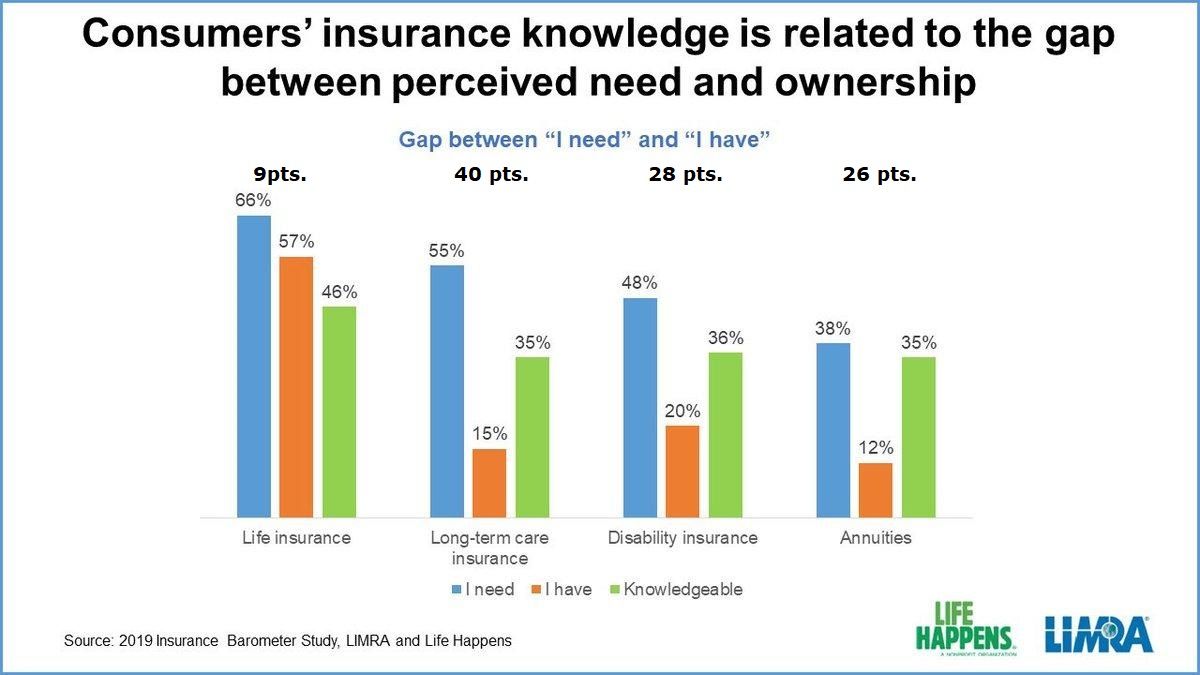
Long Term Care insurance: Disconnect

Courtesy of FoIB Scott Olson:

"55% of those surveyed say they need #longtermcare insurance. But only 15% own it."

It gets even better:


[click to embiggen]

Thursday, May 16, 2019

Evergreen State Long Term Care

So the great state of Washington has passed legislation implementing what appears to be the first "Social-Insurance Program for Long-Term Care" in the nation.

Cool.

But what, exactly, does that mean?

Well first, let's look at what this plan isn't:

It is not an individually owned, Partnership Compliant long term care insurance plan (it's not, in fact, 'long term care' coverage at all, but we'll circle back to that). That's not to say it's evil, fattening or carcinogenic, just noting its limitations.

On the other hand, it's also not the late, unlamented CLASS Act, so it actually seems to have some decent value, especially relative to cost.

Okay, that's nice, Henry, but what is it?

Pretty simple, really:

"All residents will pay 58 cents on every $100 of income into the state’s trust. After state residents have paid into the fund for ten years—three if they experience a catastrophic disabling event—they’ll be able to tap $100 a day up to a lifetime cap of $36,500 when they need help with daily activities such as eating, bathing, or dressing."

That is, they'll be eligible to receive up to a year of extra help with common tasks (assuming care costs $100 a day, and this amount increases each year). Which is, quite frankly, pretty remarkable. And at a tax rate of about 6/10th's of 1%, quite affordable. Given the state's average income of $70,000, that comes to about $400 a year per taxpayer.

So, is this a good deal?

Depends, no?

I'm ambivalent as to its likely result:

On the one hand, as it relates to encouraging folks to at least discuss the idea of long term care (and insuring it, obviously), raising awareness, I think that can be good.

What I'm afraid of, though, is that it will give folks a false sense of security as to the need to self-insure. I see this quite a bit with folks who think "oh, I don't need LTCi, Medicare will pay for it."

Uh, no, no it won't.

But a lot of folks believe that it does. And I'm concerned that folks will think that this is indeed Long Term Care insurance when it's not even really Short Term Care coverage.

On the gripping hand, it may well be all that many (most?) Washingtonians want, or need, or even qualify for.

Then here's this: proponents say that "[a]ll working people will pay into the fund through a payroll tax and then be able to claim a benefit when they need it."

Oh, really?

Then what happens if I pay into the plan for 20 years, and then decide to retire to Florida?

Time will tell, no?

[Hat Tip: Bill Comfort]

Wednesday, May 15, 2019

From the 'Be Careful What You Wish For' Files


A portent of MedicaidForAll.

#CanuckCareWinning

Tuesday, May 14, 2019

Bond, Dr James Bond

Just saw this report on the latest 007 outing:

"The difficult road to production on the latest James Bond film has hit another hurdle after shooting was reportedly suspended following an injury to star Daniel Craig."

The actor apparently suffered an unspecified leg-related injury during a stunt.

So what's that got to do with insurance?

Well:

"... the actor ... has been flown to the U.S. for X-rays." [emphasis added]

So apparently Her Majesty's Secret Service has no use for her Much Vaunted National Health Service©.

Hunh.

From the P&C Files: Active Shooter Insurance

So as one might imagine, this has become something of a hot topic of late. I knew we should blog on it (for all the obvious reasons), and since it's in the P&C world, I wanted to be sure that I had a firm grasp on as many of the issues as possible.

To that end, I turned to my colleague Teresa S, and we had a nice (long) chat trying to identify those issues (as best we could).

Beyond the obvious (wrongful death and medical and funeral expenses), there's counseling, biohazard cleanup, and destruction of property; in some cases, relocation and rebuilding expenses might also come into play. There's also business interruption and even Public Relations, and let's not forget off-site coverage (if the business or organization needs to rent temporary facilities).
This is not, of course, an exhaustive list.

Who and what, exactly, are being insured is also important: the institution/organization, of course, but also boards of directors, Elders, etc.

And who's eligible for coverage becomes an issue: members or students, of course, but what about guests or employees?

Generally speaking, commercial liability policies will have a list of exclusions; items not on this list are then usually covered. Typical exclusions might include acts of war and/or terror, or even more specifically mass casualty events. Which latter begs the question: what does mass casualty mean?

[ed: Turns out that, much like Tootsie Pops, the magic number is 3]

The folks at World Wide Facilities sent along a very helpful guide to their program, which includes some nice features. One thing that Teresa pointed out was that regardless of whether or not one's current commercial liability insurer even offers this coverage, it may be worth considering this kind of stand-alone plan in addition to or instead of adding coverage to the current plan. 

And, of course, what kinds of establishments might be looking for this coverage (or, maybe more critically, should be considering)? That would include:

Schools                                          Hotels
Religious Organizations                Restaurants and Bars
Hospitals                                       Sports/Recreation/Entertainment venues
Municipalities                                Events and Concerts
Retail  

Whew!

Coverage limits are generally measured in the millions (or even tens of millions). One thing I liked about World Wide's brochure was that the application itself provides a great deal of helpful hints about what to be considering:

■ Is there an on-site security detail?
■ How far away is the nearest police and/or fire department?
■ Is there an emergency preparedness plan in place, and who knows what it is (or even knows that it exists)?
■  Are there regular security drills?

And more.

The bottom line, of course, is that it's a lot easier (and more cost effective) to consider these issues and this coverage before an incident. As usual, we recommend speaking with your own agent to determine what coverage (if any) is already in place, and what's missing.

Monday, May 13, 2019

Options Denied

So got a call the other day from a couple looking for health insurance. Well, Karen was; Carl is on Medicare. Karen's 63, and a cancer survivor (Yay!!). Their current, grandfathered Anthem plan sports a $5,000 deductible, and runs about $540 a month, and that's become something of a budget burden for them. They reached out to me to see if they could get something cheaper.

After determining that they're not eligible for a Special Open Enrollment, I explained that there's not a lot that we can do for them. Yes, there are cheaper alternatives, but they're either underwritten, or exclude pre-existing conditions (or both), or offer much more limited benefits than their current plan.

Out of curiosity, I looked at the 404Care.gov site, and saw that the least expensive offering there featured a $7,900 deductible (almost 60% higher than their current plan), and cost almost $640 (about 20% higher than their current plan). They would almost certainly qualify for a subsidy, but that, too, is a moot point until the Fall.

I felt bad explaining to them that, as frustrating as it is, their current policy is the least bad alternative (at least until the next Open Enrollment period). I truly hate that, but I couldn't in good conscience recommend any other plan.

/sigh

Friday, May 10, 2019

It's a Holly Jolly Linkfest

All links courtesy of FoIB Holly R:

■ Scientists in Israel have discovered what appears to be a very promising treatment for epilepsy, and it comes from an unexpected source:

"Researchers at Tel Aviv University have discovered that a drug used to treat multiple sclerosis may help epilepsy patients."

Yasher koach!

■ On the other hand, Israel's universal health insurance system (a hybrid of public and private) isn't faring so well:

"Israel’s health expenditure is way below its OECD peers’. This leaves Startup Nation lacking beds, doctors, nurses, MRIs and CT scanners"

The country has begin a major effort on tech solutions to the problem but, well:

"... if you are in need of hospital care in Israel, you may end up, like 94-year-old Mr. Dabah or Fiasl’s mother, parked for days in a ward corridor, or waiting for hours in an emergency room."

Oy.

■ As we've noted before, the major benefit to Direct Primary Care (DPC) is that it "guarantees quick access to care." And  that access also means more quality time with the doc.

Which, as it turns out (unsurprisingly), is a very good thing:

"Trojanovich spent more than an hour with patient Andrew Buttrell, who says that time spent with the doctor makes a difference with his health needs."

Hunh.

■ Bonus Link: When is a clump of dirt *more* than what it seems?

When it holds the key to a life-saving medicine:

"In 2010, when Lilli Holst scraped a lump of soil from the underside of a rotting eggplant, she had no idea that this act would help to save the life of a British teenager, eight years later and 6,000 miles away."

This is a fascinating true medical detective story. Very cool.

Thanks, Holly!