Friday, June 30, 2017

The Baby Charlie Story & Your Healthcare

As co-blogger Mike wrote about on Wednesday, 10 month old Charlie Gard has lost his fight:

"The parents of terminally-ill baby Charlie Gard are 'utterly distraught' and facing fresh heartbreak after losing their final appeal in the European Court of Human Rights."

And, as Mike pointed out, there is true irony in the court's name.

But it's his conclusion that I think needs to be magnified:

"It would not be different in America."

Here, Mike's referring to that ultimate progressive utopia: a government-run, single payer health care system. And this is the true moral of little Charlie's story: it's clearly not about the money, but has always been about control.

How do we know this?

Very simple: they explicitly told us.

Hunh?

Well, go back and read the Daily Mail story that Mike linked. Charlie's parents weren't asking for special care, or special funding, or that the Much Vaunted National Health System© (because ultimately, they own this) do anything more than get out of the way. They had already successfully raised almost $2 million in order to take him to the US for a promising therapy trial. It would have cost the MVNHS© (and the European Court) exactly nothing to let him go.

Well, that's not entirely true: because if they let Charlie go, well, Katie bar the door.

It's all about control. And if you like the idea of the IRS (for example) deciding who gets care - and who doesn't - well, be careful what you wish for.

Thursday, June 29, 2017

Honey, I shrunk the market

Still think you can keep your plan?

First up, FoIB Jeff M alerts us to this news:

"95 percent of N.C. counties expected to have just one ACA insurer next year"

Adding insult to injury:

"Blue Cross and Blue Shield of North Carolina announced that it has filed for a 22.9 percent rate increase"

Next, FoIB Holly R tips us that "Premier Health plans to exit Ohio's federally funded health insurance exchange." They're sticking it out, though, in the off-Exchange market.

For now.

#ACAWinning

Wednesday, June 28, 2017

This Sceptered Isle Part MCVII

At some point, the state legal system, not the family, will decide whether further care will be permitted - even if the family has raised the money to continue treatment. 

"The ECHR (European Court of Human Rights) announced the application to the court by the parents was 'inadmissible' and added that their decision was 'final'.

Court of Human Rights,  eh?  Take notice.  This is what "human rights" means, in a government, single payer medical insurance scheme.  

It would not be different in America.

Something Different

Early in my career, before I decided to focus solely on the life/health side of this business, I got my Property/Casualty license and sold a few home and auto policies, and one batting cage plan.

Hunh?

Well, one day a call came in from a person who was planning on opening a batting cage business, and needed help with the liability. Since I was still pretty much a newbie who didn't know any better, I said "sure!"

Then I went looking for a carrier.

Turned out that (at least in the mid-80's) batting cages are a big problem from a liability standpoint, and none of our carriers would even quote it. So I turned to what's called the "excess market," and was able to secure coverage through an arrangement with Lloyd's of London (really!). As I recall, it wasn't a particularly high dollar case, but it was certainly an eye-opener.

Since that time, I no longer dabble in that side of the business, and don't really have any need for a LLoyd's connection. But that doesn't mean that the famous firm doesn't have a place on this side of the business. This morning, FoIB Jeff M sent me a link to a very interesting article about how Lloyd's was able to help a successful investment firm arrange for $50 million of key man disability insurance. This type of plan pays the business if the executive becomes disabled. It isn't ubiquitous, but it's also not unheard of. The challenge is in the amount at risk: $50 million is a lot of coverage, and the firm's regular insurance folks had to turn to LLoyd's to fulfill the order.

Anyway, it's a very interesting case study that proves the old saying (which I made up years ago) that you can insure anyone for anything .... if money's not an object.

Wednesday LinkFest

■ From the Oy, Canada! Department, our friend WeirdDave alerts us to a report on how that free health care's working out for our Neighbors to the North©:

"Canadians who need medically necessary surgeries waited longer than ever for treatment"

And the average was about 5 months! But hey, free.

■ And speaking of "free" health care, our friends across The Pond prover once again that government-run health care schemes are no bargain:


■ And finally, you just know that ObamaCare's in free-fall when a high profile Democrat congresscritter explicitly admits it on camera:


[Courtesy WeaselZippers and FoIB Rich W]

Tuesday, June 27, 2017

MMO takes the offensive

Sometimes I feel very coddled: I practice in southwest Ohio, and rarely hear about shenanigans in the exact opposite corner of the state, which also happens to be the home turf of Medical Mutual of Ohio. They keep me in the loop regarding products and marketing decisions, but today I got this "Special Broker Update" from them:

"For years, we’ve wondered why we couldn’t win government and other public sector business in Northwest Ohio, despite submitting what we believe were very competitive bids. Recently we learned through a public records request that our chief competitor for this business has likely violated Ohio’s ethics laws. As a result, Medical Mutual filed a lawsuit today against FrontPath Health Coalition."

Yikes!

The email goes on to address specific instances and cites public records. Unfortunately, I know nothing of the background save for this email, so I've reached out to MMO's Media Relations folks to help fill in some of the gaps. In the meantime, interested readers can click here for a copy of the Special Update.

More ACA Anecdata

Another wonderful renewal case study. As we've reported over the years, we have a number of grandmothered plans ("If you like your plan, you can keep it.")("But make no changes"). Ralph and Laura (and their son) have a Medical Mutual "Wellness HSA" plan: $3,000 per person/$6,000 per family deductible, the 100% (and includes "free" annual physicals).

Their current rate is $844, and is slated to increase some 14% (to $960 per month) in September.

Yikes.

Except:

Went to the 404Care.gov site, and found that things could be worse.

The Cheapest plan, from CareSource, runs just over $800 a month, and sports a $13,300 family deductible (and an additional additional $1,000 out-of-pocket maximum). So they'd save $2,000 a year, but take on over $83,000 in additional risk.

The Closest I could find was Premier Health Gold, with a $3,500 individual deductible, but $12,000 family maximum, for a bargain basement $1,600 monthly premium.

Now granted, these are not apples-to-apples comparisons, but as close as we can really get. Sad.

Monday, June 26, 2017

The More You Know: Flooding the zone

This, courtesy of PCI:

[click to embiggen]


[Hat Tip: LexisNexis]

Friday, June 23, 2017

Health Wonk Review is up

HWR co-founder Joe Paduda hosts this week's eclectic roundup of healthcare-related punditry. And it's really two editions in one: ACA/AHCA and then, not.

Cool.

A Must Read: (Re)Peeling an Onion

Writing at Cut Jib Newsletter blog, FoIB tsrblke offers an excellent take on the AHCA/BCRA (Better Care Reconciliation Act), as he attempts to thread the needle between two very different perspectives: Avik Roy and Michael Cannon.

I must say, he does an admirable job. Some examples:

- As regards Medicaid rollback: "slowing the growth of Medicaid is a huge win, if you think it will stick." [emphasis in original]

- Regarding tax credits: "still relying on “tax credits” that are paid directly to the insurer masking the true cost of the insurance."

And there's more. It's quite a good analysis, offered from (and for) a layman's perspective (although he's a PhD candidate in a medical-related field).

Recommended.

Kudos to us!

Once again, we've been named a Best Men's Health Blog by Healthline:

"Our editors carefully selected the most up-to-date, informative, and inspiring blogs that aim to uplift their readers through education and personal stories. We’re glad to have you on the list!"

That's two years in a row - not too shabby.

Thanks, Healthline!

(And click here for a list of all this year's winners)

Thursday, June 22, 2017

Giving Back

We've written before about Gleaner Life's commitment to community:

"Since 1980, The Gleaner Life Insurance Society Scholarship Foundation has awarded more than $2.6 million in scholarships"

To be fair, that's for the direct benefit of Gleaner Life customers, which is fine. Now, though, they're rolling out another program, this one aimed at the communities in which their policyholder live and work. These "Give and Grow Grants" put real dollars directly into the hands of folks who want to help "to improve their communities through volunteer service projects." These can be anything from "cleaning up a local park to providing lunches for the homeless."

And it's not just the $250: the company's also providing branded t-shirts and resources for promoting projects. Eight of these grants are awarded every month; at $250 (plus shirts) each, that's $24,000 annually.

Sweet.

Wednesday, June 21, 2017

#ACAFailure

Now a major motion picture (for certain values of "major"):
I will point out however, that the clip neglected to mention another major #Fail; that is, folks who are insured often can't afford to actually use their plans.

#ACAWinning: Status Update [UPDATED]

 (Please scroll down for update)

From FoIB Holly R, two (interesting?) developments:

Some Evergreen state citizens are in for a shock come November:

"Two Washington State Counties Lack ACA Health Insurer for 2018"

The local Blue Cross franchise, Premera, has decided to dump these two (so far, but who knows, maybe more) due to cost concerns for insureds neighboring counties.

And in Iowa, Hawkeye state residents can look forward to rate increases topping 43% (43.5%, to be precise), just as we predicted. The good news is that Medica has decided to stick around for the 2018 plan year, but at promise comes with a price:

"We know this will impact people who do not currently receive a subsidy particularly hard," says the carrier's VP. Which is true, but of course misses the big picture that the subsidies don't come from out of thin air. Gee, wonder where they do come from.

Econ 101, how does it work?

Ah, well.

UPDATE: And now The Badger State joins the fun:

"Anthem [BX] ... has made the difficult decision to reduce its 2018 Individual plan offering in Wisconsin to one eoof-exchange medical plan in Menominee county only"

This is similar to their Ohio game plan for next year; one supposes for the same reason:

"They are doing this so it doesn't constitute a full exit. Under HIPAA rules full exits require insurers to leave markets for five years."

Tick, tock...

Tuesday, June 20, 2017

UHC vs Premier: Mid-June Update

Got another letter from Premier today. Basically, they're lamenting that UHC isn't folding like a cheap suit offering more concessions. Premier says that they've agreed to hold off on rate increases until year's end, and to offer only nominal increases for '18 and '19 (although, given that they're already apparently at the top of the heap rate-wise to begin with, this position seems a bit self-serving).

They're also asking folks to contact UHC corporate directly, to push for an acceptable resolution.

So, now the ball's in UHC's court.

We'll continue to keep our readers posted as things move forward (or don't).

Monday, June 19, 2017

Oy Canada, Part 5,294

As we've often noted, the ACA was always designed as a path to a single payer, nationalized health "care" scheme. And we've also noted many times that CanuckCare (seems to be a primary role model for that goal) isn't doing so well as a panacea of health care delivery.

"There’s just one problem: The Canadian model of universal coverage is failing."

The Canadian system is government funded, but delivered by what are essentially heavily-regulated private entities. And we really do mean "heavily regulated:"

"Canada’s government-controlled health-care system has become more restrictive than communist China’s."

Yikes.

And something else which was new to me: we've long known that private, supplemental health plans are available Up North
©, but what we did not know is that "it applies only to procedures and services that fall outside the CHA;" that is, only for things like dental, vision and prescription meds.

And, of course, it's going broke, as "it relies almost entirely on current taxpayers to subsidize the disproportionately large health-care needs of elderly Canadians in their final few years of life."

Hunh.

[Hat Tip: Dr. Shane‏]

Friday, June 16, 2017

Penn Treaty Update: Well, D'Uh edition

The Penn Treaty story (our last update of which is here) continues to take (unexpected?) turns. In that last update, we learned that the cost to bail out the now-defunct carrier is running north of $4.6 billion (yes, that's billion, with a b).

Gulp.

Left unsaid in all these reports has been what, exactly, these other carriers are bailing out. Well, thanks to FoIB Jeff M, we learn that at least PT's agents were on the ball, product-wise:
■ 55% of the unit's long-term care insurance policyholders chose compound inflation protection
■ 56% of the long-term care insurance policyholders with inflation protection have policies with no elimination period
■ [Very few] have policy benefit periods with 36 or fewer months
That last is important, because it means that most plans are for longer than 3 years. Those can quickly eat up a carrier's reserves. And it's compounded by the fact that about 40% of their policies are for lifetime benefits (which haven't been available open market for a while now).

The terms of the bailout require that all policy provisions remain intact; participating carriers may be on the hook for some big claims, both in terms of benefit amounts and for how long they'll have to pay them. On the other hand, they plan to somewhat mitigate this exposure with substantial rate hikes.

On the gripping hand, history has shown us that even 40% hikes aren't enough to scare off most insureds. This, of course, has long been a problem for LTCi: the original models assumed attrition rates matching Disability Insurance plans. Alas, that turned out to be wishful thinking.

And if you're thinking that PT's problems are isolated, think again. The folks at Berson-Sokol Agency tell us that TransAmerica is requesting new rate hikes in 38 states.

So if you're shopping, better sooner than later.

Patient's Attitudes in the Medical Office

Reading my daily articles regarding medicine, I came across this title, “3 ways to help doctors and staff deal with racist patients” and I chuckled to myself. We don’t deal with only racist and bigoted patients, we deal with arrogant and angry patients, we encounter threats, both personal and legal, as well as being called many derogatory names.

The 3 ways cited in the article are, 1. Establish a Committee, 2. End the Silence, and 3. Take a stand against cultural and religious discrimination. These ideas are a beginning to dealing with a problem that is rarely recognized. In my career in medicine, I have dealt with many angry and rude patients, but several encounters stand out.

I once encountered a patient who insulted every minority staff member in his first few minutes in the office. When being led to his room by an Asian Medical Assistant, he sniffed and said loudly, “I smell Chinese”, then when he passed a female physician of Indian Descent, he insulted her heritage and then he loudly proclaimed “No Jews”, in front of a male Jewish physician. When I was contacted to come to the exam area, I faced a barrage of upset staff requesting that I take care of the patient. I composed myself and went into the room, introduced myself and asked the patient if he had any problems with his visit to our office. He looked at me, smiled and said “No, why did I ask?” Using all my Social Work and Human Resource skills, I explained to the patient that sometimes we may say something that we think is fine but can be hurtful to others, that we had to be careful how we used our words. I further explained that in our office we do not allow or condone any type of discrimination based on sex, race, or religion. I asked him if he could abide by these guidelines, he stated he could. I thanked him and told him the doctor would be in soon. I went back to my office, not 2 minutes later, the Medical Assistant ran into my office, the patient had left in a huff.  While leaving the office, he ran into a female, black Medical Assistant. He told her that our office had too many non-whites, but she was okay, he liked blacks.

I have wondered for many years now, what makes a normal person become a crazed maniac when entering a doctor’s office. Why is every issue escalated to anger? As more guidelines (HIPAA, HITECH, EO’s) are forced upon medicine and we enact those guidelines, patients only become angrier.
What do you mean you can’t talk to me about my spouse/child/friend? (HIPAA)

Why do you care if I have gun in my house? (EO)

What if I don’t want my information on a portal on the internet? (HITECH)

Why do I owe SO MUCH money didn’t my insurance pay? (ACA) 

It will take how long for me to see MY doctor? (Fewer physicians, more patients)
Each day we deal with these angry comments and more. I have had times felt physically threatened by a patient and have requested that I not have any more contact with that patient. While these are few and far between, it is an issue in medicine. It is nice to see an article addressing the issue, if only in a narrow area, but if we can build a conversation in medicine, then maybe we can begin to address these issues.

Thursday, June 15, 2017

Regulations vs Productivity, Medical-style

Interesting article today in MedPage about how five doc's manage their practices (or have bailed on them) through years of increasingly onerous paperwork and record-keeping reg's.

For example:

"Around 2005, Dr. A was starting to fatigue. He was well into his sixties and did not like the direction medicine was going. The hours were too strenuous, the documentation requirements were getting increasingly complicated, and he saw the writing on the wall. Regulation was coming, and the results would be devastating. So, he decided to retire."

What happens next is a cautionary (true) tale, including the experience of FoIB Dr Gerard Gianoli. And it seems likely to get worse before getting better (if that's even possible at this point). Frustrating information, but a good, well-written piece.

Kudos.

MMO on the Board

So got this in email from Medical Mutual this morning:

"Earlier this month, Anthem announced it would be exiting the Ohio ACA market for 2018. We at Medical Mutual understand this announcement adds uncertainty for brokers around the 2018 open enrollment period. We want to take this opportunity to alleviate some of that uncertainty for you, our valued broker partners."

Which is nice, and they go on to reassure us that they've already filed to offer ObamaPlans next year, and that they're "committed to offering individual health insurance options where it is feasible for us to do so."

While I appreciate the goodwill inherent in these kinds of non-committal messages, they really only serve to make a carrier look good by comparison (not exactly a high bar). And, as co-blogger Patrick points out:

"There wasn't a doubt they would participate. Likely they add a few counties but not the full 20 without an insurer. Plus, you haven't seen the rates yet."

Indeed. Considering that they may well be the only option in some areas, the likelihood is that rates will be even higher (after all, absent competition, what's to hold them down?).

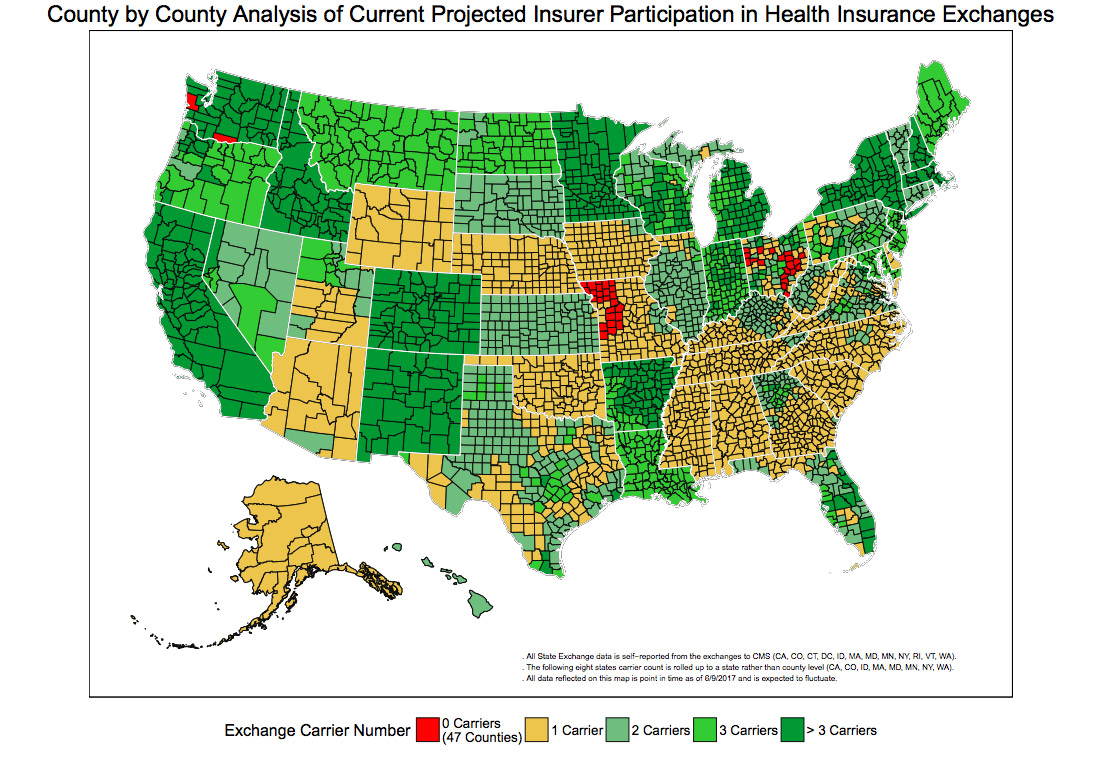
And that's just one carrier, in one state. Our friend Holly R sent us this link to a map of the US showing states which will have at most one carrier next year:


[click to embiggen]

Yikes!