Tuesday, May 09, 2006

Round(s) and Round(s)

Grand Rounds, hosted this week by aetiology, has something for everyone. And I mean, everyone. I quit counting at 50 submissions, including several about sex (really!).
With so many to choose from, it's hard to go wrong. I found this post by Kevin, MD fascinating: physicians who require their patients to sign a "no frivolous lawsuits" contract. Hmmm...

Monday, May 08, 2006

What's a PAP?

Bob Vineyard does more than just post interesting, and often provocative, items here at InsureBlog; he looks for, and finds, ways to help others.
Case in point: how many folks know about Patient Assistant Programs? Thanks to Bob, we now know that they "provide assistance to low income individuals & families when it comes to medical care."
Want to know more, including how to contact various programs for information? No problem, just click here.
Thanks, Bob!

And it's Carnival Time!

It's Monday, so it must be time for the Carnival of the Capitalists. This week, you'll find an action-packed edition over at Harshly Mellow [ed: is that like jumbo shrimp?], where our host has sifted through 70 entries....Whew! He's even included some that were missed in previous editions; now that's a good sport.
With so many great choices, it's hard to pick a favorite, but I'm still impressed with Joe Kristan's fisking of HSA critics. There are some good, valid reasons to be skeptical of CDHC, but (as Joe points out) the critics seems to miss these.
This week's Carnival of Personal Finance is a treat! Jim at Blueprint for Financial Prosperity has put together a clickable Treasure Map encompassing all 37 entries. What a hoot!
I was particularly drawn to this post at Inchoate Random Abstractions. A recent study quantified a stay-at-home-mom's salary. Why did this pique my interest? Click here.

Early May Health Wonk Review

This week's host, Joe Paduda at Managed Care Matters, has put together a really well-designed Review. In true capitalist fashion, he let his "real job" come first [ed: we approve!], but came back roaring.
With almost 20 entries, the HWR continues to grow. And these are some serious, and seriously interesting, posts. My fav was frequent IB commenter Marcus Newberry's bittersweet perspective on good health.

Thursday, May 04, 2006

NewsBits…

■ As we’ve blogged before, Association Health Plans may look good on paper, but they’re hardly without blemish. While we hate to “pile on,” the latest group to join the Bash-An-AHP-Today bandwagon are the Attorneys General of 80% of the Union:
While that’s not necessarily the same as an indictment, it does give one pause.
■ Not everyone’s impressed with Massachusetts’ efforts to insure everyone: California health care experts, for instance, say the Massachusetts plan just won't work in the Golden State. According to the California HealthCare Foundation, "(w)ith health coverage, it always comes back to money," says group President and CEO Mark D. Smith. "Where will the funds come from? And will it be affordable for those people it intends to serve?"

Wednesday, May 03, 2006

On Integrity

While InsureBlog is not a political blog (or at least partisan), the nature of the topics we address necessarily reflect a political viewpoint. Hopefully, this is a by-product, and not an intentional theme.

There are, however, a lot of poliblogs out there, and sometimes things "get out of hand." So a bipartisan group of bloggers has started Online Integrity, a blog dedicated to promulgating these principles:

■ Private persons are entitled to respect for their privacy regardless of their activities online.

■ Public figures are entitled to respect for the non-public nature of their personal, non-professional contact information, and their privacy with regard to their homes and families.

■ Persons seeking anonymity or pseudonymity online should have their wishes in this regard respected as much as is reasonable.


■Violations of these principles should be met with a lack of positive publicity and traffic.


InsureBlog is proud to be among the earliest signatories of this endeavor, and we urge other bloggers to consider endorsing it, as well.

Happy blogging!

Getting Transparent...

According to the Council for Affordable Health Insurance, “Americans are ready to become health care consumers, if given the tools to do so.
Well dunh, I could’ve told you that!
Actually, this has been brewing for a long, long time.
According to CAHI, more than 80% of those surveyed agreed that providers should publish the prices of their services. Of course, price isn’t (or at least it shouldn’t be) everything, but almost as many folks said that they’d “be likely to shop for the best price.
That’s troublesome.
There are probably very good reasons why Dr Smith’s charges are so much lower than Dr Jones. After all, what do you call the guy who graduates at the bottom of his med school class?
Doctor.
So it’s not necessarily heartening to see that folks are so price-sensitive, when there are other factors, as well. Of course, it’s not really surprising: I get a lot of folks looking for insurance “deals,” too; it’s my role to help folks see that there’s a difference between low price and value.
But there’s another side, as well.
I recently received a letter from the Chairman of the Board of one of my carriers (and no, I’m not special: it appears to be a form letter. Darn) whose company refuses to pay what they consider “outlandishly high prices” for services rendered. At claims time, if the carrier is convinced that the charges are out of line, they simply refuse to pay the billed rate, and offer to settle for a lower amount [NB: this carrier doesn’t use generally use networks, so there are no contractual issues].
So what happens if the provider says “no?”
They sue the insured for the balance.
Now, they are obviously within their rights to do so. After all, the patient/insured signed a consent form, agreeing to pay for services rendered. If their insurance company balks at the price, the patient/insured is left “holding the bag.” Now that’s a problem.
But:
"If the hospital sues our customer, we provide defense with a lawyer chosen by the customer…Our customer will not be out of pocket one nickel."
Now that’s putting your money where your mouth is.
On the other hand, I’d be concerned about credit issues. While it’s all well and good that the insured doesn’t get stuck paying the higher price for services rendered, it may well be a black (or red?) mark on one’s credit rating. And since that measure is becoming more and more important (for loans, credit cards, even auto and home insurance rates), there’s a real danger that saving a few dollars on a procedure could result in a severely damaged credit rating. And then what?
When I walk into Wendy’s, I know how much that salad’s going to cost [ed: salad. Right]. But when I walk into Dr Smith’s office, I really don’t know how much that strep test is going to cost. And since each carrier has its own pricing, the model seems much more analogous to airline fares than restaurant fares.
Soon, the gummint will be sharing what Medicare pays for some common procedures. While that’s a step in the right direction, I’m not sure how useful that will be. Providers typically charge different amounts for Medicare patients than commercially insured ones, let alone those without coverage. At least for our seasoned citizens, more information may be close at hand.
And providers themselves are getting into the act; over at MedBill Advisors, host Chris Parks tells us about how HCA (Hospital Corporation of America) plans to inform its patients about their costs, in advance.
The bottom line is, transparency in pricing is an important, and potentially useful, tool. No one tool, however, is useful in all situations, and most jobs require several, as well as the skills to use them.

Health Q & A

(Presented with tongue firmly in cheek)
Q: I've heard that cardiovascular exercise can prolong life; is this true?
A: Your heart is only good for so many beats, and that's it... don't waste them on exercise. Everything wears out eventually. Speeding up your heart will not make you live longer; that's like saying you can extend the life of your car by driving it faster. Want to live longer? Take a nap.
Q: Should I cut down on meat and eat more fruits and vegetables?
A: You must grasp logistical efficiencies. What does a cow eat? Hay and corn. And what are these? Vegetables. So a steak is nothing more than an efficient mechanism of delivering vegetables to your system. Need grain? Eat chicken. Beef is also a good source of field grass (green leafy vegetable). And a pork chop can give you 100% of your recommended daily allowance of vegetable products.
Q: Should I reduce my alcohol intake?
A: No, not at all. Wine is made from fruit. Brandy ! is distilled wine, that means they take the water out of the fruity bit so you get even more of the goodness that way. Beer is also made out of grain. Bottoms up!
Q: How can I calculate my body/fat ratio?
A: Well, if you have a body and you have fat, your ratio is one to one. If you have two bodies, your ratio is two to one, etc.
Q: What are some of the advantages of participating in a regular exercise program?
A: Can't think of a single one, sorry. My philosophy is: No Pain...Good!
Q: Aren't fried foods bad for you?
A: YOU'RE NOT LISTENING!!! .. Foods are fried these days in vegetable oil. In fact, they're permeated in it. How could getting more vegetables be bad for you?
Q: Will sit-ups help prevent me from getting a little soft around the middle?
A: Definitely not! When you exercise a muscle, it gets bigger. You should only be doing sit-ups if you want a bigger stomach.
Q: Is chocolate bad for me?
A: Are you crazy? HELLO Cocoa beans! Another vegetable!!! It's the best feel-good food around!
Q: Is swimming good for your figure?
A: If swimming is good for your figure, explain whales to me.
Q: Is getting in-shape important for my lifestyle?
A: Hey! 'Round' is a shape!
Well, I hope this has cleared up any misconceptions you may have had about food and diets.

Tuesday, May 02, 2006

Time for Grand Rounds...

After some major tech problems, Scott at Polite Dissent presents this week's Grand Rounds. With over 50 posts, broken into helpful and logical categories, it's a tremendous job.

My favorite was a wonderful post by Dr Charles, about an old woman, an old pharmacist, and some old-fashioned values. Read it: you'll feel better.

Monday, May 01, 2006

Masters of the Obvious

Perhaps it’s just Monday Madness, but there seem to be an awful lot of seriously moronic articles coming out of the insurance industry today. And as if we didn’t already know this, the New York Times (no less) clues us in on the latest:
In three quarters of a dozen states, for example, Blue Cross has more than half the business, according to The Gray Lady. This has apparently shocked legislators (who have, of course, their own deluxe health care coverage), who believe that the answer is, wait for it, Association Health Plans.
Now, Bob and I have blogged on these before, so I won’t rehash why AHP’s are no panacea, either. But the point here is that such plans are, ultimately, insured by a carrier. Now, if one particular carrier has already darn near cornered the market without the help of the gummint, why would a sensible person believe that it won’t continue to so so, and gobble up the AHP market (such as it is) to boot?
Of course it would.
Frankly, I’m none too pleased that any one carrier has that much market share, but more government intervention isn’t the answer (cf: Ma Bell). In a free market such as ours, it behooves other carriers to do what they can to make themselves more attractive.
And, of course, it’s up to agents to make a more concerted effort to “push” other carriers, even when (or maybe because) this requires a bit more work on our part.
Ultimately, though, it’s the marketplace that has the final say. If employers who buy group plans, and individuals who buy, well, individual plans want to see more competition, they have to get past the “price is everything” mentality. Granted, BX tends to have the most extensive networks in their markets, but others are not too far behind.
And, of course, the story has to include mention of the (suspect) 45 million uninsured. What, pray tell, has that to do with the subject at hand? Ah, just as I thought.
As an agent, I’m concerned that the marketplace keeps shrinking; and it’s not just health carriers: there are fewer and fewer (quality) disability and long term care insurance carriers extant, as well. I believe that competition is good: it helps drive down costs, encourages innovation, and gives the consumer more choices. So the shrinking pool of carriers is troubling.
The only thing more troubling would be the government “fixing” it.

Ironic/Clueless Headline of the Day...

Terrorist Attack Could Wreck Group Life Industry
Ya think?!
For once, words fail me.

The Policy that Fell to Earth (Part Two)

In Part 1, we learned about the history of Universal Life, and the mechanics of how it works.

Properly funded and used, UL can be a great insurance planning tool. And it’s not my intention here to “bash” it. Indeed, I own both Universal and Variable Universal Life policies, so I’m a believer.

To a point.

The challenge, and the reason I’ve become less enamored of UL, is that, despite the best intentions of agents, clients, and carriers, UL carries within it the seeds of its own destruction (pause for dramatic effect). That is, in the later years of these plans, that spigot gets turned wide open, and the cash value drains very quickly, leaving the client with no insurance (and potentially a sizeable tax bill).

The problem is that, ideally, agents would recommend – and clients would agree – that the client should put in as much money as possible in the early and middle years, to compensate for that wide-open spigot in the later years.

But one of the appeals of UL is that it can be funded at a lower (sometimes much lower) level than a comparable Whole Life plan, and the temptation is to save money. Nothing wrong with that, but it can be difficult playing ‘catch up’ in those later years.

And there’s the rub: policies bought and sold in the 1980’s are now 25 years old, and starting to show signs of wear and tear. Folks who didn’t put in the maximum dollars are finding that their plans don’t have enough cash to keep going, even if they increase their premiums. Sometimes, we have to lower the face amount AND raise the premium.

And it’s not likely that things will get much better soon.

So what’s the lesson? Well, first of all, look at your annual statements, and see how well they track with what was illustrated. They won’t match exactly, but it’ll give you a sense of what’s happening with the plan. Second, call your agent, and ask what options are available. Agents can run (or have run) “in-force” illustrations, and play “what if” with the plan.

Finally, don’t conclude that UL is a poor choice: it has its uses, and it can be a great tool. Like any financial or insurance product, though, it requires supervision, and fortitude.

It's Money Monday!

Flexo, proprietor of Consumerism Commentary, is once again hosting the Carnival of Personal Finance. And a terrific job he (she?) does, too: there are a ton of entries, and each one has a summary, making it easy to find just the right post to read.
I found these 10 Money Savers, suggested by No Credit Needed, helpful. Maybe you will, too.
And this week's Carnival of the Capitalists is now up and running at Interim Thoughts, a blog based in India. Don't tell me we're outsourcing Carnivals?!
Actually, it's a great effort: Neelakantan, our host, has posts grouped by subject, and even intersperses little blogbits about the Indian economy along the way. Great job!
Among other gems, previous CoPF host Five Cent Nickel (is there any other kind?) has a cautionary tale for those of us who fail to answer the phone.

Saturday, April 29, 2006

Blogging for MS - Thank You!

This morning, my lovely wife and daughter participated in the Walk for MS. This was their first year, and they did meet their goal. Actually, they went a little over!

Thank you to everyone who helped!

Friday, April 28, 2006

A Health Care Money Tree

Joe Kristan has a great take-down of a congresscritter's critique of HSA's. Interesting reading, because Joe (even though -- or maybe despite? -- the fact that he's a professional bean counter) "gets" the premise undergirding HSA's, and has understands the stakes. Highly recommended.
And while you're there, Joe does take comments...

Thursday, April 27, 2006

The Policy that Fell to Earth (Part One)

Universal Life insurance was developed in the early 80’s primarily as a response to money market accounts.

Hunh?

Okay, let’s rewind a little:

Back in the early 80’s interest rates were sky-high (20%+ mortgages, 17%+ money market “savings” accounts). Folks that owned whole life insurance policies saw a growth rate of 3-5%, and a loan interest rate of about 4-5%. A lot of these folks looked at their insurance policies, and did the math: I can borrow the funds for 5%, make 18%, and there’s essentially no risk.

Where do I sign up?!

Carriers were understandably less than sanguine about this, and looked for a way to staunch the flow. They knew that a lot of folks were intrigued by the “Buy Term and Invest the Difference” approach, and sought to capitalize on it. What emerged was a policy that stripped away many of the guarantees of whole life (WL), but offered the potential of greater growth. This was also the dawn of the modern computer age, which made it technologically possible for companies to illustrate more complex policies.

Thus was born Universal Life. It offered higher current interest rates than conventional WL plans, and a minimum guaranteed interest rate. The policy itself was really a hybrid: the cost of the insurance was, for the first time, “unbundled” from the plan, and one could see what the actual cost of the death benefit could be. And that cost could change from time to time, based on the insurance companies’ experience.

There is a current charge, and a guaranteed maximum charge.

It also offered more flexibility than its WL predecessor: one could change the premium, and the death benefit, pretty much at will. So if one came into some extra cash, one could dump it into the policy to give it a push; if one had a run of bad luck, one could lower (or even skip) the premiums.

Pretty cool, and a useful tool.

The problem is that we all assumed what has historically been the case: that over a given period of time (say, 20 years), interest rates always go up. That is, they go up and down, but the average interest rate for that 20 years will always be higher than the initial rate. By the way, I’m not pontificating here: I actually did the research early on in my career.

The problem is, for the past 10 or 15 years, this has not been the case, and the policies are beginning to “blow up.” That’s insurespeak for lose value, and threaten to lapse.

Think of the policy as a bucket:
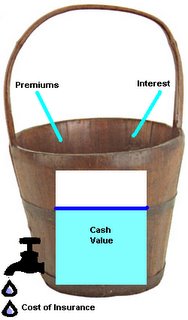

At the top, we see Joe’s premiums going in, year after year. And we see the insurance company depositing interest each year.
 
In the middle, we see the cash value of the policy growing and growing (it’s comparable to the equity in your house).

At the bottom, there’s a spigot, draining out the cash value at a rate that’s determined primarily by the cost of the insurance (although loan interest would play a part, as well). In the early years, when Joe’s young, the spigot is opened just a little, so only a few drops leak out, and they’re more than compensated for by the premiums and the interest.

The goal is to keep enough “water” (cash value) in the bucket so that it doesn’t ever run dry.

Ok, so now what?

Well, for that, see Part 2

Wednesday, April 26, 2006

Number Crunching...

Every once in a while, we run across interesting statidbits*:
For example, Ernst & Young surveyed Human Resources executives, asking which programs had the greatest impact on retaining older workers:
Turns out, almost 26% hired retirees as consultants. About 15% recommended a "company culture that promoted generational diversity" (don't ask), while another 15% used the oldest carrot in the book (in the form of retention bonuses). Interesting.
Here's another one:
According to the Employment Policies Institute, almost 90% of those employed full-time are covered by health insurance, as are over 80% of those working part-time. Almost the same percent of self-employed folks are also covered. and almost 2/3 of unemployed Americans also have health coverage.
Wow.
*Yes, I made that up. But "factoid" was already taken. I hate when that happens.

Tuesday, April 25, 2006

Grand Rounds!

David Williams of the Health Business Blog, fresh off of hosting the Health Wonk Review earlier this month, has tackled this week's Grand Rounds. He managed to review, sort, and comment on 50 submissions. Outstanding!
As a beer connoisseur-wannabe, I loved this post from Dr Charles. Best of all, it has a VERY happy ending!

Monday, April 24, 2006

Monday Carnivals...

Despite some tech diff's (Blogger apparently suspended his "main" blog) , Clint at Million Dollar Goal is hosting this week's Carnival of Personal Finance.
He's chosen an interesting, if unorthodox, format: instead of listing each blog and its submission, he put posts into categories, sans blog or author. The idea is that, if you find a post's topic intriguing, you'll click thru to see where it is.
Which is what I did. We get a number of entrepreneurs here at IB; this post, at Frugal for Life, is the first in a two-part series on work-at-home scams, and how to avoid them.
And this week's Carnival of the Capitalists is up at the eponymously-named Entrepreneur's blog. Scott, our host, sifted through over 50 submissions, organizing and ranking them according to topic (and his review). Our own Bob Vineyard's post on High Deductible High Jinx was "Best in Category." WooHoo!
In keeping with the self-selected theme of entrepreneurship, take a moment to read Steve Pavlina's post on the 10 Stupid Mistakes Made by the Newly Self-Employed.

Charge it!

Growing up, “be careful what you wish for” was always a popular saying around my home. And, as a vocal (and vociferous) proponent of Consumer Driven Health Care, I should have seen this coming:
It seems that the convenience of these cards may also have a downside: as consumer credit card debts continues to climb (according to the article, it’s about $2,300 for the average citizen), charging health care could contribute to a substantial increase in such debt.
Now, I must confess that the concept of a “credit” card for HSA’s, FSA’s, and the like is somewhat foreign to me: I’ve always considered these to be more in the nature of debit cards. That is, they simply replace my checkbook when I’m paying for health care. Whatever funds are in the account represents the amount I have to spend; no more, no less.
So it came as a surprise to me (must be my sheltered existence) that financial service companies would set these up as unsecured lines of credit, as opposed to merely account balance conduits. But that’s apparently what is happening:
The card, at a 12.96% interest rate, may be used to pay for elective or quality of life procedures, such as laser eye surgery, cosmetic dental care, orthodontry [sic] and hearing aids. Prices for such services easily go into the thousands, but Citi Health Card enables patients to "structure payment plans of up to 48 months, so members can customize their payments to fit their overall financial planning and medical spending."
The first two items, at least, aren’t even “kosher” by IRS standards; that is, they’re not eligible for tax free reimbursement under Section 213d. The beauty of our capitalist system is that folks are free (for the most part) to buy the things which are important to them.
Maybe I’m just a fuddy-duddy, but I’m skeptical that a credit card is the best vehicle for CDHP’s. Still, it will be interesting to see if the idea takes off.