Monday, November 13, 2006

Not Quite Ready for Prime Time…

Belay that line!” In rock-climbing, it means controlling one’s rope to prevent a nasty spill; in insurance, it apparently now means the latest gizmo from the minds of United Healthcare:
According to UHC, working stiffs make up a sizeable percentage of “the uninsured,” and are prime candidates for affordable health insurance. Their latest offering, called “Belay,” is built on a High Deductible Health Plan (HDHP) chassis, and comes in two models: with an HSA (Health Savings Account) and without. Sold directly to unsuspecting consumers through the Golden Rule distribution channel, these plans appear to directly challenge the notion that HDHP’s are primarily for “the wealthy.”
It’s an intriguing idea, and one which, on its face, appears to be the answer to a lot of prayers: high deductible, low cost, and easy to understand. Initially available only in the Cleveland and Chicago markets, no one can accuse UHC of over-reaching. And certainly, any effort toward reducing the number of folks without insurance at a given time is to be commended.
But I remain underwhelmed.
Why is that, you may ask?
Well, for one thing, Golden Rule has a (well deserved) reputation of being quite stringent in their underwriting. While that’s not necessarily a bad thing, it’s not something the layperson would be expected to know. Professional agents do, though, and can offer suggestions about which carriers a given client should be considering. But Belay isn’t available from agents, only directly from the carrier, which could leave consumers worse off if they’re declined.
For another thing, the press release touts how easy it is to sign up: “just click here.” Problem is, that just takes you to the regular GR site; even feeding in a Cleveland address gets one zero info on Belay (is Belay delayed?).
Expect a lot of hoopla surrounding this newest venture (they’re bringing in a professional rock climber for the official “rollout"); what follows should tell us whether or not this is indeed an idea whose time has come, or whether it’ll end up “on the rocks”.

Carnival Monday!

With over 35 entries (all with context), in 11 categories, Casey Software has done a tremendous job with this week's Carnival of the Capitalists.
I was intrigued by this post on alternative fuel technologies, brought to us by the Long or Short Capital blog. Unfortunately, it doesn't appear that it will be available in Israel (or Saudi Arabia).
Geek's World brings us this week edition of the Carnival of Personal Finance. It has almost 70 entries, most with helpful summaries.
With that much content, it was challenging to find my "favorite:" since my family is also dealing with "ageing parent issues," I found Wenchypoo's post on finances and the elderly to be spot on.

Sunday, November 12, 2006

Insurance Dispatch

In this week's column, we look at how failing to disclose your medical history can cause problems when buying insurance. You could wind up with a big loss on a large claim.

A lesson in truth-telling, available at The Medical Blog Network.

Saturday, November 11, 2006

And Now For Something Completely Different...

Okay, this post has absolutely nothing to do with insurance, but hey, it’s the weekend, so what the heck:

Is a burrito a sandwich?

The Panera Bread Co. bakery-and-cafe chain says yes. But a judge said no, ruling against Panera in its bid to prevent a Mexican restaurant from moving into the same shopping mall…

"A sandwich is not commonly understood to include burritos, tacos and quesadillas, which are typically made with a single tortilla and stuffed with a choice filling of meat, rice, and beans," Locke wrote in a decision released last week.

Apparently, the Panera at this particular mall has a clause in its lease that prohibits another “sandwich shop.” Their contention is that a burrito is a sandwich, meaning that Qdoba (the Mexican eatery at issue here) is outta luck.

I don’t know: the folks at Slashfood say “A sandwich is any kind of food that you can combine with another kind of food and/or condiment and eat it while holding it in your hand…sometimes (especially in these carb-counting times), a sandwich can be made without bread.

On the other hand, “The first recorded sandwich was by the famous rabbi, Hillel the Elder, who lived during the 1st century B.C. He started the Passover custom of sandwiching a mixture of chopped nuts, apples, spices, and wine between two matzohs to eat with bitter herbs.” (At our family’s seder, we call this a “Hillel Big Boy") Since matzah is unleavened bread, this would seem to settle the question in favor of the ubiquitous bakery/cafĂ©.

On the gripping hand, Sandwich is a town in Barnstable County, Massachusetts, United States. The population was 20,136 at the 2000 census.

I guess that doesn’t really help much.

I tend to side with the judge here; if a burrito is a sandwich, then so is a crepe, a blintz, and moo shoo. Just because a food can be held and eaten with one hand doesn’t mean it’s a sandwich (ice cream or otherwise).

Bon appetit!

Friday, November 10, 2006

The lawyers have been at it again...

As has been covered in several previous posts, Blue Cross of California is in the middle of a class action lawsuit over rescission of coverage. When used appropriately and with discretion, the ability to rescind coverage is important to protect the carrier against fraud. It's also a disaster for the consumer if it's inappropriately applied.

We've just received the new version of the small group application forms and there have been dramatic changes that address this issue. I thought you would be interested to see the differences between the old and new forms.

Here is the wording in previous version of the employer app:
Coverage may be rescinded if there are misstatements in this application.
Simple. No? And now for the new version:
Rescission

We have provided a complete history of material information that is considered in the acceptance or denial of the enrollment application. Following approval of coverage, if Blue Cross discovers that we intentionally provided incomplete or false material information or withheld material information from Blue Cross prior to the Effective Date of the Agreement, Blue Cross may revoke coverage. This means Blue Cross may cancel coverage as if it never existed.
If Blue Cross revokes our Group coverage under the Combined Evidence of Coverage and Disclosure Form, Blue Cross will send a written notice explaining the basis for the decision and our appeal rights. We have the option to submit a new application in the future to be underwritten and considered for enrollment.
We will be required to pay for any services that were covered for an employee, and Blue Cross will refund any amounts paid by our Group except amounts already paid by Blue Cross on behalf of our employees.
We have personally read and attest to the completeness and validity of the information provided on this application for coverage. If we are accepted, this application will become part of the contract between Blue Cross and our Group. We and any enrolled family members agree to abide by the terms of that contract.
Initials: (emphasis added)
That's potentially a bankruptcy-level penalty for a small business.

And on the employee's side, the old app read:
Even if this application is approved, any misstatements or omissions may result in future claims being denied and the policy being rescinded.
The new employee application reads:
Rescission

I have provided a complete history of material information that is considered in the acceptance or denial of this enrollment application. I understand and agree that I alone am responsible for the accuracy and completeness of this application, and to the best of my knowledge and belief, I have done everything necessary to be able to assure you that all information about any children under the age of 18 listed on this application is true and complete. Also, all of my dependents listed on this application that are over the age of 18 years have read this application and have provided complete and accurate Information for this application. I understand and agree that following approval of the enrollment application, if Blue Cross discovers that I intentionally provided incomplete or false material information or withheld material information from Blue Cross prior to the Effective Date of the Agreement, Blue Cross may revoke coverage. This means Blue Cross may cancel coverage as if it never existed.
If Blue Cross revokes your coverage under the Combined Evidence of Coverage and Disclosure Form, Blue Cross will send you a written notice explaining the basis for the decision and your appeal rights. You have the option to submit a new application in the future to be underwritten and considered for enrollment. You will be required to pay for any services that were covered while you were a Member, and Blue Cross will refund any amounts paid by you except amounts already paid by Blue Cross.
I have personally read and attest to the completeness and validity of the information provided on this application for coverage. If I am accepted, this application will become part of the contract between Blue Cross and I. I and any enrolled family members agree to abide by the terms of the contract. Initials:


Notice that the old version of the employee application has ambiguity in the difference between "future claims" and the concept of rescission back to day one. The new version clears that up and basically says that you're toast if the coverage is rescinded. It also specifically adds in the words "intentionally" and "materially" so trivial and accidental omissions don't provide a basis for rescission...regardless of the size of the claim that triggered the review.

The new forms are a huge improvement in openness and clarity. Rescission is a very serious matter and it's important that it be fully explained.

Down Under...Lookin' Up!

Here's a bit of news...
Australian researchers found that Google identified the correct diagnosis in 58% of uncommon medical cases, after entering a few of the symptoms from the 26 cases into the search engine, according to an online study from the British Medical Journal, the London Daily Express reports (Fletcher, London Daily Express, 11/10).
Cool! A new cost savings feature...you can use Google to diagnose yourself! Now, if they can just get that 42% error rate down a bit...

More from Across the Pond…

As we’ve noted before, the British National Health System (NHS), while touted as far superior to our own flawed efforts, continues to prove its proponents wrong. For example, Britain's Royal College of Obstetricians and Gynaecology is now urging doc’s to do away with sickly infants, which “can disable healthy families.
As it stands now, such activities are illegal in the ‘Isle, but the College is pushing for that to change. Kinda makes sense, from their standpoint: “sickly” infants are a real drag on finances, both the family’s and those of the NHS. Much better to nip those costs in the bud, so to speak, than to place an even greater financial and emotional burden on those affected.
Excepting, of course, the newborns themselves.
But they don’t vote.
In related news, a simple case of gallstones has left an Ipswich woman in severe pain for several months. Turns out, the treating hospital faces substantial penalties for providing needed care “too quickly.” Her doc has suggested that she maintain a steady diet of saltines and water to help manage the pain, which diet could last for several more months. She’s already lost over 40 pounds, and is concerned that she’ll have trouble conceiving a child.
On the other hand, that may be good news, since it might be “sickly” and thus be euthanized.
Great system, folks; where do I sign up?

Thursday, November 09, 2006

FSA = Failing Support Abounds?

Flexible Spending Accounts (aka Section 125 Plans) seem to be struggling, even as their HSA (Health Savings Account) cousins are taking off. Although FSA’s have great market share (a LOT of medium- and large-size employers offer them), not so many folks actually avail themselves of the plans.
Briefly, an FSA allows one to sock money away, pre-tax, for unreimbursed medical and daycare expenses. This can save one a great deal of money (after all, it means that Uncle Sam is paying a third of your medical costs), but there’s a potential down-side, as well: FSA’s are “use it or lose it” propositions, which means that money left unspent is forfeited.
According to a recent study by the International Foundation of Employee Benefit Plans, more than 90% of their members offer FSA’s. But, less than 40% of eligible employees actually use them. Even worse, about 7% of the ones who do end up leaving “money on the table.”
Oh, and about a third of the respondents said that their company also offered some type of Consumer Driven Health care product, as well. Unfortunately, the study didn’t indicate how many folks chose that option, or how many actually contributed to an HSA.
Maybe next time.

Cavalcade #12 Is Up...

Kudos to Chris Parks at MedBill Manager who hosts this week's CoR while on the road. It's breezy, informative, and boasts 17 entries from around the riskier parts of the blogosphere.
Think that OTC med you're taking is "risk-free?" Think again: David Williams of the Health Business Blog reports on how even Big Pharma is looking anew at risk assessment.
And don't forget, if Chris can put one together "on the road," you can host one from the comfort of your armchair. Just drop us a line.

Wednesday, November 08, 2006

It’s a Wash, Right?

Met with one of our clients today; he’s 62, his spouse is 65. A retiree, he’s concerned about making the right choice for his health insurance. Having just gone through a similar election process myself, I was only too happy to help him noodle it through.
Mort (not his real name) was debating between staying with the generic PPO plan, or switching to the new HSA (Health Savings Account) option. On the one hand, this is pretty momentous: leaving the low deductible “generic” plan with its prescription drug card and (seemingly) low out of pocket, and moving to a high deductible plan can be scary.
On the other hand, he can switch back next year, so even the worst-case scenario really isn’t a big deal.
Still, it’s a paradigm shift, and there are some complications [ed: aren’t there always?]. For one thing, his wife is Medicare eligible, which means that (in this case), she really can’t take advantage of the plan. However, this is still considered “family” coverage, so we had to use the family (i.e. 2x) rate for the deductible and coinsurance calculations. Ouch!
Another “twist” is that, if Mort goes with the PPO plan, he’ll be required to contribute almost $1,000 in premium over the course of the year. If he chooses the HSA plan, no such contribution is required; in fact, he could dump the whole thing into the loss-fund account itself. Sweet.
So why was this a difficult decision? Well, the numbers kept canceling each other out. It was the weirdest thing: my typical experience with group HSA’s is that usually there’s a big difference in what comes out of the client’s pocket (a lot) and how much he saves (not so much). This, in fact, has been my primary complaint with HSA’s in the group market: there just isn’t enough play in the premium to make them attractive (yes, broad brush, but true nonetheless).
In this case, though, something interesting happened: turns out that, when we looked at the worst case scenario (maximum OOP for a catastrophic claim), the HSA plan saved Mort almost $1,000; and if he had a “normal” year (some meds and office visits), he essentially comes out even.
Which will he choose? Don’t know, but he’s supposed to call me when he decides. I’ve got own guess, of course, but I’ll have to wait.

Tuesday, November 07, 2006

Grand Rounds...

Rita Schwab at the MSSPNexus blog has a terrific 'Rounds this week. In a nod to mod culture, she channels Peter Parker & Charles Emerson Winchester, and a few other "celebs" in between. And THEN, she presents over 45 posts, helpfully categorized and extensively annotated. Enjoy!
Movin' Meat blog (yucky name, neat post) has the inside story on med-mal (medical malpractice) claims. Interesting and provocative.

Red's Blue

Although we're primarily about insurance, our readers' health is also a concern. And so we're disappointed that what was touted as a "breakthrough" technology for the treatment of the dreaded papillomavirus has been found wanting:
Oh well, back to the ol' drawing board.

Monday, November 06, 2006

Carnival Monday!

This week's Carnival of Personal Finance is posted at City Girl's Financial blog. Our hostess presents us with weel over 50 posts, all categorized and some with helpful commentary.
My favorite will come as no real surprise: Jeffrey Strain gifts us with a "beer calculator." 'Nuff said.
Gill Blog hosts the Carnival of the Capitalists this week. Over 30 posts, all with helpful insights and commentary, fill this great edition.
Execupundit has a neat little quiz, challenging us to match classic movie dialog wioth current mananegment style. Funny, and maybe a bit uncomfortable.

HSA/MSA in the News...

Well, how 'bout that? Two seemingly disaparate demographics are about to be introduced to Consumer Driven Health Care:
Seasoned citizens will have an MSA (Medical Savings Account) option, courtesy of WellPoint. Rolling out in a week or so (November 15), these high deductible Medicare Advantage plans will be coupled with an MSA* administered by ACS/Mellon Bank.
At the same time, officials in the Empire State will introduce a HDHP (High Deductible Health Plan) for the "working uninsured," sole proprietors and small businesses.
Available in January (2007), Healthy NY's HDHP touts a lower premium, which makes sense since deductibles start at $1,150 for singles and $2,300 for families. Apparently, they're also exploring the idea of offering other (higher) deductible choices, as well.
This is definitely a trend we'll be watching.
*Yeah, I'm a bit confused, as well: MSA's morphed into HSA's some time ago, so it's not clear why these plans still use the old terminology. We'll keep you posted.

Sunday, November 05, 2006

Safety at Work

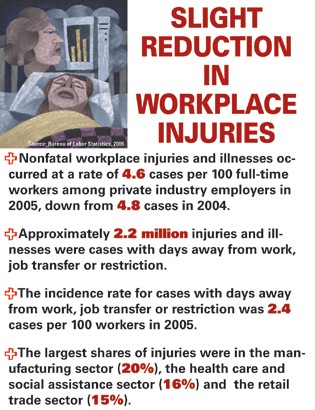
According to its website, the Bureau of Labor Statisticsis the principal fact-finding agency for the Federal Government in the broad field of labor economics and statistics.” One of its functions is to track the number (and severity) of injuries we suffer while at work:

We don’t know, of course, what’s caused this decline; perhaps our friends at Worker’s Comp Insider will have some insights. Regardless, this seems to me to be good news.

Insurance Dispatch

Employee Assistance Programs, about which we've written here at IB, are the subject of this week's column now posted at The Medical Blog Network.

Friday, November 03, 2006

Your Health or Your Wealth?

We blogged recently on the kinds of benefits most American workers prefer. But a new survey, conducted by the American Payroll Association, went a bit further: they found that most of us apparently prefer increased benefits to increased wages:

In a way, that makes sense: wages are subject to taxes, which dilutes their value; benefits are not, and so retain full value. Over 30,000 folks participated in the survey.

Cavalcade #12 - Submissions Due

Just a reminder that submissions for next week's C of R are due Monday (the 6th). Chris at MedBill Manager would love to see your work. You can submit entries:

■ via email or

■ at Blog Carnival

PLEASE include:

► Your blog's url

► Your post's url

► The trackback url (if applicable)

► A (brief) summary

PS: We're still looking for hosts. If you'd like to host a future edition, just drop us an email.

Thursday, November 02, 2006

Health Wonk Review

Terrific HWR this week, hosted by Jason Shafrin at the Health Care Economist. He includes 16 posts in 5 different categories.
Here at IB, we talk a lot about consumer empowerment, but Social Marketing and Change's Craig Lefebvre warns about the problems of consumer health illiteracy.

Better Late Than Never Department...

Apparently, this week's Carnival of the Capitalists scheduled host went AWOL, and the estimable Jay took up the cause. There are over 40 entries in this edition, each with at least some context. Bravo, Jay, Bravo!
Always a fan of "over the top" thinking, I really enjoyed Long or Short Capital's post on a, um, unique fundraising idea (all for a good cause, of course).