Tuesday, March 20, 2018

Much ado about ... What, exactly?

Health Agents for America (HAFA) president Ronnell Nolan produces a series of vlogs (basically video blogs) about various issues that we deal with every day. Recently, she posted this one. Please watch (it's only a few minutes long) and then I'll share our discussion about it:


She linked the video on Twitter, with the warning that "one of HAFA's Agents from New Hampshire with a large book of business lost their Anthem contract. Basically, they were told because they could! READ YOUR CONTRACTS!!"

This agency, which had apparently brought a lot of business to Anthem's table, was summarily excused from it. This is not in dispute. Where Ms Nolan and I part ways is in her characterization:

I pointed out that Anthem was well within its rights to execute the contract's cancellation clause, as would be any carrier (and, of course, agents are also free to bail at their discretion). To which Ms Nolan replied:

"Most Agent/Brokers do not know contracts can be cancelled at will. Goes back to the question....whose customer is it. After I bring the company to you....you have a right to discard me?"

Well, yeah.

As I responded, when I request appointment with a carrier I also agree to abide by the terms of their contract (which is supplied to me and which I of course read from cover to cover). And yes, I did bring them my customer/client. Which client, by the way, I am free to move to another carrier in the future, and there's nothing that Anthem (et al) can do about that.

Understandably, Ms Nolan wasn't entirely satisfied with this take, and pointed out that it's "Not wrong by contract you are right. But morally wrong."

Perhaps, although as I just pointed out, it's a two-way street: am I "morally wrong" when I move clients from one carrier to another?

The bottom line is that while I in no way condone Anthem's actions here, I'm not seeing anything illegal or even "wrong" in what they've done. Reprehensible, probably, but not wrong.

Monday, March 19, 2018

From the P&C Files: AirBnB Issues

Several years ago, my daughters traveled to Vancouver (because reasons) and stayed in an AirBnB. What I most recall about the experience was that the hostess insisted upon "meeting" them on Skype and interviewing them to see if they'd be a 'fit.' Having stayed in numerous traditional Bed & Breakfasts myself, this struck me as both odd and sensible.

Apparently, not every such host goes that extra mile, and to their detriment. FoIB Tsrblke alerts us:

"An Airbnb host claims that a nightmare guest left $18,000 worth of damage in her home"

After some 300 people trashed their house (invited by her client, no less), the owner admits that there were some "red flags", but it appears that the "green dollars" overcame them.

Ooops.

The corporate folks at AirBnB HQ offer a cool million dollar "guarantee" for hosts, but so far this one's not seen a dime.

So why doesn't she just claim it on her homeowner's policy?

We reached out to our regular Guru of P&C, Bill M, who told us that:

"The use of your home for commercial purposes is typically excluded.  Some companies are coming out with a business endorsement for “air b&b” type exposures.

The biggest thing is to communicate with your agent to discuss challenges and how best to solve them.

And by the way, traditional B&B's can have some of the same issues, especially if the owners/hosts live in the home
."

As Tsrblke reminds us:

"Nobody in the "sharing economy" is taking basic steps to protect their assets. The company "guarantees" aren't insurance and shouldn't be treated as such."

Yup.

Friday, March 16, 2018

Willfill Blindness or Simple Fanatacism?

There is no question that insurance companies, primarily as a result of the politics and economics of ObamaCare, contribute less value and drive more out-of-pocket than ever before. And it's also true that Direct Primary Care (DPC) continues to offer a viable alternative method of health care delivery and (to a much lesser extent) health care financing.

But I'm concerned that DPC proponents are, as the saying goes, becoming the abyss:


To which I replied:


And this is becoming a real problem. Regular readers know we have no compunction about calling out Stupid Carrier Tricks, but the fact is, insurance can (and does) play a uniquely vital role in most people's ability to afford catastrophic health care expenses.

Yes, re-introducing true Cat plans would be a tremendous step in the right direction, but we don't have that yet, and aren't likely to any time soon (more's the pity).

But the fanatical DPC Brigade risks losing whatever credibility it's built up by ignoring the actual costs of major claims and presuming that regular folks can bear the brunt of them.

#Sad

Thursday, March 15, 2018

Ides of March Health Wonk Review

Our good friend David Williams hosts this month's round-up of all things health wonkery.

Do check it out.

Tuesday, March 13, 2018

Another opinion survey

Civis Analytics (CA), a firm started by 2012 Obama campaign veterans, conducted a telephone opinion survey February 28 about American policy priorities.  Powerline reported their results here, and Vox here.

Powerline excerpts two charts from the CA survey.

The first chart shows responses of likely Democratic voters - of whom 45% give top priority to “health care”!  Whut!? Because Obamacare didn't work?  Because this time, they’ll get it right fer shur?  

Reminds me of an old Flip Wilson punch line:  “Hell no, you broke yours off already!” 

The second chart shows responses to the same questions, only this time the sample group is all likely voters – in other words, not just Democrats.  Notice how the percentages change from the first chart to the second.  The second chart reveals far less less support to “health care”.

Yet Civis Analytics has this to say:  “Democratic voters, and voters in general, seem very clear in their preference that health care come first.”  Vox opines that “the numbers are strikingly similar, with answers more concentrated around health care and guns”.   Really? Voters in general?  Strikingly similar??

I don’t think so.  I say CA and Vox have it wrong.  I say Powerline has it right: “the results skew when all likely voters—not just Democrats—are reported”.  How much does it skew?  Assuming CA surveyed roughly equal numbers of likely Democratic and non-Democratic voters, the results in the two charts imply about 17% support for “health care” among likely non-Democratic voters. Do 45% and 17% seem strikingly similar to you?   Do 45% and 17% mean underlying agreement?   

Of course not.  CA and Vox both err in looking at the average of the combined surveys as though that average reflects unified public opinion. It’s an error because the responses of the two survey populations show a clear and sharp difference of opinion about “health care”.  Therefore it’s false to claim the overall average represents any general preference.   CA’s conclusion is like claiming that, on average, Americans have one testicle and one ovary.  It’s only “true” when you ignore the reality underneath the average. 

Yet despite Civis Analytics’ (and Vox’s) equivocations, I think the CA survey does reveal two important truths – (1) “health care” remains a divisive issue among Americans and (2) the division still appears to have more to do with politics than with the actual substance of “health care”.  

Low Opinion or Xenophobia (or both?)

Well, have to do the (stupid) Anti-Money Laundering course again (don't ask). Each time I do so, I find something else that's ironic and/or humorous (or, more often:  dumb).

[click to embiggen]
So what are they saying here, exactly?

And aren't the folks who actually write and enforce this material in an "elected or appointed government position?"

Oy!

Monday, March 12, 2018

On Severability

We first noted this issue way back in 2010:

"[A] federal judge in Virginia has ruled the (Evil) Individual Mandate unconstitutional ... Since the judge has ruled that the precept of "severability" does not attach"

Um, Henry, what's your point?

Well, it actually involves The Lone Star State (and 19 of its closest buds), The Constitution, and the law. Severability simply means that if one part of a particular law is deemed unenforceable, the rest of it could still be fine. But its absence would mean that if one part is tossed, then the rest is, too  (baby, bathwater, you understand). Most legislation includes a "severability clause" that essentially says "hey, even if Part 2 is deemed non-enforceable, the rest of this law still stands." It's pretty standard wording.

Unless you're the Party in Power
©, in which case you ram through a hastily written revampling of our entire healthcare financing and delivery system, and decide one's not necessary [ed: we would also accept "You're the Party in Power© and are too stupid to catch its absence"]. And here's where it gets .... interesting:

The theory behind the suit is that, since Justice Roberts (et al) deemed the Mandate 'kosher' as a funding mechanism, and since  the  Tax Cuts and Jobs Act of 2017 explicitly set that funding at $0, the entire platform on which ObamaCare was built is null-and-void.

Whoa there, Henry, went a little fast there, didn't you?

Okay, remember that "severability clause:" we discussed? Well:

"Once the heart of the ACA — the individual mandate — is declared unconstitutional, the remainder of the ACA must also fall."

Of course, the Supremes will do what the Supremes will do, but this seems like at least a viable argument.

Sunday, March 11, 2018

'Nuff said


[Hat Tip: tsrblke]

Friday, March 09, 2018

Breaking: CMS puts kibosh on Gem State ACA plans

Back in January, we reported on Idaho's decision to circumvent the #ACA by allowing carriers "to sell cheap policies that ditch key provisions of the Affordable Care Act."

At the time, we wondered how that would play out from DC's perspective.

Well, now we know:

"CMS Rejects Idaho Proposal for non-Affordable Care Act Plans"

Ooops.

CMS honcho Seema Verma [ed: which would be a great name for a rock band] points out (correctly) that ObamaCare "remains the law, and we have a duty to enforce and uphold [it]."

So that's that.

For now, anyway.

InsureBlog meets Mercatus

Yesterday, I had the distinct privilege of meeting longtime Friend of InsureBlog Bob Graboyes, Senior Research Fellow and Health Care Scholar at the Mercatus Center at George Mason University, and esteemed co-blogger Patrick Paule. Bob was in Columbus for a speaking engagement, and so Patrick and I drove in so that we could all meet, break bread, and shmooze:


[click to embiggen]

It never fails to amaze me that one can develop such strong bonds over these electronic tubes, and what a delight it is to actually meet "in the real world." Our conversation ranged from family, to background, to policy (of course!), and it was just a great opportunity to share ideas and get to know one another on a more personal level.

Thanks, Gents!

Wednesday, March 07, 2018

Triumph of Socialized Health "Care"

For certain values of "triumph," of course.

First up, the caring, compassionate folks at the Much Vaunted National Health Service© seem to really enjoy killing newborns:

"The parents of a seriously ill toddler have lost their appeal against a High Court decision to end his life support."

Alfie Evans, a 21-month old Brit, has been fighting hard for his young life. But the Powers That Be at the MVNHS
© are (literally) pulling his plug, even though his parents have requested to send him abroad for treatment.

And I'm sure that there's no irony ion the fact that the hospital he's being treated at, well, was being treated at, is in Liverpool.

Interesting Pathway, nyet?

But we really shouldn't be that surprised, since we see similar results here in our own version of government-run healthcare:

"Obamacare Medicaid expansion is causing more disabled people to die on waitlists."

Shades of the VA, no?

Again, what good is having "insurance" if you can't actually access care?

Inquiring minds....


[Hat Tip for Baby Alfie story:  NDH]

Monday, March 05, 2018

Latest #ACA Winners and Losers

■ Last time we checked, Blue Cross/Shield of North Carolina had just "filed for a 22.9 percent rate increase."

So how'd that work out?

Well, FoIB Jeff M alerts us that the carrier - the largest in The Tar Heel State - appears to have done okay for itself, as it:

"[H]as reported a higher than anticipated net income margin in 2017 at 7.8 cents for every dollar of revenue."

I bet.

■ Over on The Twitter, Dr Ari Friedman warns us about the dangers of ObamaCare's Medicaid expansion:

"Declining Medicaid Fees and Primary Care Appointment Availability for New Medicaid Patients"

To be fair: someone has to pay the piper.

■ Finally, longtime FoIB Holly R tips us to this bit of non-helpful rhetoric from the anti-ACA side:

"Sen. Orrin Hatch calls Obamacare supporters 'stupidest, dumbass people'

The Senator may not be wrong, but this kind of inartful, divisive and insulting characterization does not help out the good guys. In fact, it cheapens and denigrates the anti-ObamaCare argument.

Respectfully: Zip it, sir.

Friday, March 02, 2018

More Great News from the MVNHS©

Free health care rocks!

Wait, what?

The Much Vaunted National Health System© strikes again:

Not So Open Enrollment

I've been working with a referral over the past few days. This young man works for a regional retail store, and thought he'd enrolled for the group health insurance during their most recent Open Enrollment period (he was a relatively new hire at the time), but found out unexpectedly (at the provider, natch) that he had not, and was currently uninsured.

So he went to HR to try to get back on-board, but his appeal was denied. Ken was told that he'd have to find another health insurance plan, "any plan," in fact, and then cancel it to be eligible (yeah, didn't track for me, either, but there it was).

Over the course of several emails and phone calls, Ken shared with me this little tidbit that seemed to confirm what he was being told:


[click to embiggen]

Eagle-eyed readers will note the two rather glaring problems here. First, does no one use spell-check any longer? Second - even more egregiously - as I pointed out to Ken, "Credible" coverage would mean any ID card I successfully PhotoShopped together. And it's not like "Creditable" coverage is a new term, it's been around for at least 20 years.

In the event, we still had to get him something for a month, but with ObamaCare's Open Enrollment in the rear-view, and no Special Open Enrollment triggers available, what to do?

Of course, this is a perfect use of Short Term Medical (I mean, how much shorter of a term could there be?), so we got Ken signed up for March, and we'll cancel it at the end of the month so he can qualify for group coverage.

What's that? "Playing chicken, you say?"

Yup:

My concern is that we'll get to the end of the month, cancel the STM, and then find out that it wasn't "Credible" coverage, after all. All we could do then, of course, would be to look at another STM, or perhaps explore other options for the balance of the year.

I'm not happy about this, but at least we've bought him some time.

Thursday, March 01, 2018

"Duty of Care"

Our friend Peter Shulteis at Global Underwriters wants folks to be aware of some critical issues related to working in distant lands:

"The number of people driving and flying for business purposes each year is astounding. The Global Business Travel Association counts over 488 million trips taken annually. Each year business travelers take an average of 12 trips, typically lasting at least 5 days. An estimated 1.3 million business trips occur daily in the U.S. alone. These figures are expected to grow another 7% this year.

Even with video conferencing, webinars, and daily conference calls business travel continues to increases and is vital to the success of your clients company. Hectic schedules, missed flights, transportation issues, and hotel problems are the least of employees' worries. Many employees are citing concerns related to personal security, terrorism, political unrest and infectious disease epidemics.

It's crucial that companies and organizations embrace Duty of Care obligations [ed: about which we've previously posted] and take the necessary steps to reduce potential dangers or problems that could occur while employees travel. Employers need to have a well communicated plan in place and part of this plan is providing Business Travel Accident (BTA) insurance for their employees. BTA insurance is an inexpensive benefit that supplements any employee benefit program. This World Class Protection is designed to offset the risk and potential loss of a key employee(s) and to compensate families of employees for their loss of income due to accidental death or permanent disability of a loved one
."

So, what is Business Travel Accident (BTA) insurance? Basically, it "provides protection for employees who travel on business domestically and / or internationally."

By the way, this is available both for American companies sending folks abroad, and for business travelers coming to our fair shores.

Peter goes on to note:

"Most companies and organizations are innocently unaware of potential hazards that exist for employees that travel on behalf of the company or organization. Employers need to know how a Business Travel Accident (BTA) policy can mitigate risk for both the company and employee(s). Serious consequences can be levied against companies or organizations that neglect to properly insure or protect their employees when they travel."

Thanks, Peter!

And readers interested in more detailed info on BTA should click here.

Wednesday, February 28, 2018

MidWeek LinkFest

■ Medical Mutual of Ohio is enhancing its autism coverage for many of its insureds "on the spectrum." I've already reached out to one client that I know of who's likely to benefit from this.

Coverage enhancements include speech, language and occupational therapy, as well as screening and diagnosis benefits.

Yasher koach.

■ Last time we looked at the burgeoning Life Settlements industry, I mentioned my own uneasiness with the concept:

"It's not that I have any particular ethical qualms; after all, it's my client's policy, so why should I care? It just feels ... weird to bring this up."

But our friend Allison Bell reports from that industry's annual convention that they're facing an equally difficult challenge:

"Life insurers and life settlement firms are struggling to comply with new tax reporting rules without an official tax form, a draft tax form, or a clear idea of what the Internal Revenue Service might like to see."

Turns out, even though viaticals have been deemed 'kosher' for some 20 years, their fraternal twin Life Settlements are facing different tax treatment (which makes sense, one supposes), and the IRS still hasn't gotten around to providing a fix.

Whether or not that will prove an insurmountable obstacle remains to be seen.

■ And speaking of relatively new, burgeoning industries, I've been spending a lot of time lately educating folks on the Direct Primary Care model (since I no longer sell ACA-compliant health plans, and still want to provide some service to clients). The challenge is that I really didn't know where to send folks for local DPC practices.

Now, thanks to FoIB John Chamberlain, I've been clued in to this helpful site which offers an interactive map of nearby DPC's.

Nice!

Tuesday, February 27, 2018

Tomayto, tomahto

Via The Banana News Network (courtesy FoIB Holly R):

"About 9 million fewer Americans will have health insurance next year thanks to the Trump administration and Republicans in Congress, a new report estimates"

Translated:

“About 9 million more Americans will have the choice of finding lower priced, better coverage ACA alternatives, thanks to Donny Two Scoops” 


Related:

"20 states sue Trump administration to end Obamacare after mandate repeal"

The logic seems to be that deleting the tax fine penalty somehow "invalidates the mandate and all of Obamacare."

Interesting.


Monday, February 26, 2018

The MVNHS© continues swirling

Another day, another chapter in the on-going train-wreck we lovingly call the Much Vaunted National Health System©:

"NHS crisis: Patients face delays for vital treatment amid 'staggering increase' in cancelled operations"

Well no wonder. I'm old enough to remember this (from last month):

"Every hospital in the country has been ordered to cancel all non-urgent surgery until at least February in an unprecedented step by NHS officials."

Things (obviously) haven't gotten any better, with the Independent reporting that:

"Nearly 1,000 urgent operations have been cut so far this winter for patients with life-threatening illnesses due to pressures on hospital resources ... It’s unsurprising that urgent operations have come to be cancelled at a greater rate over these years of spending restrictions and increasing demands on services."
No kidding.

But remember kids, national health care schemes are proven to reduce costs and provide excellent, timely care.

Plus: Free!

[Hat Tip: FoIB Michael Bertaut]

Dunkin' (Medicare) Donuts

We first blogged on the (so-called) Donut Hole in Medicare over a dozen years ago:

"The donut-hole comes into play whenever a covered person (“beneficiary” in Medicare parlance) reaches a specific threshold, and leaves that person without prescription drug cover until another threshold is reached."

And it's a big problem for seniors, since that demographic tends to use a lot of meds.

Recently, our friends at Cornerstone alerted us that:

"For Medicare Part D beneficiaries with high prescription drug expenses, the “Doughnut Hole” means they pay more for their medicine once costs reach a certain threshold. Narrowing each year since the Affordable Care Act was passed in 2010, the gap was scheduled to close in 2020. With the 2/16 budget deal, the doughnut hole will now close in 2019."

So, good news, right?

Well, maybe not. As co-blogger Bob V explains:

"Medicare drug donut hole to close in 2020 as part of Obamacare. Trump closed a year earlier in latest budget deal. Carriers are unhappy because they will have to pay more for drugs. Also CMS trying to shift expensive drugs currently covered under Part B to Part D."

To which I (who should have known better), replied:

"Ah. Well too bad for the carriers, but seems like okay for insureds?"

(Yeah, dumb)

Bob put it to rest:

"Rule #1. Carriers don't pay for higher costs.

Consumers do.
Higher premiums, copay's, deductibles, OOP [out-of-pocket]"

Yup.

"I'm from the government..."

Wednesday, February 21, 2018

Tacos, Tequila and (Medical) Tourism

Medical Tourism has been a frequent topic here at IB, so this tweet from FoIB Dr Kris Held caught my eye:
Perhaps not-so-coincidentally, I recently received this in email:

[click here for full graphic]

There are, of course, downsides to traveling to foreign lands for health care, and one wonders how (or even if) such care is covered under one's insurance. But there's no question that actually receiving timely care seems to be a lot more important than owning an insurance ID card that doesn't actually provide it.

[Hat Tip: Lisa B]

Tuesday, February 20, 2018

"Skimpy" Insurance

Tomayto, tomahto. From CMS Secretary Seema Verma:


And Reuters' more, um, progressive take:

"U.S. to extend skimpy health insurance outside of Obamacare"

Well first, no one's "extending" anything: Short Term Medical plans have been around for a long, long time.

And let's talk about that rather loaded term: "skimpy"

Most STM's offer deductibles as low as $500 (or lower), with out-of-pocket exposure (MOOP) limited to a few thousand dollars.

Contrast that to typical ObamaPlans with deductibles over $7,000 a person, and MOOPs in the tens of thousands. But yeah, the STMs are "skimpy."

All this particular ruling does is restore the maximum policy length to the status quo ante, before the previous administration unilaterally (and illegally) cut those short.

So which one's "skimpy," skippy?

[Reuters Hat Tip: FoIB Holly R]

Monday, February 19, 2018

Monday Morning LinkFest

■ Interesting story about the (perhaps not so precious) Much Vaunted National Health System©, courtesy of co-blogger Mike:

"[Prime Minister Teresa] May spoke of the importance of “taking a balanced approach to government spending, so we get our debt falling but can also invest in the things that matter -- our schools, our police and our precious NHS.”

The article's author points out that this is a rather odd description of a government bureaucracy, and he goes on to explain why it's rather troubling.

■ It's been a while since we've posted on Alzheimer's; last May we noted that "[m]aple syrup isn't just delicious, it could also cure Alzheimer's disease."

Now, thanks to FoIB Holly R, we learn that "scientists have successfully reversed Alzheimer's in a middle-aged lab mouse."

That's the (potentially) good news.

The bad news is that the day before this breakthrough was announced, another clinical trial of the med was called off "due to safety fears."

Hopefully they can get those resolved.

■ A Lone Star state mother appears to have chosen poorly:

"A Texas mother of two died Sunday from flu complications after reportedly deciding that the $116 medication to treat the virus was too costly."

As FoIB Jeff M (who tipped us to this sad story) observed, "the funeral is likely to cost even more."

Her widower defended her decision thusly:

"She wouldn't go get medicine because she's a mama. Mamas are tough ...  I don't think she is being irresponsible. I don't think she thought she was that sick. It happened so quick."

The truly tragic part is that her husband actually picked up the drugs for her, but by then it was too late.

Tragic, but easily preventable.

Friday, February 16, 2018

STCi: Revisited

It's been a while since we talked about Short Term Care insurance coverage:

"Short-term care (also known as Recovery Care or “LTC Lite”) is not a new product but it has been gaining ground in the last 2 years ... With its shorter underwriting cycle, high-issue rates, and low premiums it’s becoming increasing popular"

As may be, but contra this take, we really haven't seen much discussion of this product in the intervening five-and-a-half years, so one wonders about its appeal.

On the other hand, there must be something positive about it; we recently received this educational video on a related plan from our friends at Guarantee Trust Life:


GTL's Short-Term Home Health Care Insurance from Guarantee Trust Life Insurance on Vimeo.


Thanks, GTL!

Thursday, February 15, 2018

Post-Valentine's Health Wonk Review

Steve Anderson hosts this month's eclectic collection of health care wonkery, with a decidedly Olympian effort.

Do check it out!

Celebrating Obamacare's Exchange "Success"

Last week a new report came out - albeit not from CMS - showing Obamacare's enrollment results for 2018. The headlines make the case that enrollment is "stable", that the law "isn't dead". Another headline by the AP's Ricardo Alonzo-Zaldivar portrays it as a success "despite efforts to dismantle the ACA" by the Trump Administration. Fast Company's headline goes as far as to say Obamacare is "still pretty popular" despite attempts to "kill it."

These stories are total spin showing media are nothing more than fairweather fans. The truth is, since 2015, Obamacare's exchange enrollment figures show that Team Obama hasn't been able to move the football down the field. What has changed, is in eight years of Obamacare we have seen goalposts moved. This allowed Team Obama to spike the football on a field that is less than half the size of what they originally were playing on.

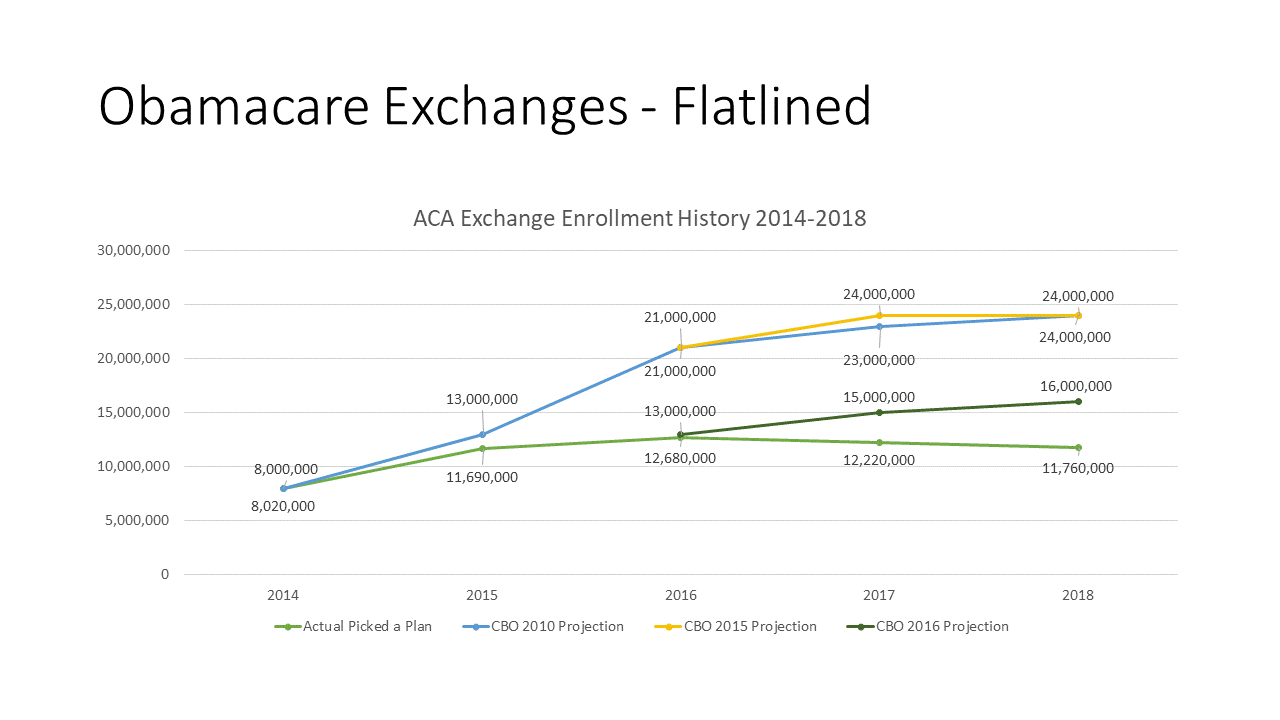
In the original CBO score enrollment in the exchange was supposed to be 21 million in 2016, 23 million in 2017, and 24 million in 2018. By 2016 CBO set new goal posts hoping to break 13 million. Cutting the field in half was the only way Obamacare supporters could claim that insurance exchanges are working. You can see here how bad the exchanges have actually performed.


The chart is nothing to celebrate. This is not a success. This is a football team that is entrenched in mediocrity. The team has struggled to move the ball because the offense being run doesn't work. Instead of being open to a new offense, fairweather fans jumped on the bandwagon embracing changes to the rules of the game. When that didn't work they started blaming losses on the new coach who inherited a mediocre team from his predecessor.

Wednesday, February 14, 2018

Sidebar Update News

FoIB Roger Downey has launched a new health news aggregating site, and it's quite interesting:

"My Healthcare Report is the healthcare version of the Drudge Report without the politics. There is nothing else like it on the internet: I select the top story and populate the three columns below with links to the latest healthcare stories."

I like the minimalist, easy to navigate design, and there are a lot of interesting news items. We've added it to our sidebar ("Blogs of Interest").

Do check it out.

About That Individual Mandate...

For the last few months we have been hearing President Trump touting his "repeal of the individual mandate" as a huge opportunity for people to not be penalized for going without health insurance. On the Democratic side Nancy, Chuck, and their minions have been scolding Republicans for kicking 13 million people off of insurance.

This game of rhetoric is confusing to the general public. Well, never fear, here at IB we are all about educating the public as to what the reality of the latest partisan divide actually means.

First, let's get the "people are going to die/kicked off insurance" fallacy out of the way.

Democrats were quick to point out that CBO is showing that in 2026 (8 years away!) 13 million more people will be uninsured through their scoring system. In telling the story democrats have used language that insinuates people are going to be kicked off of their plans. This is a blatant lie. 

The CBO report notes that 5 million people will drop off of Medicaid, 2 million will not stay on their employer sponsored plan, and 5 million people will not buy insurance in the individual market. Note that none of these people are being forced to lose insurance. Rather they are electing not to participate. That's a huge difference.

So, what is the truth about "repealing the individual mandate"?

Quite simply put, the mandate still exists. It's still in the law. What has changed is the penalty for not purchasing health insurance has been zeroed out in the new tax law. More important, the zero doesn't begin until 2019. So not only is the mandate alive it still has teeth (alright maybe only a single tooth) for this year. Here's the actual language from the tax bill Trump signed:

PART VIII—INDIVIDUAL MANDATE
SEC. 11081. ELIMINATION OF SHARED RESPONSIBILITY PAYMENT FOR INDIVIDUALS FAILING TO MAINTAIN MINIMUM ESSENTIAL COVERAGE.

(a) In General.—Section 5000A(c) is amended—
(1) in paragraph (2)(B)(iii), by striking “2.5 percent” and inserting “Zero percent”, and

(2) in paragraph (3)—
(A) by striking “$695” in subparagraph (A) and inserting “$0”, and

(B) by striking subparagraph (D).

(b) Effective Date.—The amendments made by this section shall apply to months beginning after December 31, 2018.

A swing in the political pendulum could bring the penalty for not having insurance back. Changes in congress could reopen these discussions. Striking "Zero percent" and inserting "2.5 percent" could happen. Republican's aren't telling you this.

Honesty is a lost attribute for politicians these days. Yet CNN, Fox News, and countless other media continue to promote what the inner beltway folks tell them as if it is gospel. This is why we are in the political environment we are today. Honesty doesn't get you reelected. And the best stories are the ones that are the most egregious.

Fortunately for IB readers, we aren't politicians or journalists. Instead we are insurance professionals. You know, the guys who politicians think are one step below ambulance chasers and one grade above used car salesman. 

Tuesday, February 13, 2018

#Fake ObamaCare News

Uh-oh, looks like someone misspelled 3000% rate decrease:

"Health care premiums for the skimpiest Obamacare plans in the District of Columbia are skyrocketing in 2018."

Rates for Bronze-level plans are supposed to be among the lowest (with concomitantly higher out-of-pocket exposure). The article cites the example of Daniel Turner, "a single healthy guy in Washington, D.C., with no dependents." His Bronze plan shot up almost 36%, to over $4,400 a year. Couple that with his deductible and co-insurance and he's out over $10 grand before the plan pays a nickel.

Oh, wait, he does get a "free" colonoscopy, which is worth at least a few hundred, right?

Monday, February 12, 2018

Monday Afternoon LinkFest

■ First up, via FoIB Holly R, is news that the Much Vaunted National Health System© continues to circle the drain:

"[E]xpenses have forced 40% of walk-in health centers to close, all elective surgery in January [had] to be cancelled, and primary care has been decimated"

But hey: Free.

This is, of course, rationing by government fiat, and it's how nationalized health "care" works. Which is why it's not likely to take hold here (and the apparent rollback of the ACA Death Panel helps nail this particular coffin shut).

■ Down the road, FoIB Jeff M tips us to this Tale of Two Exchanges:

"Most states that operate their own ObamaCare exchanges saw more people sign up in 2018 than last year, while 29 of the 34 states that rely on the federal government to promote enrollment saw their sign-ups fall."

Overall enrollments continue to free fall; last year saw a year-over-year falloff of almost 4%.

Of course, the article attempts to lay the blame on the Trump administration, despite the fact that we've seen enrollments decline pretty much the whole run of the HC.gov debacle.

■ Readers may recall our post a few weeks about mudslide coverage for our Golden State friends:

"We wondered if (and/or how) one would be covered if one's house (literally) went downhill."

Co-blogger Bob alerts us that the state's Insurance Commissioner has chimed in:

"The notice acknowledges that homeowners’ and certain commercial property insurance policies frequently have exclusions for losses from mudflow, debris flow, mudslide, landslide or other similar events."

Okay, so far so good.

"Under California insurance law, the exclusions are not enforceable if the facts establish that the wildfire, which is a covered peril, was the “efficient proximate cause.”

Oh, frabjous day. Let's just wave the ol' magic wand and conjure up coverage.

WooHoo!

Another Timely Reminder

That health insurance ≠ health care. As FoIB David Fluker points out:


To which I replied:

"We have same issues here in OH with CareSource, Molina, etc"

In my market, and in fact in most counties in the United States, there are only a few "choices" when it comes to ACA-compliant health insurance plans. Here in Montgomery county, the only such carriers are all primarily known for their Medicaid business (for lack of a better term, since Medicaid isn't insurance) that have jumped in to the ACA marketplace. And with very narrow networks (since most doc's don't want any part of Medicaid-level reimbursements), insureds are finding that their purchase may have saved them from the penalty tax fine, but is of little other value (well, except for that free birth control, er, convenience items).

So if one can't actuality use the plan, what's the point in paying for it?

Co-blogger Patrick also jumped in to the fray, pointing out that "Centene is already at the center of a lawsuit for insufficient network adequacy."

Thing is, suing for a desired result doesn't guarantee that result; the question becomes "how does one force a carrier to add non-willing providers?"

I wouldn't be counting any chickens just yet.

Happy (Belated) Blogiversary

Well! I certainly don't understand how that happened: We recently (January 31st) marked our 15th (!!) blogiversary, but failed to note it. Still amazed that a decade-and-a-half later we're still going strong, with the best co-bloggers on the internet.

Thank you, dear readers, for for your continuing support and interest!

Monday, February 05, 2018

From the Mailbag: A Toughie

This one seems to be a real poser:

"I am hoping you can answer some questions I have. I've been looking at my marketplace application and it asks about dependents and whether or not you claim them on your taxes. My divorce decree is written so that I can claim 2 kids one year while my ex claims 1. The next year it switches. So for the purposes of getting insurance through the marketplace, can I only claim each year which children I will be claiming that tax year? My ex says when he claims the children he cannot get the child tax credit because they do not live with him. So all of this is confusing to me. I will have to pay even more for insurance if I do not claim them all. They live with me full time and their father pays child support.

As things stand now, I am court ordered to carry them on insurance. However when I fill out the application it asks me if they have access to private health insurance. Technically they do through their father but I do not have the power to force him to carry them without seeking a court order. If I answer that question as they do not have access, is that technically correct since I can’t make him without a court order? My plan is to get the order changed anyway but I have considered carrying them if it makes the premium cheaper. However, I do not know if I legally can. I would like to know what my options are in regards to this.

I have asked a few attorneys I know about this and none of them even an answer. If you cannot answer me, do you know of someone who can answer?

Thank you so much! I know that is a lot of craziness
."

I replied:

"I’ve gone round and round on this, and the challenge is that these are really closer to legality/tax questions than I’m comfortable answering (since I don’t play either a lawyer or*an accountant on TV).

Two thoughts:

1 – I’d call the .gov hotline (800-318-2596) and see what they have to say.

2 – I’ll also make this offer: We would be happy to post this in our “From the Mailbag” series (anonymously, of course), see if that produces anything helpful.

Just let me know.

I’m so sorry I can’t be of more help
."

She responded:

"Unfortunately none of my lawyer buddies know the answer to this but none of them specialize in tax law. I will try the government hotline as soon as I can. If you want to post it on your blog that is fine with me as well. I can’t be the only one with this problem."

Which is more than a fair cop.

Please feel free to share your thoughts in the comments, or drop us a line in email if you'd prefer.

NB: For now, this is strictly about coverage, not subsidies.

Thank you!