Thursday, May 11, 2006

Under the Mass Microscope (Part 1)

Eight years ago, when Kennedy-Kassebaum (aka HIPAA) was being hammered (and subsequently rolled) out, a colleague and I downloaded and read the entire legislation (which, IIRC, ran some 200+ pages in a pdf file).
While everyone else was touting guaranteed issue, and portability, and even viaticals, Ray and I noticed something other things: NPI, and PHI, and other less than savory components.
We predicted that HIPAA would, ultimately, create at least as many problems as it purported to solve. And, ultimately, that seems to be the case.
So now we turn our attention to the oft-cited, but apparently less well understood, MassHealth insurance reform plan now being implemented in the Bay State. As is our wont here at IB, we’re going to look at some of the items that are currently “under the radar,” but which could very easily become profound. And, unlike some blogs, we won’t rely on the news media’s interpretation of “what it all means,” we’re going to be working strictly from the law itself.
■ To subsidize the purchase of private insurance for low-income individuals
■ To reduce the number of uninsured
■ And to direct more federal and state dollars to individuals and less to institutions
Lofty and laudable goals, to be sure, but are they the least bit realistic?
Well, let’s see.
The very first piece is about low-income folks. But many (most?) are already covered by Medicaid. So this is just good old-fashioned cost-shifting, or perhaps that should be “shafting.” And a lot of other folks choose to go “bare.” What happens to them?
Almost a year ago, when this plan was embroyonic, I asked “where are the teeth?” Well, we got ‘em: introducing the “Health Insurance Responsibility Disclosure” form, “to be completed and signed, under oath, by every employer and employee doing business in the commonwealth,” failure to comply with which “may be subject to sanctions under chapter 111M.”
Whatever that means (but it probably isn’t fun).
Believe it or not, there’s more. Click for Part 2.

Wednesday, May 10, 2006

Restraint of Trade, and A Lesson...

For a very, very long time, most types of insurance have been sold through the General Agency system. Briefly, a carrier contracts with a General Agent, which acts as a distributor, usually for several carriers. The GA then contracts with individual agents who actually sell the product to the public. The GA provides technical and administrative support to the agents, and acts as a conduit for compensation (commissions, overrides, bonuses, etc). Very good GA’s act as advocates for the agent if there are “issues” with the carrier, and act as “backup” for the agent if a client has one (see: Cylons).
Because we enjoy a free market system, agents are free to move among GA’s, picking the one (or ones) that best suit their needs.
So far, so good.
Now one carrier has adopted a strange and provocative tactic: it has “frozen” such transfers. That is, if I represent that company, and I have a problem with my GA, well, too bad. I can’t switch to another one.
And that is “restraint of trade.”
Now, I happen to have an excellent GA, and can’t imagine a situation where I would wish to change to another one. But, I fervently enjoy my freedom to do so should the need arise. When I received the letter this afternoon, announcing this new company directive, I immediately called the Attorney General’s office.
Now, you may ask, “Henry, it’s an insurance company, why didn’t you call the Department of Insurance?” There are two answers:
First, this is a legal, not an insurance, issue and second, the DOI is useless in this matter. Their primary constituency is not the consumer, nor the agent, but the carriers. So even if they could do something, it's unlikely that they would.
So, I spent the next 40 minutes being shunted around the AG’s office, growing more and more frustrated because no one seemed to know whether or not there was anything they could do. At one point, a (nice) lady admitted that they didn’t do much legal work in her area, which led me to ask why I was paying their salaries.
Eventually, I ended up with an actual, real live attorney. So, for the fourth (fifth?) time, I repeated my story. He replied that the Department of Insurance (DOI) was his client, so he didn’t see what he could do. I am proud to say that I did not, in fact, point out to him that I was his client, since I pay his salary. Rather, sensing that this would not move the ball forward, I let it go.
He did give me the phone number for the Anti-Trust Department, and wish me luck.
I decided that I needed a bigger gun.
One of my clients also happens to be my State Representative, so I decided to bring the Legislative Branch into play. I called him, and explained the situation. At first, he offered to speak with the DOI, but I was able to redirect him toward the AG’s office. He promised to have someone from Anti-Trust call me, and (more importantly) to call him back, so that he could stay in the loop (and involved).
That’s the game so far; I’ll keep you posted on my progress.
Oh, the lesson? If you’re an insurance company, try not to tick me off.
UPDATE (5/12/06): A gentleman from my Rep's office called, and I explained the situation to him. He's promised to contact the Anti-Trust folks at the AG's office, and to stay in the loop, as well. And indeed, I've been copied an email he sent to the AG's office.
It would be nice to know if there are other agents (and/or brokers) who are affected by this unfortunate decision. If so, please email me (addy in profile).

More Number Crunching...

According to the Kaiser Family Foundation, an average person with medical expenses pays 35% of those costs out-of-pocket; the rest is paid by insurance.
More than 40% of those OOP costs, by the way, are for prescription meds. Ouch!
The balance of the OOP is office visits and dental care. Remember, though, YMMV.
And remember the old 80/20 rule? Well, it still holds: the 20% of our fellow citizens with the highest spending account for 80% of medical costs. To put a finer point on it: the 5% of Americans with the highest spending account for about 49% of total health expenditures.
The really BIG numbers come in when we step back and look at the big picture: total U.S. health expenditures will end up around $2.16 trillion this year, and are projected to reach $4 trillion in 2015. That's a lot of Tums.
But wait, there's more!
According to a recent WSJ/Harris poll, support for rewarding providers based on outcomes seems to be fading:


What's striking to me is that, while everyone talks about only wanting the best of care, there seems to be little support for paying for that: only about 20% of those surveyed believe that "it would be fair for patients to pay more to be treated [by providers that] provide better care."
Um, folks, you get what you pay for.
UPDATE: David Williams at the Health Business Blog has more.

Tuesday, May 09, 2006

Round(s) and Round(s)

Grand Rounds, hosted this week by aetiology, has something for everyone. And I mean, everyone. I quit counting at 50 submissions, including several about sex (really!).
With so many to choose from, it's hard to go wrong. I found this post by Kevin, MD fascinating: physicians who require their patients to sign a "no frivolous lawsuits" contract. Hmmm...

Monday, May 08, 2006

What's a PAP?

Bob Vineyard does more than just post interesting, and often provocative, items here at InsureBlog; he looks for, and finds, ways to help others.
Case in point: how many folks know about Patient Assistant Programs? Thanks to Bob, we now know that they "provide assistance to low income individuals & families when it comes to medical care."
Want to know more, including how to contact various programs for information? No problem, just click here.
Thanks, Bob!

And it's Carnival Time!

It's Monday, so it must be time for the Carnival of the Capitalists. This week, you'll find an action-packed edition over at Harshly Mellow [ed: is that like jumbo shrimp?], where our host has sifted through 70 entries....Whew! He's even included some that were missed in previous editions; now that's a good sport.
With so many great choices, it's hard to pick a favorite, but I'm still impressed with Joe Kristan's fisking of HSA critics. There are some good, valid reasons to be skeptical of CDHC, but (as Joe points out) the critics seems to miss these.
This week's Carnival of Personal Finance is a treat! Jim at Blueprint for Financial Prosperity has put together a clickable Treasure Map encompassing all 37 entries. What a hoot!
I was particularly drawn to this post at Inchoate Random Abstractions. A recent study quantified a stay-at-home-mom's salary. Why did this pique my interest? Click here.

Early May Health Wonk Review

This week's host, Joe Paduda at Managed Care Matters, has put together a really well-designed Review. In true capitalist fashion, he let his "real job" come first [ed: we approve!], but came back roaring.
With almost 20 entries, the HWR continues to grow. And these are some serious, and seriously interesting, posts. My fav was frequent IB commenter Marcus Newberry's bittersweet perspective on good health.

Thursday, May 04, 2006

NewsBits…

■ As we’ve blogged before, Association Health Plans may look good on paper, but they’re hardly without blemish. While we hate to “pile on,” the latest group to join the Bash-An-AHP-Today bandwagon are the Attorneys General of 80% of the Union:
While that’s not necessarily the same as an indictment, it does give one pause.
■ Not everyone’s impressed with Massachusetts’ efforts to insure everyone: California health care experts, for instance, say the Massachusetts plan just won't work in the Golden State. According to the California HealthCare Foundation, "(w)ith health coverage, it always comes back to money," says group President and CEO Mark D. Smith. "Where will the funds come from? And will it be affordable for those people it intends to serve?"

Wednesday, May 03, 2006

On Integrity

While InsureBlog is not a political blog (or at least partisan), the nature of the topics we address necessarily reflect a political viewpoint. Hopefully, this is a by-product, and not an intentional theme.

There are, however, a lot of poliblogs out there, and sometimes things "get out of hand." So a bipartisan group of bloggers has started Online Integrity, a blog dedicated to promulgating these principles:

■ Private persons are entitled to respect for their privacy regardless of their activities online.

■ Public figures are entitled to respect for the non-public nature of their personal, non-professional contact information, and their privacy with regard to their homes and families.

■ Persons seeking anonymity or pseudonymity online should have their wishes in this regard respected as much as is reasonable.


■Violations of these principles should be met with a lack of positive publicity and traffic.


InsureBlog is proud to be among the earliest signatories of this endeavor, and we urge other bloggers to consider endorsing it, as well.

Happy blogging!

Getting Transparent...

According to the Council for Affordable Health Insurance, “Americans are ready to become health care consumers, if given the tools to do so.”
Well dunh, I could’ve told you that!
Actually, this has been brewing for a long, long time.
According to CAHI, more than 80% of those surveyed agreed that providers should publish the prices of their services. Of course, price isn’t (or at least it shouldn’t be) everything, but almost as many folks said that they’d “be likely to shop for the best price.”
That’s troublesome.
There are probably very good reasons why Dr Smith’s charges are so much lower than Dr Jones. After all, what do you call the guy who graduates at the bottom of his med school class?
Doctor.
So it’s not necessarily heartening to see that folks are so price-sensitive, when there are other factors, as well. Of course, it’s not really surprising: I get a lot of folks looking for insurance “deals,” too; it’s my role to help folks see that there’s a difference between low price and value.
But there’s another side, as well.
I recently received a letter from the Chairman of the Board of one of my carriers (and no, I’m not special: it appears to be a form letter. Darn) whose company refuses to pay what they consider “outlandishly high prices” for services rendered. At claims time, if the carrier is convinced that the charges are out of line, they simply refuse to pay the billed rate, and offer to settle for a lower amount [NB: this carrier doesn’t use generally use networks, so there are no contractual issues].
So what happens if the provider says “no?”
They sue the insured for the balance.
Now, they are obviously within their rights to do so. After all, the patient/insured signed a consent form, agreeing to pay for services rendered. If their insurance company balks at the price, the patient/insured is left “holding the bag.” Now that’s a problem.
But:
"If the hospital sues our customer, we provide defense with a lawyer chosen by the customer…Our customer will not be out of pocket one nickel."
Now that’s putting your money where your mouth is.
On the other hand, I’d be concerned about credit issues. While it’s all well and good that the insured doesn’t get stuck paying the higher price for services rendered, it may well be a black (or red?) mark on one’s credit rating. And since that measure is becoming more and more important (for loans, credit cards, even auto and home insurance rates), there’s a real danger that saving a few dollars on a procedure could result in a severely damaged credit rating. And then what?
When I walk into Wendy’s, I know how much that salad’s going to cost [ed: salad. Right]. But when I walk into Dr Smith’s office, I really don’t know how much that strep test is going to cost. And since each carrier has its own pricing, the model seems much more analogous to airline fares than restaurant fares.
Soon, the gummint will be sharing what Medicare pays for some common procedures. While that’s a step in the right direction, I’m not sure how useful that will be. Providers typically charge different amounts for Medicare patients than commercially insured ones, let alone those without coverage. At least for our seasoned citizens, more information may be close at hand.
And providers themselves are getting into the act; over at MedBill Advisors, host Chris Parks tells us about how HCA (Hospital Corporation of America) plans to inform its patients about their costs, in advance.
The bottom line is, transparency in pricing is an important, and potentially useful, tool. No one tool, however, is useful in all situations, and most jobs require several, as well as the skills to use them.

Health Q & A

(Presented with tongue firmly in cheek)
Q: I've heard that cardiovascular exercise can prolong life; is this true?
A: Your heart is only good for so many beats, and that's it... don't waste them on exercise. Everything wears out eventually. Speeding up your heart will not make you live longer; that's like saying you can extend the life of your car by driving it faster. Want to live longer? Take a nap.
Q: Should I cut down on meat and eat more fruits and vegetables?
A: You must grasp logistical efficiencies. What does a cow eat? Hay and corn. And what are these? Vegetables. So a steak is nothing more than an efficient mechanism of delivering vegetables to your system. Need grain? Eat chicken. Beef is also a good source of field grass (green leafy vegetable). And a pork chop can give you 100% of your recommended daily allowance of vegetable products.
Q: Should I reduce my alcohol intake?
A: No, not at all. Wine is made from fruit. Brandy ! is distilled wine, that means they take the water out of the fruity bit so you get even more of the goodness that way. Beer is also made out of grain. Bottoms up!
Q: How can I calculate my body/fat ratio?
A: Well, if you have a body and you have fat, your ratio is one to one. If you have two bodies, your ratio is two to one, etc.
Q: What are some of the advantages of participating in a regular exercise program?
A: Can't think of a single one, sorry. My philosophy is: No Pain...Good!
Q: Aren't fried foods bad for you?
A: YOU'RE NOT LISTENING!!! .. Foods are fried these days in vegetable oil. In fact, they're permeated in it. How could getting more vegetables be bad for you?
Q: Will sit-ups help prevent me from getting a little soft around the middle?
A: Definitely not! When you exercise a muscle, it gets bigger. You should only be doing sit-ups if you want a bigger stomach.
Q: Is chocolate bad for me?
A: Are you crazy? HELLO Cocoa beans! Another vegetable!!! It's the best feel-good food around!
Q: Is swimming good for your figure?
A: If swimming is good for your figure, explain whales to me.
Q: Is getting in-shape important for my lifestyle?
A: Hey! 'Round' is a shape!
Well, I hope this has cleared up any misconceptions you may have had about food and diets.

Tuesday, May 02, 2006

Time for Grand Rounds...

After some major tech problems, Scott at Polite Dissent presents this week's Grand Rounds. With over 50 posts, broken into helpful and logical categories, it's a tremendous job.

My favorite was a wonderful post by Dr Charles, about an old woman, an old pharmacist, and some old-fashioned values. Read it: you'll feel better.

Monday, May 01, 2006

Masters of the Obvious

Perhaps it’s just Monday Madness, but there seem to be an awful lot of seriously moronic articles coming out of the insurance industry today. And as if we didn’t already know this, the New York Times (no less) clues us in on the latest:
In three quarters of a dozen states, for example, Blue Cross has more than half the business, according to The Gray Lady. This has apparently shocked legislators (who have, of course, their own deluxe health care coverage), who believe that the answer is, wait for it, Association Health Plans.
Now, Bob and I have blogged on these before, so I won’t rehash why AHP’s are no panacea, either. But the point here is that such plans are, ultimately, insured by a carrier. Now, if one particular carrier has already darn near cornered the market without the help of the gummint, why would a sensible person believe that it won’t continue to so so, and gobble up the AHP market (such as it is) to boot?
Of course it would.
Frankly, I’m none too pleased that any one carrier has that much market share, but more government intervention isn’t the answer (cf: Ma Bell). In a free market such as ours, it behooves other carriers to do what they can to make themselves more attractive.
And, of course, it’s up to agents to make a more concerted effort to “push” other carriers, even when (or maybe because) this requires a bit more work on our part.
Ultimately, though, it’s the marketplace that has the final say. If employers who buy group plans, and individuals who buy, well, individual plans want to see more competition, they have to get past the “price is everything” mentality. Granted, BX tends to have the most extensive networks in their markets, but others are not too far behind.
And, of course, the story has to include mention of the (suspect) 45 million uninsured. What, pray tell, has that to do with the subject at hand? Ah, just as I thought.
As an agent, I’m concerned that the marketplace keeps shrinking; and it’s not just health carriers: there are fewer and fewer (quality) disability and long term care insurance carriers extant, as well. I believe that competition is good: it helps drive down costs, encourages innovation, and gives the consumer more choices. So the shrinking pool of carriers is troubling.
The only thing more troubling would be the government “fixing” it.

Ironic/Clueless Headline of the Day...

Terrorist Attack Could Wreck Group Life Industry
Ya think?!
For once, words fail me.

The Policy that Fell to Earth (Part Two)

In Part 1, we learned about the history of Universal Life, and the mechanics of how it works.

Properly funded and used, UL can be a great insurance planning tool. And it’s not my intention here to “bash” it. Indeed, I own both Universal and Variable Universal Life policies, so I’m a believer.

To a point.

The challenge, and the reason I’ve become less enamored of UL, is that, despite the best intentions of agents, clients, and carriers, UL carries within it the seeds of its own destruction (pause for dramatic effect). That is, in the later years of these plans, that spigot gets turned wide open, and the cash value drains very quickly, leaving the client with no insurance (and potentially a sizeable tax bill).

The problem is that, ideally, agents would recommend – and clients would agree – that the client should put in as much money as possible in the early and middle years, to compensate for that wide-open spigot in the later years.

But one of the appeals of UL is that it can be funded at a lower (sometimes much lower) level than a comparable Whole Life plan, and the temptation is to save money. Nothing wrong with that, but it can be difficult playing ‘catch up’ in those later years.

And there’s the rub: policies bought and sold in the 1980’s are now 25 years old, and starting to show signs of wear and tear. Folks who didn’t put in the maximum dollars are finding that their plans don’t have enough cash to keep going, even if they increase their premiums. Sometimes, we have to lower the face amount AND raise the premium.

And it’s not likely that things will get much better soon.

So what’s the lesson? Well, first of all, look at your annual statements, and see how well they track with what was illustrated. They won’t match exactly, but it’ll give you a sense of what’s happening with the plan. Second, call your agent, and ask what options are available. Agents can run (or have run) “in-force” illustrations, and play “what if” with the plan.

Finally, don’t conclude that UL is a poor choice: it has its uses, and it can be a great tool. Like any financial or insurance product, though, it requires supervision, and fortitude.

It's Money Monday!

Flexo, proprietor of Consumerism Commentary, is once again hosting the Carnival of Personal Finance. And a terrific job he (she?) does, too: there are a ton of entries, and each one has a summary, making it easy to find just the right post to read.
I found these 10 Money Savers, suggested by No Credit Needed, helpful. Maybe you will, too.
And this week's Carnival of the Capitalists is now up and running at Interim Thoughts, a blog based in India. Don't tell me we're outsourcing Carnivals?!
Actually, it's a great effort: Neelakantan, our host, has posts grouped by subject, and even intersperses little blogbits about the Indian economy along the way. Great job!
Among other gems, previous CoPF host Five Cent Nickel (is there any other kind?) has a cautionary tale for those of us who fail to answer the phone.

Saturday, April 29, 2006

Blogging for MS - Thank You!

This morning, my lovely wife and daughter participated in the Walk for MS. This was their first year, and they did meet their goal. Actually, they went a little over!

Thank you to everyone who helped!

Friday, April 28, 2006

A Health Care Money Tree

Joe Kristan has a great take-down of a congresscritter's critique of HSA's. Interesting reading, because Joe (even though -- or maybe despite? -- the fact that he's a professional bean counter) "gets" the premise undergirding HSA's, and has understands the stakes. Highly recommended.
And while you're there, Joe does take comments...

Thursday, April 27, 2006

The Policy that Fell to Earth (Part One)

Universal Life insurance was developed in the early 80’s primarily as a response to money market accounts.

Hunh?

Okay, let’s rewind a little:

Back in the early 80’s interest rates were sky-high (20%+ mortgages, 17%+ money market “savings” accounts). Folks that owned whole life insurance policies saw a growth rate of 3-5%, and a loan interest rate of about 4-5%. A lot of these folks looked at their insurance policies, and did the math: I can borrow the funds for 5%, make 18%, and there’s essentially no risk.

Where do I sign up?!

Carriers were understandably less than sanguine about this, and looked for a way to staunch the flow. They knew that a lot of folks were intrigued by the “Buy Term and Invest the Difference” approach, and sought to capitalize on it. What emerged was a policy that stripped away many of the guarantees of whole life (WL), but offered the potential of greater growth. This was also the dawn of the modern computer age, which made it technologically possible for companies to illustrate more complex policies.

Thus was born Universal Life. It offered higher current interest rates than conventional WL plans, and a minimum guaranteed interest rate. The policy itself was really a hybrid: the cost of the insurance was, for the first time, “unbundled” from the plan, and one could see what the actual cost of the death benefit could be. And that cost could change from time to time, based on the insurance companies’ experience.

There is a current charge, and a guaranteed maximum charge.

It also offered more flexibility than its WL predecessor: one could change the premium, and the death benefit, pretty much at will. So if one came into some extra cash, one could dump it into the policy to give it a push; if one had a run of bad luck, one could lower (or even skip) the premiums.

Pretty cool, and a useful tool.

The problem is that we all assumed what has historically been the case: that over a given period of time (say, 20 years), interest rates always go up. That is, they go up and down, but the average interest rate for that 20 years will always be higher than the initial rate. By the way, I’m not pontificating here: I actually did the research early on in my career.

The problem is, for the past 10 or 15 years, this has not been the case, and the policies are beginning to “blow up.” That’s insurespeak for lose value, and threaten to lapse.

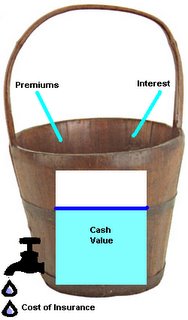
Think of the policy as a bucket:


At the top, we see Joe’s premiums going in, year after year. And we see the insurance company depositing interest each year.
 
In the middle, we see the cash value of the policy growing and growing (it’s comparable to the equity in your house).

At the bottom, there’s a spigot, draining out the cash value at a rate that’s determined primarily by the cost of the insurance (although loan interest would play a part, as well). In the early years, when Joe’s young, the spigot is opened just a little, so only a few drops leak out, and they’re more than compensated for by the premiums and the interest.

The goal is to keep enough “water” (cash value) in the bucket so that it doesn’t ever run dry.

Ok, so now what?

Well, for that, see Part 2…

Wednesday, April 26, 2006

Number Crunching...

Every once in a while, we run across interesting statidbits*:
For example, Ernst & Young surveyed Human Resources executives, asking which programs had the greatest impact on retaining older workers:
Turns out, almost 26% hired retirees as consultants. About 15% recommended a "company culture that promoted generational diversity" (don't ask), while another 15% used the oldest carrot in the book (in the form of retention bonuses). Interesting.
Here's another one:
According to the Employment Policies Institute, almost 90% of those employed full-time are covered by health insurance, as are over 80% of those working part-time. Almost the same percent of self-employed folks are also covered. and almost 2/3 of unemployed Americans also have health coverage.
Wow.
*Yes, I made that up. But "factoid" was already taken. I hate when that happens.

Tuesday, April 25, 2006

Grand Rounds!

David Williams of the Health Business Blog, fresh off of hosting the Health Wonk Review earlier this month, has tackled this week's Grand Rounds. He managed to review, sort, and comment on 50 submissions. Outstanding!
As a beer connoisseur-wannabe, I loved this post from Dr Charles. Best of all, it has a VERY happy ending!

Monday, April 24, 2006

Monday Carnivals...

Despite some tech diff's (Blogger apparently suspended his "main" blog) , Clint at Million Dollar Goal is hosting this week's Carnival of Personal Finance.
He's chosen an interesting, if unorthodox, format: instead of listing each blog and its submission, he put posts into categories, sans blog or author. The idea is that, if you find a post's topic intriguing, you'll click thru to see where it is.
Which is what I did. We get a number of entrepreneurs here at IB; this post, at Frugal for Life, is the first in a two-part series on work-at-home scams, and how to avoid them.
And this week's Carnival of the Capitalists is up at the eponymously-named Entrepreneur's blog. Scott, our host, sifted through over 50 submissions, organizing and ranking them according to topic (and his review). Our own Bob Vineyard's post on High Deductible High Jinx was "Best in Category." WooHoo!
In keeping with the self-selected theme of entrepreneurship, take a moment to read Steve Pavlina's post on the 10 Stupid Mistakes Made by the Newly Self-Employed.

Charge it!

Growing up, “be careful what you wish for” was always a popular saying around my home. And, as a vocal (and vociferous) proponent of Consumer Driven Health Care, I should have seen this coming:
It seems that the convenience of these cards may also have a downside: as consumer credit card debts continues to climb (according to the article, it’s about $2,300 for the average citizen), charging health care could contribute to a substantial increase in such debt.
Now, I must confess that the concept of a “credit” card for HSA’s, FSA’s, and the like is somewhat foreign to me: I’ve always considered these to be more in the nature of debit cards. That is, they simply replace my checkbook when I’m paying for health care. Whatever funds are in the account represents the amount I have to spend; no more, no less.
So it came as a surprise to me (must be my sheltered existence) that financial service companies would set these up as unsecured lines of credit, as opposed to merely account balance conduits. But that’s apparently what is happening:
“The card, at a 12.96% interest rate, may be used to pay for elective or quality of life procedures, such as laser eye surgery, cosmetic dental care, orthodontry [sic] and hearing aids. Prices for such services easily go into the thousands, but Citi Health Card enables patients to "structure payment plans of up to 48 months, so members can customize their payments to fit their overall financial planning and medical spending."
The first two items, at least, aren’t even “kosher” by IRS standards; that is, they’re not eligible for tax free reimbursement under Section 213d. The beauty of our capitalist system is that folks are free (for the most part) to buy the things which are important to them.
Maybe I’m just a fuddy-duddy, but I’m skeptical that a credit card is the best vehicle for CDHP’s. Still, it will be interesting to see if the idea takes off.

Friday, April 21, 2006

Worst. Pre-Ex. Ever...

"An Oregon man who went to a hospital complaining of a headache was found to have 12 nails embedded in his skull from a suicide attempt with a nail gun, doctors say."

Oooookay.

But that's not the best part.

This is:

"The unidentified 33-year-old man was suicidal and high on methamphetamine last year when he fired the nails — up to 2 inches in length — into his head one by one."

Well, of course he shot them "one by one." Those semi-automatic nail guns are expensive!

On a sad note, the Darwin Awards have thus lost an outstanding nominee.

Stupid Carrier Tricks...

So Medical Mutual of Ohio (a fairly large, state-wide carrier) just bought Summit Insurance (a much smaller one). The deal’s been in the works for at least six months, and was finalized and announced a month or so ago.
So far, so good.
The actual transfer of business is set to take effect on May 1, so the carriers scheduled a series of meetings to familiarize brokers (agents) with what the sale means, what changes we can expect, and to answer any questions we might have.
Yesterday, I attended the last of 4 locally scheduled broker meetings:
First, the representative from Summit got up and spoke for about 45 minutes (which was approximately 35 minutes longer than was necessary). One could tell that the gentleman was not pleased to see his beloved company fade into oblivion, but we got that message pretty early on. He fielded a few questions, answering some, and passing others to the MMO person.
When Mr Summit was finished, he turned the meeting over to Ms MMO. She also spoke for a bit longer than was necessary.
There were, of course, a number of important (and urgent) items, but the two “take away” pieces were:
■ Although most maintenance prescriptions will (theoretically) transfer over from Summit to MMO, controlled substances and compounded meds will not; they will have to be re-prescribed. While this may not sound like a big deal, it certainly could be: physicians are restricted in how many of these scrips they can write for a given individual. Ooops.
■ Any procedures pre-authorized by Summit, which are scheduled for May 1 and later, must be re-authorized (by MMO). Granted, this makes sense from a claims standpoint, but announcing it only 10 days in advance is, well, stupid. How many such procedures will now have to be re-scheduled, as well?
The icing on this particular cake, however, took place near the end of the meeting. Our presenters had been unable to answer about half of our questions. So, I raised my hand:
“I have a more big picture question. Y’all have been working on this for over 6 months, and yet you’ve been unable to answer a lot of the questions we’ve asked today. And, this is the fourth such meeting you’ve held. We have no idea what questions were raised, and left unanswered, in the other three meetings. So, will there be an email or fax that addresses all these questions for us?”
Ms MMO replied that “that’d be a great idea. But we haven’t been writing them down, so we don’t know what all of them were.”
Yeah, me too.

Thursday, April 20, 2006

Health Wonk Review, WooHoo!

The fifth installment of HWR is up at the Envisioning blog. This bi-weekly compendium continues to grow, and this week's version is particularly well put-together. Make sure to check out each of the Einstein "photo's."
Since Consumer Driven Health Care is a something of a meme here at IB, I particularly appreciated FoIB MarketPlace, MD's announcement of a "Blogposium" on CDHC. An extremely informative and interesting piece.

Wednesday, April 19, 2006

Norris vs Annuities: A Reality Check

No, not that Norris: One of our clients is a law firm which deals with administrative and compliance issues for qualified plans. For example, they’re the folks that take care of our agency’s 401(k). We’ve always had a good relationship with the firm, and it recently got even better:
Turns out that one of their other clients is a reasonably large local financial services firm, from which a number of folks will be retiring over the next few months and years. They have a “defined contribution” plan, which guarantees a lump sum to each participant, and from which each participant will receive a monthly income. The vehicle of choice for such applications is a Single Premium Immediate Annuity.
SPIA’s are custom made for this. I give the computer (or the carrier) the participant’s age, sex and the lump sum amount, and I get the monthly income that each participant will receive for as long as they live. Simple enough, right?
Not so fast, Buckaroo:
Back in 1983, the Supreme Court handed down what’s come to be known as the Norris Decision. Because women (as a group) outlive men (as a group), the monthly benefit amount which a woman would receive from a given lump sum is less than the amount for the man. Makes sense: the original sum has to last longer, in general.
Norris, though, said that such discrimination violated the ban against sex discrimination in employment in Title VII of the '64 Civil Rights Act. So, an annuity which used gender-specific assumptions was a no-no. The upshot is that in cases which must be Norris-compliant, one needs to use a unisex annuity. Simple enough.
Except that there is no such animal. By definition, annuities which pay a lifetime income are based on the sex of the annuitant. But that doesn’t matter to Norris, which bans such discrimination even if the only annuities available are based on sex-segregated annuity tables.
Ooops.
So now what?
Well, it turns out that there is a plan available that seems to meet the Norris challenge. It was, in fact, designed specifically to do so. The only drawback, if there is one, is that it is a group annuity, which the employer (plan) itself owns. And it is this program which I’ll be looking to as I continue working on this case. My only real problem with this is that I like to have choices for my clients, and this seems to be the only such product on the market.
Still, beats having to say “sorry, I can’t help you.”

Babe Alert!

Jenni, hostess of ChronicBabe, has kindly linked us as one of her Fab Five favorite sites. She says InsureBlog is a "smart (that would be me) and snarky (that you, Bob?) look at all things insurance."
Thanks for the kudos, and back at ya!

Tuesday, April 18, 2006

Department of Counterintuition…

And yes, I (think) I just made up a new word. But it seems to fit; according to a new study in the New England Journal of Medicine:
The study purports to show that excising limits on services for mental health and substance abuse does not drive up health insurance costs, and eliminating caps (e.g. on the number of therapy sessions or days in a psych ward) does not boost spending. The "gotcha," though, is interesting: in this study, parity went hand-in-hand with managed care, which has had something of a cool reception from the behavioral health community.
The study compared several federal (government) plans that offered mental health and substance-abuse services equal to general medical benefits to plans that did not offer such cover. Of the seven, only one showed a considerable increase in usage of services, while another showed a marked decrease in usage; the rest showed little change. “Plan costs decreased in three plans and did not change in the other four. Out-of-pocket spending on mental health services decreased in five of the seven plans, according to the research.”
While I’m skeptical that adding more covered benefits doesn’t increase utilization, and costs, this study does make a certain sense: after all, the insurance industry has been touting the case for managed care for a long time, so it seems consistent that mental health cover could benefit from a little, as well.
Puts my mind at ease.

'Tis Time for Grand Rounds

And a fine job Fat Doctor does, at that. Over 50 entries, all arranged into "broad categories," including BODY PARTS AND BROKEN HEARTS. Oy!
I was most intrigued by Dr Bob's post explaining the medical coding process, and highlighting some of its history.

Monday, April 17, 2006

The (expensive) Little Blue Pill

For many years, armchair pundits have claimed that men’s fascination with the automobile is symbolic. Well, it turns out that this wasn’t so far off the mark:
In fairness, this was a concession hard-won by the workers’ union, which dictated that such lifestyle drugs be covered by their members’ insurance:
"Once you have these benefits, it's very difficult to take them away," said Jim Sanfilippo, president of AMC Inc., an industry consultancy in Detroit."
And, of course, an aging workforce also contributes to the demand:
“(G)iven the huge number of older GM workers who might need help to "keep the spark alive," the tab for Viagra and other erectile dysfunction drugs isn't likely to go down soon.”
This challenge mirrors current health care insurance issues in general: how to keep costs in line while maintaining needed (or just desired) coverage. Whether we’re talking about Viagra, IVF, or birth control, lifestyle medications do impact the overall cost of health insurance, and seem like a reasonable place to start when we talk about medically unnecessary treatments.

Money Monday: Carnivals

This week's edition of the Carnival of Personal Finance is already up at Five Cent Nickel. With 34 entries(!), you're sure to find something interesting, or at least though-provoking. I know I did: this entry from Matt Inglot explains that money is really just a tool, and why that's important to understand.
Not far behind, the Free Money Finance hosts this week's Carnival of the Capitalists. This edition boasts 43 entries, all arranged in helpful, useful categories. For a bit of whimsy, check out this post explaining the economics of Harry Potter's world.

Friday, April 14, 2006

Color Me Skeptical...

In the world according to AARP, about half the folks on Medicare lacked coverage for prescription meds; Part D has apparently helped reduce those numbers. The upside is that the new plan has helped those who’ve opted in to save some significant dollars on prescriptions.
On the other hand, "(m)illions of senior citizens have not signed up for and do not know much about" it. Almost 30 million of our seasoned citizens have signed up for Part D, but between 8 and 14 million are playing “wait and see.” Which is, of course, their right to do, even as the clock winds down on the May 15 deadline.
Not surprisingly, “(t)he drug benefit is being accepted more warmly by those who stand to take personal advantage of it than by the public at large. Half of the seniors polled approve of the plan, compared with 41 percent who disapprove.” That seems to me to be just common sense: of course those who directly benefit from a given program are going to be more favorably disposed towards it than those who are actually paying the freight.
One line in the Yahoo article jumped out at me:
“AARP is working to make the Medicare drug program even stronger by allowing HHS to negotiate drug prices for the program.”
Now, perhaps I’m reading this wrong, but I was not aware that AARP had such an unprecedented influence on the Executive Branch; I sure hope W had the courtesy of sending them a Thank You note.
Even stranger, she reveals that, just a few years ago, the organization “went so far as to sponsor their own Medicare Part D Plan.” And that their own studies showed that “prices in the new prescription drug benefit were lower than buying drugs from Canada.”
So which is it?

Wednesday, April 12, 2006

Dale Carnegie: Spinning...

This will probably be a fairly long rant, so please be patient with me.

The title of this post refers to the great motivational author and speaker, Dale Carnegie, and his classic tome "How to Win Friends and Influence People." In it, he teaches folks effective means of communication, both in business and personal relationships.

The experience I'm about to relate might be titled "How to Effectively Damage Your Business, and Squander Years of Good Will."

Although ours is an independent agency, my P&C colleagues place the bulk of their business with a specific carrier. This is neither good nor bad, it just is. For a number of reasons, I have given this carrier's life insurance subsidiary "first dibs" on the life business that I write.

Each spring, this carrier puts on a sort of traveling roadshow, called the Annual Sales Meeting. Folks from the home office travel all over the midwest, and it gives both the agents and the home office staff the opportunity to mingle, and to share experiences and ideas. It's a lot of fun, and I look forward to them.

This year's would have been my 22nd consecutive meeting.

You'll notice I said "would have been." That's because the meeting was scheduled for the first night of Passover. This is a significant and special Holy Day, and is marked on most calendars. Now, I don't think that anyone intentionally set out to offend those of us in the field who are Jewish; most likely, it just never occurred to whomever set the dates to even check.

I was, at first, annoyed at this oversight; the more I thought about, the more irritated I became. Knowing my own limitations, I knew that I needed to tell someone how I felt, so I called the home office, and asked for the office of the CEO (hey, it's not like I have any problem calling the head honcho). I didn't really expect to speak with him personally; I just wanted to make sure that he knew that I was disappointed to miss the meeting, and offended at the reason that this was so.

My colleagues were split as to whether they thought I'd get an apologetic return call or not. I predicted that I wouldn't hear anything about it.

I was wrong.

This morning, I received a call from the Regional Sales Manager for the carrier, chastising me for not "going through channels." No acknowledgement of the offense, just a "slap on the wrist" about following their protocol.

Regular readers (and those who know me personally) will be pleased, if not shocked, to learn that I did not, in fact, lose my temper. I politely, but firmly, told the gentleman that, first, I did not want to say or do anything to damage the relationship between our agency and his company. But, I explained, I did not care about his protocol, because I do not work for him or his company. He was momentarily taken aback, but pressed on, admitting that he didn't see what I was so offended about in the first place.

At that point, I told him that, contrary to his intent, he was not helping his own cause. Indeed, he was offending me even more. I explained that I was anticipating an apology (at best), and that I would have also accepted no response at all. I concluded by asking him if there was anything else I could do for him, and we concluded our conversation.

In addition to representing this carrier, I have been a customer for over 20 years, as well: my home, auto, umbrella and much of my life insurance has been with them. As soon as we hung up, I buzzed one of my colleagues and asked her to get me the numbers for moving all of my P&C cover to our other primary company. I have also determined that I no longer feel comfortable placing business with this carrier: I am currently working on 6 life cases, all of which I will now place with other carriers.

What's so disappointing about this is that the gentleman has irreconcilably destroyed over 20 years of good-will and customer satisfaction. I sure hope he's happy.

ADDENDUM: In reviewing the phone conversation, I recalled another telling piece of information. At the very beginning of the call, the gentleman mentioned that he had received an email directing him to call me. Since I had spoken only with the CEO's office, I can only conclude that this gentleman's opinions represent those of the company itself; that is, the CEO had obviously directed him to inform me of my faux pas, and to abstain from any apology. That also speaks volumes.

A Pleasant Passover...

For those of us about to enter "The Flat Side," I wish everyone a healthy and happy Pesach!
And to my Christian friends (of whom there are many), an early Joyous Easter!
Interesting (at least to me) lagniappe: This year, our family's First Night Seder includes the Pastor of a local congregation: GracePoint Church. Don and Cindy have become good friends of ours over the years. It is truly a joy and an honor to share our home and our seder with their family.

The Oldest Profession...

Just got an interesting update. At least one health insurer has developed, and a medical plan for “guest workers,” as one of the current crop of immigration bills calls them.
I’m not really sure what the market will be; after all, these folks are getting “free” health care now, so why would they see a need for insurance?
Still, it’s reassuring to see that our industry hasn’t lost its flair for innovation. And, frankly, I don’t see a downside to this idea: if “guest workers” buy into the American dream to the extent that they want to buy health insurance, that’s “a good thing.”

The Farmer in the Dell

Earlier this week, Dell (the computer folks) announced that they’ll be offering their employees a new benefit:
The idea is that employees’ claims info will be fed directly into the database (dontcha just love the jargon?), enabling those employees better and quicker access to their health information.
Dell’s goal is to enhance preventive care, which the company sees as a key to controlling its health care costs. It seems to be a “smart” system, as well:
“as new information is added to a worker's personal health record, the system will send out automated alerts about the kind of care that patient should get next.”
I’d be curious to see how this impacts long term health care trends at Dell. The premise seems to be that by encouraging its employees to be more proactive and informed, the company can keep rate increases down. Of course, that will depend in large part on what percentage of their workforce chooses to participate. Interesting idea, worth watching.

Tuesday, April 11, 2006

Told Ya So!

Last August, we talked about some of the ramifications of Anthem and Premier’s year-long “trial separation.” At the time, we learned that Anthem was reimbursing its insureds directly (rather than sending payment to the providers). And, to no one’s great surprise, a number of these “lucky ducks” chose not to pass on those claims reimbursement dollars to said providers. The results were, of course, predictable:
“Now Premier wants its money, taking legal action on what Shaw called "the most egregious cases." He said most of the suits are for bills in the neighborhood of $5,000, but they range from $1,000 to a $99,000 reimbursement check, which the patient said her estranged husband left town with.” (ibid)
So what, you ask?
Well, here’s what:
“A group of local patients have (sic) filed a lawsuit seeking class action against their insurer, Anthem Blue Cross Blue Shield, claiming it failed to cover large portions of their hospital bills.” [ed: link not yet available]
Now, you may think that this has to do with the Out-Of-Network penalties which Anthem imposed during the kerfluffle.
But you would be wrong.
The real reason for the discrepancy? Well, let’s let one of the plaintiffs do the talking:
“ Williams received a bill for $108,848.88 and later a second bill for $102,649.34. Blue Cross Blue Shield of Michigan [ed: his carrier] sent him a check without an explanation that matched the first amount, and he deposited that check into his personal account …He received a second check for $8,009.76 and deposited that check…” (emphasis added)
Further compounding the problem, he subsequently ignored all the bills he received from the hospital, leading that august institution to file suit against him. Only then did he deem it appropriate to fork over the $100,000. Of course, this only covered half his balance, which is still due, and still in litigation.
Mr Williams, et al, would do well to recall the First Rule of Holes.

This Week's Grand Rounds

can be found over at Treatment On Line. Our hosts have grouped the posts by category, which makes it easy to find just what you're looking for.
While you'rte there, check out Kevin, MD's interesting take on defensive medicine.

Monday, April 10, 2006

Dr Wonka, I Presume?

We’ve discussed the health benefits of my favorite bean before. But a British physician has gone one better:
According to the experts, the anti-oxidants in chocolate have the ability to dampen LDL (bad cholesterol) levels.
The downside – if there is one – is that the chocolate “doses” are relatively small (about 3 tenths of an ounce, or one M&M). The article also notes that “it is probably wrong to say that all dark chocolate is good for you.” And, they’re still trying to determine which brand works best.
Unfortunately for your intrepid correspondent, the study is being conducted across the pond. Still, I eagerly await the results.

Money Carnivals

My Money Blog got an early jump on this week's installment of the Carnival of Personal Finance. Over 50 posts were submitted, and MMB did a terrific job getting them organized.
My favorite was this post on ending (or at least reducing) clutter, by the folks over at Money and Investing blog.
The Carnival of the Capitalists is also up and running, courtesy of Dane's Business Opportunities blog.
With Passover fast approaching, I really appreciated this post at Multiple Mentality, toting up the cost of our annual excursion to the flat side.

Saturday, April 08, 2006

Last Minute Tax OOPS?

Joe Kristan has some helpful answers for last minute (and after!) corrections.
Thanks, Joe!

Health Wonk Review

The early April edition of HWR is up at the Health Business Blog. As usual, it's chock full of interesting posts from the more policy-oriented sector of the medblogosphere.
Marcus Newberry, who often comments here at IB, has an interesting item recommending a simple, but potentially profound, change in paying for health care: rendering full payment for professional service and then submitting the bill for reimbursement. An idea so crazy, it just might work!

Tuesday, April 04, 2006

A Truly Grand Rounds

For a real treat, stop by Urostream for this week's Grand Rounds. The host, a urologist, has constructed a comprehensive GR using a uniquely apt metaphor: a doctor's apppointment, complete with history and exam. Very cool (although the profusion of pink is a little much).
I was quite taken with this entry, from The Blog That Ate Manhattan (burp!), an interesting and thought-provoking post on alternative medicine.

Monday, April 03, 2006

OT: Pet Peeve, Finance Dept

So I’m driving back to the office, and along comes one of those ubiquitous re-fi commercials. Normally, I just tune these out, but this one got to me. In the middle of the pitch comes this little gem:
“And credit card companies want even more of your money.”
No, they don’t.
They may want more of their money (back), but that is an altogether different animal. If you have a credit card, and you owe money, it’s because you’ve used their money to buy your dishwasher, or groceries, or mp3 player.
Nothing wrong with that, of course, but don’t believe for a minute that it’s your money.
It’s theirs, on temporary loan to you.
Okay, rant off.

Carnival Monday!

The Carnival of the Capitalists is up over at Jotzel (is that a cool blog name, or what?). An interesting twist this week is the ability to vote for your favorite post (hint: Bob's item on health insurance and dating).
For something a bit unusual, try Joe Kristan's post about the Iowa Interior Design Board (a.k.a. "your tax dollars at work").
Okdork blog has finally posted this week's episode of the Carnival of Personal Finance. It includes an interesting post, from Search Light Crusade, about the games that lenders play, as well as a helpful spreadsheet to help make sense of all the different rates and points.
I must add, though, that I am singularly unimpressed with Okdork's hosting efforts. Although it includes but 40 articles, they highlighted only eight, and then threw the rest into a kind of jumbled up mishmash.
By contrast, the folks at Jotzel had well over 50 posts (25% more content), yet they organized and commented on each one. And they had their carnival up many hours before Okdork (which, by the way, couldn't even be bothered to get the name of the carnival right).

Apply Yourself!

The least glamorous part of this business (what, you thought insurance was all glitz?) is completing the application. Back in the day, I always thought that the considerate thing for me to do was to ask the questions, and record the answers. That way, I reasoned, I wouldn’t wear out my clients’ hand, or my welcome.
Times change, though, and I long ago dropped that practice. There are a lot of sound reasons for having the insured complete “the app,” not least among them is the potential liability I risk in how I ask the questions and, more importantly, how I record the answers. So, I hand the app to the client, and wait patiently for him to complete it.
I do offer one admonition, however: don’t lie, and don’t volunteer. That is, if the application asks if you’ve had a bloody nose in the past 5 years, and you had one 4 years and 11 months ago, then the answer is yes. But if it truly was 5 years and 1 month ago, then one is not obligated to mention that.
The goal, however, is to be truthful, because lies (whether by commission or omission) will come back to bite you.
Which brings us to the point of this post (and yes, there really is one):
Now, WellPoint is really Blue Cross, but this issue is really about the industry, and about the application and claims processes:
“Attorney William Shernoff said in a statement that he filed the cases to trigger reforms of what he described as a widespread practice in the health insurance industry.” [ibid]
The phenomenon of underwriting at claims time is, at best, problematic. Blue Cross isn’t the only company to engage in this practice, of course, but because it is such a marketplace behemoth, it’s bound to attract more attention.
Obviously, some people lie on their applications. The challenge is that there’s no evidence that most people do. The challenge, of course, is how a carrier can protect itself while at the same time treating its policyholders fairly. And that’s not as easy as it sounds:
"At the time she completed the (application) she was 46 years of age and had never experienced any illness for Hepatitis B," the lawsuit said. "Plaintiff did not realize her childhood exposure to Hepatitis B was relevant to the questions posed in the (questionnaire)."
It doesn’t really matter, legally, whether or not Hep B has anything to do with breast cancer (as far as I know, it doesn’t). If the application asked if this patient/insured has ever had hepatitis, then that is a material misrepresentation. On the other hand, if it asked about recent symptoms, or limited the relevant question to, for example, the previous 5 years, then it is not.
The answers one gives on an insurance application form the basis of the relationship. These answers, based on the phrase “to the best of your knowledge,” are representations, not guarantees. That’s an important distinction, because it means that we have a responsibility to be truthful, but what we don’t know may hurt us.
The carrier relies on these representations in offering and pricing the product. Carriers shouldn’t routinely deny (or even just slow) claims without some reasonable basis for doing so. But they need to have some way of dealing with questionable claims, as well.
We’ll watch this one closely.