Tuesday, November 07, 2006

Grand Rounds...

Rita Schwab at the MSSPNexus blog has a terrific 'Rounds this week. In a nod to mod culture, she channels Peter Parker & Charles Emerson Winchester, and a few other "celebs" in between. And THEN, she presents over 45 posts, helpfully categorized and extensively annotated. Enjoy!
Movin' Meat blog (yucky name, neat post) has the inside story on med-mal (medical malpractice) claims. Interesting and provocative.

Red's Blue

Although we're primarily about insurance, our readers' health is also a concern. And so we're disappointed that what was touted as a "breakthrough" technology for the treatment of the dreaded papillomavirus has been found wanting:
Oh well, back to the ol' drawing board.

Monday, November 06, 2006

Carnival Monday!

This week's Carnival of Personal Finance is posted at City Girl's Financial blog. Our hostess presents us with weel over 50 posts, all categorized and some with helpful commentary.
My favorite will come as no real surprise: Jeffrey Strain gifts us with a "beer calculator." 'Nuff said.
Gill Blog hosts the Carnival of the Capitalists this week. Over 30 posts, all with helpful insights and commentary, fill this great edition.
Execupundit has a neat little quiz, challenging us to match classic movie dialog wioth current mananegment style. Funny, and maybe a bit uncomfortable.

HSA/MSA in the News...

Well, how 'bout that? Two seemingly disaparate demographics are about to be introduced to Consumer Driven Health Care:
Seasoned citizens will have an MSA (Medical Savings Account) option, courtesy of WellPoint. Rolling out in a week or so (November 15), these high deductible Medicare Advantage plans will be coupled with an MSA* administered by ACS/Mellon Bank.
At the same time, officials in the Empire State will introduce a HDHP (High Deductible Health Plan) for the "working uninsured," sole proprietors and small businesses.
Available in January (2007), Healthy NY's HDHP touts a lower premium, which makes sense since deductibles start at $1,150 for singles and $2,300 for families. Apparently, they're also exploring the idea of offering other (higher) deductible choices, as well.
This is definitely a trend we'll be watching.
*Yeah, I'm a bit confused, as well: MSA's morphed into HSA's some time ago, so it's not clear why these plans still use the old terminology. We'll keep you posted.

Sunday, November 05, 2006

Safety at Work

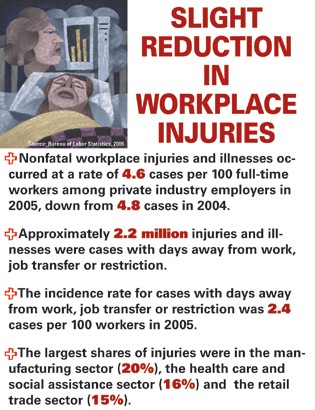
According to its website, the Bureau of Labor Statistics “is the principal fact-finding agency for the Federal Government in the broad field of labor economics and statistics.” One of its functions is to track the number (and severity) of injuries we suffer while at work:

We don’t know, of course, what’s caused this decline; perhaps our friends at Worker’s Comp Insider will have some insights. Regardless, this seems to me to be good news.

Insurance Dispatch

Employee Assistance Programs, about which we've written here at IB, are the subject of this week's column now posted at The Medical Blog Network.

Friday, November 03, 2006

Your Health or Your Wealth?

We blogged recently on the kinds of benefits most American workers prefer. But a new survey, conducted by the American Payroll Association, went a bit further: they found that most of us apparently prefer increased benefits to increased wages:

In a way, that makes sense: wages are subject to taxes, which dilutes their value; benefits are not, and so retain full value. Over 30,000 folks participated in the survey.

Cavalcade #12 - Submissions Due

Just a reminder that submissions for next week's C of R are due Monday (the 6th). Chris at MedBill Manager would love to see your work. You can submit entries:

■ via email or

■ at Blog Carnival

PLEASE include:

► Your blog's url

► Your post's url

► The trackback url (if applicable)

► A (brief) summary

PS: We're still looking for hosts. If you'd like to host a future edition, just drop us an email.

Thursday, November 02, 2006

Health Wonk Review

Terrific HWR this week, hosted by Jason Shafrin at the Health Care Economist. He includes 16 posts in 5 different categories.
Here at IB, we talk a lot about consumer empowerment, but Social Marketing and Change's Craig Lefebvre warns about the problems of consumer health illiteracy.

Better Late Than Never Department...

Apparently, this week's Carnival of the Capitalists scheduled host went AWOL, and the estimable Jay took up the cause. There are over 40 entries in this edition, each with at least some context. Bravo, Jay, Bravo!
Always a fan of "over the top" thinking, I really enjoyed Long or Short Capital's post on a, um, unique fundraising idea (all for a good cause, of course).

Tuesday, October 31, 2006

Stupid Carrier Tricks: Umpteenth Edition

Sometimes, it seems as if we could populate this blog exclusively with stories of the dumb things insurance companies do. Of course, we’d have to change its name, but still.

Our latest installment in this “series” comes from Anthem Blue Cross/Shield, which has notified those of us who sell their group plans of their newest requirement: when submitting a Request for Proposal, we must now include the Federal ID number (EIN) of the group in question. This is idiotic.

Why, you may ask?

Well for a number of reasons:

First, employers are no less subject to identity theft than indiviuals, but Anthem’s not requiring us to submit those when getting a quote [ed: Hush! Don’t give ‘em any ideas!]. (And, yes, most of us do quote individual products on our own PC’s, but not all agents have this ability)

Second, and IMHO, more egregious, is that this effectively shuts out competition. How so? Simple: if one is not the incumbent agent, how likely is it that a prospect (who may be a referral, or a cold call, or a friend of a friend) will be likely to part with that information simply to obtain a quote? More likely, they’ll just call their existing agent and avoid the bother.

Third, what possible reason would a carrier have to require this information simply to provide a quote? It’s just one more example of heavy handed tactics that occur when a carrier dominates a given market.

Stupid, stupid, stupid.

(There, I feel better already!)

UPDATE: It gets dumber [ed: this is possible?]. Since there's no way for Anthem to verify the abovementioned EIN, why wouldn't agents simply make one up for quoting purposes? What's the worst that could happen? "Here's a new, sold case. Oh, I accidentally included an incorrect EIN with the quote request? Gee, I'm sorry."

Boo! (Gotcha!) And so does Grand Rounds

Dr E A Poe, or rather, Dr Michael Hebert, presents a spooky (and terrifyingly creative) 'Rounds, built around the classic "The Raven." There are a haunting number of posts, all worked into a poetic treat.
Hospital CEO (and blogger) Nick Jacobs poses some interesting (and controversial) thoughts on end-of-life healthcare issues. Scary, but serious.

Monday, October 30, 2006

Carnival Monday

LA Money Guy hosts this week's Carnival of Personal Finance. He's collected and categorized well over 60 posts. Alas, none include a summary.
If you pay bills (as some do), you probably have to restock your check supply from time to time. Five Cent Nickel has some tips on how to save money when doing so.

Sunday, October 29, 2006

Insurance Dispatch

This week, we revisit (and update) our Travel Advisory post on folks traveling to (and, of course, from) Israel.

And while you're at The Medical Blog Network, be sure to check out some of the other interesting columns.

Friday, October 27, 2006

Good News: Redux

We've had an overwhelming response to Bob's post (well over 100 comments), and for that we're most grateful to our talented and insightful IB readers.
One particularly industrious poster, John Fembup, has gone beyond the call, and analyzed both the survey we posted and its 2004 predecessor. Originally posted in the aforementioned comments section, John has graciously consented to post his analysis on the front page:
So now there are TWO Kaiser Family Foundation surveys on the table, one from 2004 and one from 2006. BTW, here is a link to the actual 2004 Kaiser survey.
At the risk of triggering another 100 comments [ed: fine with us!], here is what I’ve read so far.
1. The 2004 KFF survey reports people’s responses about quality across the US, and it also reports their responses about the quality of their OWN health care. These responses differ significantly. That is an obvious disconnect. Does the abc news summary mention that disconnect? No.
The percentage of people who reported in 2004 they were dissatisfied with their own health care is shown on page 15 of the 2004 survey, split by ethnic group. Note for backs and whites, the dissatisfaction with "own care" is very significantly LESS than the answer respondents gave for the nation as a whole. This is the identical pattern reported by KFF in 2006. [That is not the case for the 2004 latino sample which suggests an important area for further research; I don't yet find any mention in the KFF report] These difference constituted a huge disconnect in the 2006 KFF survey. The same disconnect was reported in the 2004 survey.
2. The 2004 KFF survey reported that "Four in ten say the quality of health care has 'gotten worse' in the past five years" [since 1999] and the same survey also reports "When asked in an open ended question to name the most important factor in determining the quality of health care patients receive, there is no general consensus"
So the survey reported .. . what, exactly? That people who don’t agree on what quality is, nevertheless believe that whatever it was had declined sharply over the prior 5 years? And where would they get that idea? From their OWN care? From personal knowledge? Clearly Not. (page 15 again). From where then? I think from the uninformative – worse, misleading - media reporting on health care.
3. Page 9 includes this:
"After being read the following definition of a serious medical error: 'Sometimes when people are ill and receive medical care, mistakes are made that result in serious harm, such as death, disability, or additional or prolonged treatment. These are called medical errors. Some of these errors are preventable, while others may not be.' About one in three say that they have experienced a medical error in their own care"
In politics, this technique is known as "push-polling" and is considered unethical because the interviewer influences the response in a particular direction. In this case the interviewer prompts the reporting of an error. It is hard to avoid suspecting that the pollsters were pushing for answers that included reports of errors and worries about quality. That is a newsy result. But how truthful?
Having read the first 20 pages of the 2004 survey, I am now going to watch the world series. So far, I would say the most significant findings in 2004 were:
1. People were much more satisfied with their own care and costs than they thought other people were. This is the same finding as reported in the 2006 Kaiser survey. It is also consistent with findings from health care polling that I have seen since the 1970’s. I still think this disconnect results from the continual, breathless media reporting of a "crisis" in US health care.
2. People were surprisingly ignorant about health care and the cost of health care. When asked to rank quality factors by importance, they tend to rank in reverse order – this is true for both the 2004 and 2006 polls. Why would this be? Again, I think this reflects what people think they know, and what they think they know reflects the faulty media coverage of health care.
3. By 2004, people were beginning to use the internet to obtain health care information. This received almost no attention in the 2004 survey – just a small remark. But I think this was the appearance of a very important trend, because information is power. "Info to the people!"
So far I have not found information that contradicts the 2006 Kaiser survey. There ARE however contradictory statements in the abc news summary of the 2004 survey. The abc summary is skewed by its failure to point out any of the above findings. I think that the skewed abc news summary supports the point I’ve been making about the media having bungled the reporting of health care over the past several decades.
Thanks, John!

Thursday, October 26, 2006

Of Insurance Companies and Morality

Recently, a blogging acquaintance whose opinions I respect (if rarely agree with) posited that “insurance companies are immoral.” His premise was that, since carriers make a profit, but do not then plow that profit (back) into the healthcare system, they essentially consume funds that could be served to increase medical research spending, build new facilities, etc.

I had, I must admit, a visceral reaction to this: after all, since I represent said carriers, I must be part of the problem, and therefore immoral myself.

After careful reflection, though, I came to realize that my commenter’s assertion was unsupportable on its face; that is, companies (whether health insurers, car manufacturers, or newspaper publishers) are simply impersonal entities and, as such, can be neither moral nor immoral. Consider this: is a rock moral or immoral? Well, one could say that a rock that hits you in the head is immoral, but it is really the ethos of the person who heaved it at you that’s in question. Rocks and insurers, are, in fact, amoral.

Further, it seems illogical to me that one should expect an insurance company to take its profits and gift them to, for example, science. For one thing, the company (presumably) exists to make a profit for its shareholders, and to provide employment for its, well, employees. It is not in the business of delivering health care: it is in the business of paying for it. By way of example, no one expects Campbell’s to provide a personal nutritionist to folks who buy vegetable soup. Does that make them “immm-mm-moral?”

So why would an insurance company be any different?

On the other hand, businesses are required to follow the law. Again, the law itself is neither moral nor immoral: it is a set of rules by which we, as a society, have agreed to abide. Reason I bring this up is because my personal convictions (outlined so eloquently above) are being sorely tested of late.

The group insurance market is a funny thing (if by “funny” one means “frustrating”). To wit: most group health insurers require that, if you’re going to place a group with them, you must write not only the health insurance, but the group life insurance, as well. From a business standpoint, this makes sense: the group health business is barely profitable, while the life side is extremely so, thereby “balancing things out.” And, truth be told, it often makes sense to do it this way: one bill, one phone number, etc. But there are times where it is not desired, and the law in Ohio says that a carrier cannot require a “tie-in” sale such as this.

At least, that’s what I’ve always believed. I used to have a copy of the pertinent law; it is long ago lost in the paper black hole that is my office. I recently had occasion to write a small group case with XYZ [ed: Name of carrier redacted not to "protect the innocent," but because it is not the only "guilty" one], which has not previously had the life requirement. Now they do. Problem is, I already have the group life for this group written with another carrier, and neither the client nor I are particularly moved to change that. Now, though, XYZ has refused to underwrite this group absent the life. No problem, says I: I’ll dig up my copy of the relevant section of the ORC (Ohio Revised Code) and wave that in front of them. Only I can’t find the darned thing.

No problem, repeats I: I’ll find it online (the ORC and OAC are both on the web). Several hours (and cups of coffee) later, no dice. Still no problem, hopes I: I’ll call up my friendly neighborhood insurance department, they’ll have it toot-sweet [I know, just let it go]. Only they can’t find it, either.

No problem, panics I: I’ll call up a friend who works at LexisNexis, that’ll do the trick. Only, several hours later, she comes up empty-handed, as well. Now what to do? I know that they can’t force me (I actually have a very good reason to know that I’m right, but that’s not relevant here). Except, they can. They won’t back down, time is running out, and I won’t put my client at risk. Back down, counsels I: and I did.

So what’s the “moral” of this little tale? Well, it’s pretty simple: insurance companies are not immoral.

But insurance company policies sure can stretch that envelope.

Wednesday, October 25, 2006

Workin' in the Golden Years

Found this little number, based on a Pew Research Center study, enlightening:
Turns out that, even though a majority of those surveyed believe that they'll have to continue working even after they retire ("Hello, welcome to Wal-Mart!"), it may not be so. Apparently, only a bit more than 10% of retired folks currently work outside the home (either full- or part-time).
Our goals about when we'll retire seem a bit unrealistic, however: although the Average Joe (sorry, Joe!) believes he'll retire at about 61, folks are actually retiring (on average) at the ripe old age of 58. Who knew?
Most surprising (but pleasantly so) was the finding that -- 2 to 1 -- the folks who think they'll be working post-retirement expect it'll be because they want to, not because they have to.
Interesting.

Cavalcade #11 is up!

Spencer Hill hosts this week's edition. The CoR continues to grow and thrive, thanks to folks like Spencer, who presents over a dozen posts, categorized by risk-type.

Perhaps best of all, our own Bill Halper makes his CoR debut with this edition.

I was intrigued by this post from Michael Cannon over at the Cato Institute: he effectively fisks the idea that employers that offer health benefits will be at a competitive disadvantage. Interesting points.

FYI, we'd love to have YOU host an upcoming edition; you can volunteer by email. As Spencer can tell you, it's fun, it's easy, and it gets you off "the nag list."

Tuesday, October 24, 2006

Grand Rounds...

An excellent 'Rounds today; Bob Coffield, host of the Health Care Law Blog, presents over 50 posts (including 2 from IB!), all helpfully categorized and summarized. Plus, he's added "live links" to Flickr pix for some of them. Very cool!
I love to grill salmon (medium rare) and tuna (rare! for me). And, fish taco's (well, burrito's, really) are a family favorite. Now comes word, via Dr Emer at Parallel Universes, about two conflicting studies about how healthy fish really is (are?). I know I'm hooked (Sorry, Charlie!).

Monday, October 23, 2006

Carnivals!

The Carnival of the Capitalists is hosted this week by the legal beagles at Blawg Review. Broken into useful categories, each of the more than 40 entries has its own summary.

The Photon Courier (is that cool blog moniker, or what?) has the skinny on a new use for a (very) old product.

And this week's Carnival of Personal Finance is up at Fat Pitch Financials. Over 60 posts, also categorized and summarized, grace FPF's tremendous efforts.

As a self-professed "funny guy" myself, I especially enjoyed this little gem from Long or Short Capital.