Tuesday, June 18, 2013

Life Insurance, Long Term Care, Medicaid and You

Not so sure that this is such a great idea:

"State lawmakers are encouraging elderly residents to use life insurance as a way to pay for long-term care—and lower the Medicaid tab in the process."

The concept seems pretty straightforward: you take an older life insurance policy and sell it ("viaticate" is the technical term), and then use the proceeds to pay for long term care. When the policy's value is used up, one turns to Medicaid for continued long term care funding.

This is not a new idea, but the fact that states are now touting it as a viable LTC funding vehicle is telling: they're running out of money and are desperately looking for ways to slow down the ticking time bomb. Under current Medicaid rules, one is allowed to have some life insurance, but of course, that's an asset that states would very much like to tap.

Another factor is marketability. If there's a sudden glut of life insurance policies hitting the market, then of course the price that they command will be affected. Add in the fact that the key phrase in LTC is long term and potential investors could be waiting many, many years for a payoff. Not a great selling point.

But what I find so disgusting here is the states' apparent disregard for their own previous condemnation of stranger-owned life insurance. If it's morally reprehensible in one circumstance, why is it suddenly noble in this application?

Consider that rhetorical.

[Hat Tip: FoIB Holly R]

Sunday, June 16, 2013

Aetna to exit California's individual insurance market

Both the Wall Street Journal and Reuters reported Friday that Aetna will exit the California individual-insurance market at the end of 2013.

According to Aetna, this decision "will affect only 49,000 of its 1.5 million policyholders in the state."

Although Aetna declined to say why it is taking this action,  it's likely that the reason is California's health exchange rules.  According to Reuters the California Exchange rules apply to all health insurance products sold to individuals in the state, "whether or not they are offered through the exchange."  

Thus any company that decides after analysis that it's not worth the cost for it to participate in the California Exchange, can only avoid that cost by exiting the market  - as Aetna has decided to do.  

Saturday, June 15, 2013

Ain't insurance the greatest thing?

Everyone cashes in.  No one has to pay. 

And what affordable health insurance plan, its hour come round at last,
Slouches towards Washington to be born?

"We have to pass this bill, so that you can . . . "


Today’s Wall Street Journal contains this op-ed piece bySenator Orrin Hatch.

In it, he mentions that the Obamacare tax credits “are both advanceable and refundable”.    In other words, IRS will pay them first and verify the claims for them later, a practice that could be called “pay and pursue.”

I did not know the tax credits are advanceable.  Did you?

So it seems more than three years on after passage of Obamacare, the public is still finding out what is in it.   

And we are continually appalled.

Will this process of Obamacare discovery never end?

Friday, June 14, 2013

Doctors Behaving Badly

As patients, we have all experienced doctors with a bad bed-side manner: gruff in their discussion with you about your issues, leaving you feeling frustrated and angry after the appointment.  While we have been in a fee-for-service type of payment model, this kind of behavior has been tolerated from both patients and administrators, but as medicine moves to payments based on quality, then bad behavior will no longer be tolerated.  This case from 2011 is used as an example in a recent Kaiser Health News article done in conjunction with the Washington Post:
“At a critical point in a complex abdominal operation, a surgeon was handed a device that didn't work because it had been loaded incorrectly by a surgical technician. Furious that she couldn't use it, the surgeon slammed it down, accidentally breaking the technician's finger. "I felt pushed beyond my limits," recalled the surgeon, who was suspended for two weeks and told to attend an anger management course for doctors.”
Administrators have often had to apologize for bad behavior in physicians - especially surgeons - to both staff and patients:
“For generations, bad behavior by doctors has been explained away as an inevitable product of stress or tacitly accepted by administrators reluctant to take action and risk alienating the medical staff, particularly if the offending doctors generate a lot of revenue.”
Physicians understood that they were in charge; they made the money and if they wanted to behave badly, then they could do so without fear of retribution.

In 2009,  the Joint Commission (the body that accredits hospitals) released new guidelines for addressing disruptive and inappropriate behaviors by medical staff.  The Commission recommends that hospitals develop a zero tolerance for intimidating and/or disruptive behaviors.

Medicine has changed, making such behavior not only unacceptable but reckless.  Medicine is a team effort, mandated by government and a natural occurrence that comes with technology and specialization in the medical field.  If a person has a chronic condition, it is not uncommon to have several physicians involved in the care and treatment of the patient.  As more physicians become involved, then more staff, more facilities and more administrators are also involved. And, of course, more potential for personality conflicts.

Quality initiatives are also becoming more important, as hospitals and other care venues are now required to submit quality outcomes to the federal government not only for the purpose of monitoring care but also designating payments. When a physician mistreats a staff member, that staff member has a recourse through labor law which dictates that employees must work in an environment free from hostility or harassment, which could interfere with their job duties and thus patient outcomes.

Fortunately the days of administrators mollycoddling physicians and telling staff that had been verbally harassed “that is how (s)he is, ignore it and go back to work” are ending.  Once payments are based on quality, these physicians will have to change or risk losing money.

Thursday, June 13, 2013

Hey Young Invincible, Can You Afford $6000?

Last week's Ezra Klein interview with Aaron Smith was a doozy. For those who don't know, Mr. Smith is the co-founder of Young Invincibles. The group works to educate and mobilize (their words, not mine) those between 18-34 years of age. For Ezzie it was the same mantra we always hear: rainbows, pots of gold, unicorns, warm and fuzzies, with a whole lot of "free". The reality is much different. Especially for those who are supposed to spread the wealth health risk and enroll in "affordable" insurance.

Much has been said about the so-called Young Invincibles and whether or not they will purchase insurance. A more glaring concern isn't whether they will purchase or what will be subsidized, but rather whether they can afford the high out-of-pocket maximums. Under PPACA the "catastrophic" plan for those 30 and under is alleged to have a deductible of $6000 (or close to it).

The problem for young invincibles isn't insurance premiums, it is their personal finances. Recently there was a post in the Wall Street Journal that showed:
Young people also are likely to have precarious finances and scant savings socked away for emergencies. When asked if they would be able, in one month, to come up with $2,000 for an unexpected expense such as car repairs, 49% of 18-34-year-old respondents said probably not. 
Further, these same invincibles have less discretionary income. Most don't carry insurance because they can't afford the premiums. Paying $100-$150 for the catastrophic plan isn't in the budget. The $20,000-$40,000 they make per year gets completely consumed by rent, car payment, student loans, groceries, cell phone, cable TV, utilities, and cheap beer.

As we approach the deadline of where we are going to force people to buy insurance the biggest question that will remain is: If I have a choice between paying a 1% tax on income OR 3% (minimum) of my income on premiums PLUS a huge out of pocket cost factor should I get sick which one will I choose?

I think you see which way this train is headed.

Just a Minute (Clinic)!

Hard to believe, but we first started covering the "Minute Clinic" phenomenon in the fall of 2005:

"In a little strip mall in San Mateo, California, nestled “between a UPS store and a hair salon” is a new type of doctor’s office ... The office itself is as much coffee shop as medical center: prices for various services and procedures are prominently displayed above a reception desk"

Technically, that story was about QwikHealth, a Minute Clinic fore-runner. But the basic idea was the same: easy access to affordable basic care. We revisited the concept in 2008, when these little beauties started showing up inside Massachusetts "pharmacies and other retailers."

Now, of course, they're ubiquitous, which is both a blessing and a curse: more providers helps meet the increased demand for health care, but it also cuts into more traditional providers' cash-flow. And there's this: "in-store clinics could actually raise overall costs if, by making medical care easier to access, it increased the overall use of services."

Who says more is better?

Actually, it still may be, but then we also need to consider quality of care; that is, is "Dr Nurse" qualified to diagnose and treat what ails ya? It seems safe to presume that for many (most?) common ailments, the answer's probably yes. And for many folks, it may mean the difference between affordable health care and none at all (I'll leave it to the reader to decide if this is a false choice).

[Hat Tip: FoIB Holly R]

California Dreamin': How much is too much?

I find this sad:


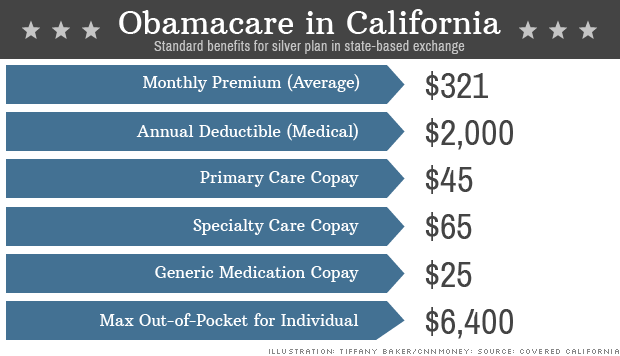
That's a snapshot of how a new ObamaTax "Silver" plan is likely to look (at least in the Golden State). It's sad because it's really no different than how insurance worked before the train-wreck. Too often, individuals focus on the co-pays (for doc visits and meds) without looking at "the big picture." I can't tell you how many times I've presented a High Deductible (HSA) plan only to be asked "what's my co-pay?"

Remember, too, that (for many, perhaps most, folks) any subsidies to which one might be entitled are for the premium which, in this case, represents only about a third of what the total potential out-of-pocket might be. There are few (if any) subsidies for co-pays, deductibles or co-insurance. That's strictly "out-of-wallet."

And even this may vastly understate the problem; as FoIB Jeff M reports, "Kaiser Permanente has offered some of the highest rates in the California health exchanges."

Now why would they do that? The article says that KP itself denies any market-rigging motivation, although it notes that:

"Some experts say Kaiser intentionally bid high to avoid drawing too many customers next year who are sick or who have been uninsured for years and may be costlier to treat."

See, that's just good business sense: we already know that the large majority of folks who actually bother to sign up for (first-time) coverage are those with the most motivation to do so: pent-up needs held back by lack of resources (ie a third party to foot the bill). And who can blame them? On the other hand, had I been the KP spokescritter on this, I would have been sorely tempted to answer the charge with a very simple "d'unh!"

But then, truth often hurts.

Wednesday, June 12, 2013

Some Very Strange Bedfellows


The New York Post reports today (June 12, 2013) that the Freelancers’ Union is seeking relief from Obamacare, and the State of New York may be about to help them.

It seems the Freelancers’ Union – which in 2012 was granted $341 million in Federal loans to set up an insurance CO-OP under Obamacare - has run into a big problem. It’s figured out that Obamacare will seriously damage its insurance business.

Will this damage come from “unexpected” problems encountered by an expert insurance organization blindsided by completely unpredictable insurance requirements?    You can believe that if you like, but I think you would be wrong.

According to the Post, the Freelancers’ Union says that Obamacare’s “onerous regulations and taxes will burden its innovative health insurance model for the self-employed with enormous added costs.”  In other words, Freelancers’ problems are the same Obamacare problems that businesses and other insurance companies have been warning about for the past four years.   They were neither unpredictable nor unexpected.

So what does Freelancers’ want?  It wants authority from the State of New York to convert its health insurance model to a self-funded model.  If it provides self-funded coverage rather than insurance it becomes an issuer of “ERISA Plans” that won’t be subject to Obamacare.

Freelancers’ Union states that Obamacare will cost its members “$38 million a year” which translates into “a per-person premium load of $178 a month”.  That’s the additional amount that would be needed just to pay for the Obamacare load.

Is that devastating?  Well if it is, wouldn't Obamacare be equally devastating to the other insured small group plans in New York – and all across America?

Yet Freelancers’ Union asks the State of New York to step in and spare their successful small-group insurance plan from the devastating effects of the President’s ‘affordable’ health law - but not to spare any OTHER insurance plan from that law.

And say, isn’t it ironic that the Freelancers Union has taken up the conservative cry that Obamacare will hurt more than it can help?  Obamacare is creating some very strange bedfellows.

Remember that 50th employee?

Almost exactly a year ago, we noted the pending demise of 50-employee companies. It now appears that even those fortunate enough to keep their current jobs (let alone obtain new employment) may be subject to reduced hours (and thus pay):

"Under [the ObamaTax], employers' cost to employ workers will climb up to $96.15 per person in the 30th hour they work each week"

That's because of a little-known "feature" of the ObamaTax called "Full Time Equivalent" (FTE). The purpose of FTE's is to discourage employers from hiring too many part-time workers by essentially combining multiple part-timers' hours and calling that one employee. So, for example, an employer with 48 actual full-time employees hires 4 part-timers. The IRS sees not 4 individuals working part time, but 2 working full-time, and that magic 50 employee threshold is reached (thus triggering mandates and fines additional taxes).

But wait, it gets worse (seriously!):

"Employers who offer health coverage that is deemed either too pricey or too skimpy will owe $3,000 for each full-time, 30-hour-per-week, worker who taps ObamaCare subsidies. Because the $3,000 fine is nondeductible, it's equal to $5,000 in deductible wages for a profit-making firm facing a 40% combined federal and state tax rate."

Remember, these are (by definition) small businesses, allegedly the backbone of our economy. Well, they *were* the backbone of our economy.

But wait, it gets murkier:

Co-blogger Bob tipped me to this little gem:

"Under the existing Senate immigration bill, immigrants who have been in the United States illegally can obtain a provisional legal status ... But this population would have to wait at least 13 years to be able to obtain full citizenship, and it isn’t until then that they could qualify for [the ObamaTax benefits]."

The net effect of this little lovely is that employers will have major economic incentives "to hire newly legalized immigrants over American citizens" because the former won't count against them in ObamaTax mandate calculations.

Hooray.

Cavalcade of Risk #185: Lean and (not so) Mean edition

Rebecca Shafer hosts this week's roundup of risk-related blogetry, simple and straightforward, with lots of interesting posts.

Tuesday, June 11, 2013

HSA's vs The ObamaTax: Part XXCVI

As we've previously noted, the survivability of Health Savings Accounts (HSA's)  and High Deductible Health Plans (HDHPs) under the ObamaTax has been questionable. The challenge is that the train-wreck limits one's total out-of-pocket costs and, as important, Exchange-qualified plan designs themselves.

Still, there's no denying the appeal of a plan that offers (potentially) lower premiums coupled with the ability to sock away tax-advantaged dollars to help offset those out-of-pocket costs. While I still have my doubts as to whether these plans will survive unscathed, the folks at Life Health Pro firmly believe that this will be the case:
"Whether your clients fear direct premium increases or higher annual deductibles, their out-of-pocket costs can be slashed using a tax-preferred vehicle that has been on the market for years: the health savings account (HSA) ... For 2013 and 2014, an HDHP is a plan with an annual deductible of not less than $1,250 for self-only coverage or $2,500 for family coverage."
And of course, there may be additional coinsurance that increases one's potential out-of-pocket liability. There are two major obstacles here:

First, Exchange-qualified plans are standardized. That is, there are pre-approved plan designs (often referred to as "metal plans" due to their names - "gold," "silver," etc). I have yet to see one called "aluminum."

Second, plans must meet stringent actuarial value standards, some of which have yet to be finalized. So while I'm hopeful that these plans will, in fact, continue to be available after full ObamaTax implementation, I'm not holding my breath.

Monday, June 10, 2013

IRS - Birth Control - Government Monitoring

To don my tin foil hat for a moment....

The IRS has been in the news for tough grilling of conservative groups seeking tax exempt status, asking for donors, what was discussed, material, etc etc and some claim using that info to target audits.

The IRS is about to start enforcing the birth control mandate.

If you're an agent, any second thoughts on discussing ways to circumvent this regulation or minimize it if your client asks? Sounds crazy, but then so did the idea they would target groups teaching the constitution or speaking up for honest elections. Would you risk being excluded from selling exchange policies? With the new licensing organizations at a national level is it really a jump to think the government might not want to work with agents not working the products they want?

Monday Morning ObamaTax Alert

■ FoIB Holly R alerts us to this breaking news that the ObamaTax will leave some 30 million Americans without health insurance. The whole article is well worth the read.

■ And leave it to Tar Heel State FoIB Jeff M to bring this Buckeye State news to our attention:

"Ohio’s insurance regulators are warning that some health policy premiums may skyrocket next year because of the [ObamaTax] ... The department’s initial analysis of the proposed rates show consumers will have fewer choices and pay much higher premiums for their health insurance starting in 2014.”

But that can't be right: we were assured that premiums would, in fact, fall by over 3000%.

■ Update from Friday's item on renewal dates. We had noted that:

"[A]t least one carrier ... is offering a special, one-time deal to existing client groups to "avoid the effects of adjusted community rating until 12/01/2014"

Since then, we've gotten a bit more detail. What they're offering is the "opportunity" to have two 2013 renewal dates: their original one, and a new 12/1/13 one. The idea is that even though a group would then have two premium increases (despite ObamaTax protestations to the contrary, they're not going down this year) the change would enable them to put off the potentially catastrophic 2014 rate increases.

Interesting gamble.

Friday, June 07, 2013

Friday ObamaTax Miscellany

■ First, a word on "strategery:" Got snail-mail from United Health One (UHC's individual medical outlet), alerting folks that plans "with an effective date up through December 31, 2013 ... can feel secure knowing that their plan/benefits will stay the same until the end of 2014."

The carrier is pretty insistent that plans with 2013 effective dates will see their benefits remain the same until the end of next year. Note, though, that they don't make the same promise about rates.

I have a problem with this: as we noted in April, there's simply no way to know what Ms Shecantbeserious will do with in-force plans.

■ Along similar lines, FoIB Beth D alerts us that at least one carrier (UHC, perhaps not coincidentally) is offering a special, one-time deal to existing client groups to "avoid the effects of adjusted community rating until 12/01/2014"

She helpfully sends along an "Attestation Form" that the group would complete and submit in the next week or so requesting that their effective (renewal) date be changed to December 1rst.

I expect to see similar efforts from other carriers shortly.

■ Finally, The Wall Street Journal finally figures out what we've been saying all along:

"But Chris Angelo, a second-generation owner ... doesn't expect a groundswell of enrollments next year from lower-wage workers ... They'd rather have the cash than pay the employee portion of the premium."

Hunh.

This has ripple effects, of course:

"[E]mployers may struggle to figure out how many of their low-wage workers will opt in for employer coverage in 2014. By the same token, it suggests that many low-wage workers could remain uninsured next year, despite the law's subsidies and penalties."

Where's my free insurance?

Cavalcade of Risk #185: Call for submissions

Rebecca Shafer hosts next week's Cav. Entries are due by Monday (the 10th).

To submit your risk-related post, just click here to email it.

You'll need to provide:

■ Your post's url and title
■ Your blog's url and name
■ Your name and email
■ A (brief) summary of the post

PLEASE remember: ONLY posts that relate to risk (not personal finance tips and the like). And please only submit if you are willing to link back to the carnival if your submission is accepted.

Thursday, June 06, 2013

LICERA (Large Insurance Company Expense Relief Act) out of Committee

Well, technically it's the "National Association of Registered Agents and Brokers Reform Act (of 2013)," but as we noted a few short months ago, its stated purpose and it's actual 'raison d'etre' are quite different.

According to the folks in Capital City, the legislation "before you today represents over a decade worth of effort and ... will finally achieve the goals ... that ensures that regulators can continue to protect consumers"

Lofty words.

Now let's run them through the Capital City Sunshine Removal Filter:

"The NARAB would not only duplicate many (most?) of the functions of the existing NIPR, but it would afford these large carriers a welcome break in their cost of doing business ...  it's industry-funded, which means a non-trivial portion will be borne by smaller, regional carriers to subsidize their larger competitors"

Doesn't have quite the same ring, though, does it?

On the other hand, it does have the value of being, you know, accurate.

Tri-State ObamaTax Roundup

So, news from 3 of the 58 states today.

■ First up, Vermont deals a blow to an ObamaTax co-op:

"A Vermont regulator said today organizers of a proposed Obamacare health insurance co-op who claimed last week they were "blindsided" were told "from the beginning" of problems with their application to operate in the state."

Oops. As we've noted before, co-ops "are nonprofit, customer-owned health plans, designed to compete against the major for-profit insurers." And, as we've also noted, they don't seem likely to fare very well. Screwing up the initial paperwork is probably not a good sign for Green Mountain State co-op wannabes.

■ Next, news from Oklahoma (okay!):

"Oklahoma attorney general Scott Pruitt has found an ingenious way to call a halt to the Obamacare project: Hold the federal government to the letter of that misbegotten law."

Turns out, the Sooner State is sticking by its guns in its federal lawsuit challenging the train-wreck's (sorry, Max!) constitutionality. As one of the 33 states that took a pass on creating its own Exchange, its citizens stand to get hit with tax penalties that seem pretty blatantly illegal.

'Course, they're only illegal if SCOTUS Chief Roberts says they're illegal.

■ Finally, the Natural State (really!) is trying out a bold new Medicaid experiment:

"Arkansas appears poised to move ahead with a plan that will bring private coverage to a population very close to the poverty level while defanging [the ObamaTax's] controversial Medicaid expansion ... that would allow — if the federal government grants a waiver — those for whom the Medicaid expansion was intended to buy private health insurance through the Arkansas health insurance exchange or marketplace."

If you "get" vouchers, then you'll "get" this: instead of an expensive and ineffectual bureaucracy, you give folks the means to purchase their own coverage, which also reinforces the basic (but recently all but extinct) concept of personal responsibility.

Win-win.

Health Wonk Review: I'll Take Health Care for $600, Alex edition

My favorite (health) econ blogger, Jason Shafrin, hosts this week's intriguing round-up of interesting health care policy posts. Don't put yourself in Double Jeopardy, click on over!

Wednesday, June 05, 2013

Who ARE those guys? A bunch of outtacontrol frat boys?

From Buzzfeed via Gateway Pundit:

“IRS confirmed that two employees have been placed on administrative leave — which is paid — and have begun the process of removing them . . . The IRS informed congressional staff investigating the agency that Fred Schindler had been put on leave for accepting the gifts. A second unnamed staffer in the division was also put on leave for accepting the gifts . . ."

So just another case of graft in IRS, right?

Well, not exactly

Schindler is the deputy for Sarah Hall Ingram, who is heading up implementation of the Affordable Care Act for the IRS. Ingram has come under scrutiny recently because she oversaw the division of the IRS which targeted conservative organizations seeking nonprofit status.

Madre de dios