Thursday, November 01, 2012

Helpful ObamaTax recap

Amelia at Nerd Wallet has a great post neatly summarizing and explaining key fallacies of the ObamaTax.

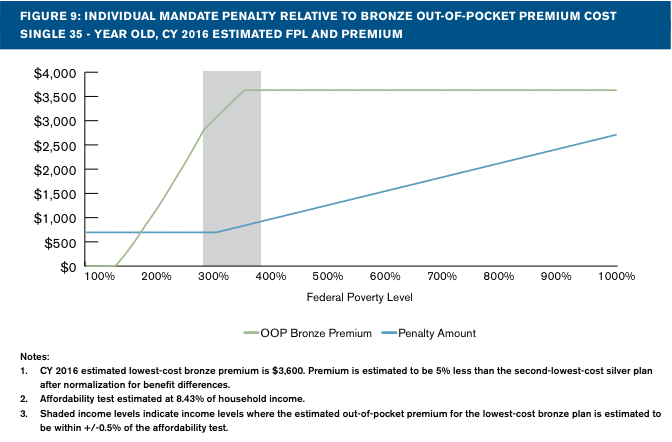
I especially liked this graph, which underscores a point we've been making for a long time (that for most folks, paying the penalty and buying coverage only when it's needed will be the most cost-effective strategy):

[click graph to embiggen]

Do check it out.

Wednesday, October 31, 2012

I was told there'd be no math

So what do these three (seemingly disparate) groups have in common:
■ People in prison
■ People living below the poverty line
■ Illegal immigrants
Give up?

"In just 14 months, Americans will be required to prove that they have federally "qualified" health insurance or face an [ObamaTax] of $695 to $2,085"

Well, most Americans. The folks comprising the three groups listed above are exempt (Sorry, Mags). And when taken as a whole, they represent over 16% of the people who live here.

They have something else in common, as well: they're the folks who, directly or indirectly, gave us the ObamaTax.

How's that, Henry?

It's pretty simple, really: the #1 selling point of the train-wreck was that some 15% or so of us were uninsured for health care. Folks in jail have no need of insurance, since their care's on us. The poor already had a myriad of social safety nets in place (eg Medicaid, SCHIP, etc). And illegals get de facto free health care.

Take out these three groups, and you're left with a handful of Americans who were uninsured (and/or uninsurable), a problem easily fixed without upending 1/5 of our economy and forcing us into nationalized health care.

Gee, thanks bunches.

Cavalcade of Risk #169: Up & Running!

Ray at the Excess Return blog makes his CavRisk hosting debut with this edition, chock full of interesting posts and helpful recaps.

Well, at least it’s free…

A report from the Physician’s Foundation lays out a very grim picture of the future of medicine in America.


This paragraph sums up medicine today:

“PRACTICE EROSION
Over the last half century or more, medicine has evolved from the province of solo and small group practitioners who contracted directly with patients, to an increasingly centralized profession in which treatment is paid for by third parties. Several decades ago, both Medicare and private insurance companies paid physicians retroactively for “usual, customary and reasonable charges,” meaning doctors typically received what they invoiced. This system has been repeatedly modified since, in an effort to reduce costs and manage care, often creating a disconnect between the services physicians provide or believe is appropriate and the services for which they are compensated. This trend may reach a culmination on January 1, 2013, when physicians are due for a 30 percent reduction of their Medicare reimbursement under Medicare’s Sustainable Growth Rate (SGR) formula.”

So physicians today are paid what the government says they should be paid.  The only option for a physician is to become non-participating with all insurance companies, concierge, or direct care, all of which are all cash paid basis for the patient.  This directly impacts a patient, as individuals are becoming more responsible for rising insurance premiums in conjunction with physicians moving away from the third party payment system.

Additionally, “the bar to professional entry for physicians keeps rising, with four years of college education, four years of medical school, and as many as seven years of residency training necessary for those who wish to sub-specialize. Medical education and training come at a high cost, as medical school graduates now carry an average of $156,456 in educational debt, according to the Association of American Medical Colleges (AAMC).”

“FLAGGING MORALE, PERVASIVE PESSIMISM
When asked which best describes their feelings about the current state of the medical profession, only 3.9 percent of physicians used the words “very positive,” while 23.4 percent of physicians indicated their feelings are “very negative.” The majority of physicians – 68.2 percent -- described their feelings as either “somewhat negative” or “very negative,” while only 31.8 percent of physicians described their feelings as “somewhat positive” or “very positive.”

“The great majority of physicians (84.2 percent) agree with that the medical profession is in decline…. Practice owners are more inclined to believe the medical profession is in decline than are employed physicians and specialists are more inclined to believe the medical profession is in decline than are primary care physicians.”

This attitude is pervasive in the medical community.  Physicians are working harder to make the same amount of money they made a decade ago.  Regulations are sapping physicians' time in unnecessary paperwork.

“There is no disputing that medicine is one of the most highly regulated of all professions, and that physicians must adhere to a vast array of laws and requirements imposed by the government and third party payers…. The Medicare regulatory code stipulating provisions by which physicians must abide is over 130,000 pages long.”

Costs such as EMR’s and staff are eating into an already thin profit margin.  Combined, these stressers are reflected in the survey in these findings:

“Over one third of physicians would not choose medicine if they had their careers to do over.”

“Over 60 percent of physicians would retire today if they had the means.”

“In the next one to three years, over 50 percent of physicians plan to cut back on patients, work part-time, switch to concierge medicine, retire or take other steps that would reduce patient access to their services.”

The exodus of doctors from the practice of medicine has begun and the nations brightest and best are no longer interested in a career in medicine.  The high caliber of medicine in America, which was developed through the free market of capitalism, has been brought to the level of mediocrity.  Well, at least it will be free.
More on that 3000% ObamaTax insurance rate decrease [UPDATED]

Not. Happenin'.

From United Health One (formerly Golden Rule) email:
"We will no longer provide our initial 12-month rate guarantee for plans with January 1, 2013 or later effective dates to allow for required changes resulting from the [ObamaTax]."
Ooops.

UPDATE: And the Cato Institute's Michael Cannon reports that the Golden State will see its citizens' insurance premiums shoot up some 25% as a result of the ObamaTax Exchange scheme:

"Under a new rating map approved by state lawmakers, the Department of lnsurance estimated that premiums for similar coverage could increase as much as 25% in West Los Angeles, 22% in the Sacramento area and nearly 13% in Orange County."

Ooops, indeed.

HWR under the 'scope

Tuesday, October 30, 2012

Bad News for Buckeyes

The ObamaTax is gonna hit us in the wallet, and the waiting room:

"A non-partisan study found that, by 2017, individual premiums in Ohio will increase by as much as 85 percent. In addition, Obamacare will deeply cut Medicare Advantage for more than 700,000 Ohio seniors enrolled in the program. And more than 30 percent of Ohio physicians say that they will place new or additional limits on accepting Medicare patients."

We've already seen major rate increases, although it's not fair to lay the blame entirely on the ObamaTax. Health care costs drive health insurance costs, and these are influenced in part by utilization and medical inflation. Still, it's undeniable that at least a chunk of these increases can be laid at the feet of the train-wreck.

Medicare Advantage plans, which actually help rein in some health care costs and offer our seniors choice in health care, have been on the proverbial chopping block for a while; it's no surprise that the ObamaTax will decimate that market.

And of course regular IB readers have known about the coming provider shortage for a while now.

[Hat Tip: Bob Vineyard]

And now for something completely different...

If you are interested in the relationship of science, religion and current events, you might want to check out a new blog by a good friend (and mentor) of mine, Dr Stuart Fickler.

Called the "Secular Kabbalist," Stuart has a Ph.D.in theoretical physics, and "is dedicated to exploring the complementary relationship between religion and science, and its impact on the realities of today."

From one of his most recent posts:
"Humanity has lived under an illusion.  Many believe that we have unlimited independence of choice.  Reality demonstrates otherwise ... The universe is a system.  Everything in it is connected by fields, such as gravity, electromagnetism, etc.  Nothing changes in the universe without the entire universe being affected."
Heady stuff, to be sure, but quite accessible. Recommended.

This Sceptered Isle - Part CLXXXIV [UPDATED]

"Caroline Cassin, 29, who suffers from Cystic Fibrosis (CF) has been offered a new drug free of charge for a limited period by the makers but her NHS hospital is refusing."
Why would that be?

One must read to the very end of the article  to find out.
"The trust decided not to obtain Kalydeco on a compassionate basis because the drug company scheme is temporary and the trust would face withdrawing the medication when the scheme stops."
So is the issue how best to provide life-preserving patient care?  Is the issue how to save money for the NHS hospital trust?  Is the issue how to protect the hospital trust from political fallout?

Whatever the answers, I think this is how so-called "death panels" work in real life.  They don't march in and command "off with your head".  Instead, they work quietly, in private; they employ trusted physicians and other medical professionals under the authority of government who decide whether to block certain types of medical care from certain patients.  This saves money without the ugly and potentially distasteful public task of later having to withdraw that medical care from the unfortunate patients.  

Innocuous . . . really.  And fair.  Right?

UPDATE [We get results!]:

"Medical Director for Heart of England NHS Foundation Trust, said: “Since our last statement we have continued discussions with the company Vertex who produce the drug Kalydeco.
 Following these discussions, we are very pleased to announce that they have taken the decision to offer the treatment on a compassionate basis to named patients, without limiting the offer to a fixed period of time."
Removing the time limit means the hospital (Trust) will not face public calumny on account of withdrawing the treatment at the end of some fixed treatment period.

Ironic, isn't it, that public calumny was necessary to move the hospital trust - and the drug maker - to this decision?

Also worth noting that public opinion still counts for something - even in a quasi-socialist nation like UK.

Not What it Seems

Bob posted about a woman who was charged for “asking too many questions.”  The article in question is about a woman, Susan Krantz, a registered nurse who was confused by her bill. The article's title - "Questions can trigger split charge" - is misleading, as no one is charged for asking too many questions.  What happened in her case is that she went in for a wellness visit and then asked the doctor about a problem, a sore hip.  At that point the visit went from a regular wellness visit to a sick visit or as the article points out, “an “acute care” matter.”

By current policy, there is no charge, referred to as co-pay or out of pocket expense, on an annual wellness visit.  What is misunderstood is that once a person brings up an acute care issue, such as an injury or illness, or if in the course of the exam the physician discovers an acute care issue, such as a lump or other malady, and then the appointment becomes a sick visit and is billed accordingly.  This billing is subjected to a deductible and co pay, which is the patient’s responsibility.  CMS defines a wellness visit as:

As of 2012, the annual wellness visit benefit includes the following services:

■ Routine measurements, such as your height, weight, blood pressure, and body mass index (BMI);
■ Review of your individual medical and family history;
■ Review of the medications, supplements, and vitamins that you are currently taking;
■ Discussion of the care you are currently receiving from other health care providers;

■ Review of your functional ability and level of safety (for example, your risk of falling at home), including any cognitive impairment, as well as a screening for depression;
■ Discussion of personalized health advice that takes into account your risk factors and specific health conditions or needs, including weight loss, physical activity, smoking cessation, fall prevention, and nutrition;

■ Discussion of referrals to other appropriate health education or preventive counseling services that may help you minimize or treat potential health risks;

This list does not include care for acute problems, such as the sore hip brought up by Ms. Krantz.

The article states, “In a written statement, the medical provider said that “the insurance company may require that patients pay or make a co-pay for services beyond the ‘preventive’ part of the appointment.”  The moral of this story is that in the end the patient is responsible for the consequences of any medical appointment with a medical provider, so be prepared.

Monday, October 29, 2012

Yikes! Obamacare Is Even More Unpopular Now than in 2010 [UPDATED]

"Americans support [PPACA] repeal by an even wider margin than they did in the immediate aftermath of its highly unpopular passage ... by a margin of 15 percentage points (54 to 39 percent), likely voters now support the repeal of President Obama’s centerpiece legislation.  In the first three polls taken in the wake of the House’s passage of Obamacare (on March 21, 2010), Rasmussen showed that likely voters then favored repeal by margins of 13 points (55 to 42 percent), 12 points (54 to 42 percent), and 12 points (54 to 42 percent)"

I seem to recall a time when the political leadership claimed that they had to pass PPACA so that we can find out what is in it. 

We are finding out.  The apparent result is this steadily growing opposition.  

Fail. BIG fail.

UPDATE [From HGS]: To get an idea why this plan is so hated, here's a link to an interactive timeline of its implementation. Notice that the plan we had to "pass to learn what's in it" comprises over 50 "checkpoints," from Adoption Assistance to taxes on "Mercedes" "Cadillac" plans.

The "Public Option" Lives

It's that time of year when the airwaves are flooded with zombies and other assorted monsters. So it should come as no surprise that the long-thought-dead Public Option has been given new life under the ObamaTax:

"The [Obamastration] will soon take on a new role as the sponsor of at least two nationwide health insurance plans to be operated under contract with the federal government and offered to consumers in every state."

After all, who needs an Exchange when we can just cut out the middleman and go directly ro government-run health insurance? These plans will "compete" with commercial insurers, but it's not exactly a level playing field: how can private companies compete with the Federal leviathan?

The simple answer is: they can't.

It's an expansion of the Federal Employees' health plan, which has worked so well in reining in health care and insurance costs. Since these plans will be subject to regs from at least three different agencies, good luck resolving claims or other issues. Which then brings us to the role of the National Association of Insurance Commissioners (NAIC). That august body "expressed alarm at the prospect of a double standard." I'm sure the Feds will get right on that.

It's interesting timing, as well, since President Obama has decided to discontinue vital health care services for our veterans. Is there a message in this?

Methinks you already know the answer to that.

Saturday, October 27, 2012

Sandy App

For those in the path of Hurricane/TS Sandy (and/or for those who may face other severe weather conditions) the Insurance Information Institute has a cool - and helpful! - app for disaster preparedness. From email:

"The I.I.I.’s “Know Your Plan” app for iPhone provides users with a library of preloaded checklists to guide them through important property protection and preparedness steps. These include specific lists to help prepare for hurricanes, floods and winter weather—the very conditions threatened by Hurricane Sandy, which may turn into a hybrid “perfect storm” with high wind, heavy rain, extreme tides and maybe snow."

You can download the app from iTunes.

Friday, October 26, 2012

Let's play Guess Who?

OK sports fans, here are three paragraphs from an interview with a brilliant and well-known college professor.

I’m quoting these paragraphs here only because in the course of the interview - which is mostly focused on other things - the conversation eventually comes around to ObamaCare.  And then the professor really lets loose.

Aside from the interesting points made about ObamaCare, my question is:  based on the following three paragraphs, can you name the professor?

“. . . Obamacare: of course, we need health care reform in this country. What a mess! Everyone agrees about that. But the Obamacare is, to me, a Stalinist intrusion — okay? — into American culture.”

“You don't want government agencies being empowered to intrude into people's lives like this. The controlling force in Obamacare is the IRS! Okay? This flies in the face of what the Free Speech Movement was about at Berkeley or about any of the values, I feel, of my generation.”

“I don't see progressives. All I see is white upper-middle-class liberals who speak in this unctuous way about the needs of the poor.  They have no connection whatever with the working class. Okay? It's the professional class gone amok. And that's why they don't notice what a bureaucratic nightmare Obamacare is.“

Here is the source.  I think many readers will be surprised.

(The ObamaCare remarks begin at 12:38)

Show me the [Pounds Sterling]

My first reaction on reading the following was disbelief at the incredible cynicism inherent in the Much Vaunted National Health System©. But then I recalled this and it began to make sense:

"Hospitals are paid millions to hit targets for the number of patients who die on the Liverpool Care Pathway ... In some cases, hospitals have been set targets that between a third and two thirds of all the deaths should be on the [Pathway]"

Yes, you read that correctly: the MVNHS© has actually begun (continued?) to set death quotas. When one considers the ObamaTax Independent Payment Advisory Board Death Panel, it doesn't seem like much of a stretch to see this idea taking hold here.

The rationale, of course, is that killing patients denying treatment is an efficient cost-savings measure. Turns out, though, not so much:

"At least £30million [about half a million dollars] in extra money from taxpayers is estimated to have been handed to hospitals over the past three years"

That's quite an incentive to shunt folks off the care line, no? And recall that "[m]edicine has always been more of an art than a science," and it becomes increasingly clear just how easy - and profitable - it becomes to just pull the plug.

Fortunately, only a very few folks end up on there, right?

Sorry:

"LCP is thought to be used in more than 100,000 cases a year"

Ouch.

Health Wonk Review: Pre-election edition(s)

Maggie Maher hosts an unwieldy and, ultimately, unsatisfying HWR this week. As a long-time participant and supporter, I feel obligated to link to it but I cannot recommend clicking through.

My understanding of, and experience with, hosting an edition of the Health Wonk Review is that one chooses which posts to include, along with a (brief) description. Sometimes, a snide or supportive remark by the host is warranted, but Maggie gives vent to full blown diatribes about several of the entries. I find this disconcerting and, frankly, off-putting.

Intriguing Carrier Idea

We've written before about Critical Illness (CI) policies. These plans pay one a lump sum upon diagnosis of a specific major illness or other similar kind of medical issue (transplants, permanent paralysis, that kind of thing). They're relatively inexpensive, and can provide a much needed transfusion of cash, especially if one has a high deductible plan (such as an HSA).

Humana's taking this a step further, bundling their CI plan with their group HSA products:

"[E]mployees receive a benefit after a serious illness, condition, or accident. During their recovery, they and their loved ones can rest a little easier knowing they won’t have to rely solely on their savings accounts or take on additional debt to cover day-to-day living expenses." [ed: from email, so no link]

Pretty clever (keeping in mind, of course, that the ObamaTax wipes out HSA's in the near future).

[Hat Tip: Cornerstone]

Cavalcade of Risk #169: Call for submissions

Ray at Excess Return hosts next week's Cavalcade of Risk - Entries are due by Monday (the 29th).

To submit your risk-related post, just click here to email it.

You'll need to provide:

■ Your post's url and title
■ Your blog's url and name
■ Your name and email
■ A (brief) summary of the post

PLEASE remember: ONLY posts that relate to risk (not personal finance tips and the like). And please only submit if you are willing to link back to the carnival if your submission is accepted.

Thanks!

Thursday, October 25, 2012

Is Medicine an Art or a Science?

My oldest daughter was born with several health issues; a cleft palate, low muscle tone, windswept feet, and jaundice.  As new parents, my husband and I were beside ourselves on how to care for our new baby.  We were lucky to find a pediatrician who calmed our fears while offering great care to our daughter.  A piece of advice that he gave me is that he trusts a mother’s intuition regarding her children; in other words, if a mother thinks something is wrong with her child, she is usually right.  I have used that philosophy for the past 23 years in raising our daughter and two other children and it has always proven accurate. 
Doctor’s use experience as well as education to treat patients.  Medicine has always been more of an art than a science.  Today, however, there is a push to make medicine a science, removing all subjective processes from t he experience.  It is a push under the title of “Medical Necessity”.  Medical Necessity has been pushed by the government for the past few years to have doctors use tests and past performances to treat a person.  Now private insurers are jumping on the bandwagon.  United Healthcare recently released a notice that it would implement Medical Necessity in inpatient care beginning Oct. 1:

“As a reminder, Medical Necessity is the process for determining benefit coverage and/or provider payment for services, tests or procedures that are medically appropriate and cost-effective for the individual member. The Medical Necessity process is based upon a foundation of evidence-based medicine and:
·  Provides an opportunity to address covered services at the individual level to support enhanced access to quality care for the member.
·  Utilizes generally accepted standards of good medical practice in the medical community.
·  Offers timely communication between health plans, members and providers to allow for prospective, concurrent and retrospective review as well as appeal rights for adverse determinations.

This foundation supports United Healthcare’s overall goals for providing enhanced access to quality care by raising performance standards and reducing variation in medical practice, and health care affordability by implementing a process that promotes efficient delivery of high-quality care in a cost-effective manner.”

What is important to note in this missive is the sentence: “The Medical Necessity process is based upon a foundation of evidence-based medicine.”  Evidence-based medicine is defined as "treatment based on tests, labs and best medical practices for the medical condition."  The problem is that diagnosing based on tests and labs is easy for the obvious conditions, such as a broken arm or an ulcer, but as a doctor once remarked to me “you cannot see pain on an x-ray”.  In other words, not all medical problems can be determined from a test or lab.  There are many anecdotal examples of doctor’s misdiagnosing or missing a serious problem, even with tests.  This was brought to attention recently in an article in the Daily Mail about a woman who died from undiagnosed cervical cancer.

If physicians will now only be paid for evidence based medicine, then many diagnoses that are being paid for today - such as chronic fatigue syndrome, depression, or low muscle tone, which cannot be determined by a test but instead by direct observation and physician expertise - will no longer be viable diagnoses.  At the end of the day, as much science as there is in medicine today, it is an art and art cannot be measured.

Medigap not evil?

When they're not screwing up consumers' life insurance choices, the National Association of Insurance Commissioners (NAIC) does try to do positive things. For example, they have a whole committee that's been working to strengthen support of Medicare supplement plans that limit beneficiaries' out of pocket expenses.

The Senior Issues Task Force [ed: good thing they didn't add "Health" in there] has been trying - thus far unsuccessfully - to communicate that message to HHS Secretary Shecantbeserious. Madame Kathy has "asked the NAIC to think about ways to change the NAIC's Medigap model regulation" to further reduce those out-of-pockets. The problem, of course, is that health care costs what health care costs, so someone is going to get stuck with a big bill.

Care to guess who?