Monday, July 31, 2006

401(k) Insurance

Many of us have some sort of disability plan, whether on our own or through our employers (although there are a lot of folks who don’t, but that’s another post). Such plans are valuable: during our working years, we’re more likely to become disabled for a while than to die.

Disability insurance can (help us to) pay our mortgage and utility bills, car payments and the kids’ college tuition. There are even tax benefits, depending on how one structures the plan.

One thing this remarkable product can’t do, though, is help us save for retirement.

Hunh?

Well, let’s think about it, shall we? If I’m contributing to my 401(k) (or other qualified plan), I’m doing so with my earned income. 

But what if, because I’m disabled, I’m not earning any income? Even if I could afford to do so (and how many disabled folks are?), I’m not allowed to contribute to my plan until and unless I’m back to work.

But time marches on, and with it, the opportunity to sock away dollars for my retirement.

What to do?

Generally, we don’t endorse or promote specific companies or products here: we’re idea- and solution-oriented. But recently, I learned that one of my carriers has developed a remarkable, and unique, new product that goes a long way toward solving the problem of retirement vs disability.

Called RetireGuard, it’s offered by MassMutual (of course, if and/or when I learn of other, similar products, I’ll update this post). Briefly, it’s a disability plan that serves one purpose: to help fund retirement if one becomes disabled. For example, let’s take that ubiquitous 35 year old. Annie began contributing $400 from each (biweekly) paycheck. She did so in order to maximize her employer’s matching program, and because she feels it’s important. Currently, she’s earning 8 percent on her investment choices.

Should nothing untoward happen to Annie, she can expect to build up about $1.18 million when she hits that “magic 65.”

But what happens when she’s hit by a drunk driver, or has a stroke, or suffers a skiing accident?

If she’s like most of us, she has no way of continuing those contributions, so she ends up with a little over $400,000 on her 65th birthday. Not exactly a pauper, granted, but not “sitting pretty,” either.

With this new insurance plan, however, she’d have $1.15 million for her retirement (about 97% of what she’d anticipated). Good deal. (Caveat: we’re plugging in arbitrary returns here, YMMV).

Now, is this the perfect solution? Well, no: nothing is “perfect.” It may be that her anticipated premiums don’t fit her budget. Or, that she has other investments that would take up the slack. But for a lot of folks, this might be a great way to ensure that our retirement plans aren't totally derailed.

Monday Finances

This week's Carnival of Personal Finance is now available at All Financial Matters. Host JLP presents over 40 entries, helpfully organized into a handy spreadsheet format. Very cool.
This post from the LA Money Guy is amusing, just the thing for a Monday morning. Here's a hint: Which way's sporting goods?
And Anita Campbell, hostess of Selling to Small Business, has posted this week's Carnival of the Capitalists. With ovwer 50 entries, this is a big 'un. Thankfully, she's included brief summaries of each post, as well.
We've all heard about those 7 habits of *successful* folks. Well, Peter Kua (of Radical Hop) warns us about the habits of *unsuccessful* ones. Ouch.

Sunday, July 30, 2006

Insurance Dispatch

This week's column is up, over at The Medical Blog Network.

We conclude our interview with Aetna's Medical Director, and learn about a unique model of price transparency.

Friday, July 28, 2006

How Much is Enough…

So I had an appointment yesterday [ed: just the one?] with a potential new client. It’s a very small tool-and-die shop, with 5 employees (including the owner), but only one or two who’d be taking the medical coverage. Group carriers don’t much like cases such as this, and there were some other factors, so we were looking at a couple of individual medical plans: a “traditional” PPO plan, and an HSA (Health Savings Account) plan.
The owner had asked for a lot of info to be faxed and/or emailed over ahead of time. I usually try to avoid this; not because I have anything to hide, but all the material, with no context, actually confuses more than clarifies. Still, the client is (almost) always right, so fax and email I did.
I always ask a lot of questions, one of which being how much of the premium the employer intends to shoulder. In this case, he wanted to pay the whole amount, and we discussed several options. Among other things, I suggested that he consult his accountant to see if a Section 105 plan might be useful in this instance.
When I arrived, it quickly became apparent that this was going to be a colossal waste of time (theirs and mine): the employer who had been so adamant about having that material ahead of time had barely glanced at it, and one of the two employees to be covered wasn’t available. Still, I’d made the drive, so why not.
As we began to talk about their needs, it became evident that they really wanted to see the quotes. They had quotes from two other agents (I knew this ahead of time, so I only ran numbers for carriers from which they had no quotes already). The problem that developed was that at least one of the other agents had misinformed them about how insurance works (or, equally likely, they had misunderstood). So when I explained how their renewal rates really had nothing to do with their own claims, and that companies couldn’t arbitrarily cancel them (having explained the difference between owning a policy versus association plans), and why quotes are, essentially, meaningless at this stage, I could see that they were confused, and uncomfortable.
At that point, it was obvious that they didn’t trust what I had to say, so I offered (in fact, I essentially insisted) to leave. If we can’t establish a relationship based on trust, then were not going to have a useful business relationship at all, and I just don’t need the aggravation. To my surprise, they asked me to stay, and we got to the real issue:
All three of us were telling this client different, and mutually exclusive, things (or, again, they misunderstood one or more of us). And so it came down to credibility, and a simple question: why should they trust me? I offered to give them referrals to other clients; they declined, because of course I’d only give them my best ones. I explained that, as a CE (Continuing Education) provider and instructor, I teach other agents about this very subject. “So?” Finally, I reiterated for them all the various ideas I’d brought to the table (e.g. HSA, 105, etc), which none of the other agents had suggested. And still, they just couldn’t, or wouldn’t, make up their minds.About halfway through, I learned something else: one of these employees is covered under his wife’s group plan, and her employer pays 90% of the family premium. Why then, I asked, are we even talking about this? Turns out, my prospective new client would be paying 100% of the employee’s premium, and they both thought it would be a good idea to have both plans in place.
Hating myself in advance, I asked “Why would you want to do that?”
Turns out, they think that having two plans in place will mean that the second plan will pay the balance of what the first one doesn’t, giving this gentleman 100% coverage.
It was then my sad duty to explain to them how COB (Coordination of Benefits) really works, and to disabuse them of the notion. But, I added, why not have the employer buy an individual disability plan, instead, to help put food on the table in case there is a terrible medical situation.
They seemed to like this idea, and one would think that it would have convinced them of my expertise, and interest. Sadly, it didn’t appear to.
And so I bid them farewell, and invited them to call me if I can be of further assistance. I’ll let you know if they do so.
There are a number of lessons here. First, quite frankly, it’s not financially beneficial to me to spend much more time with these folks. Generally, I try to develop customers into clients, and build a more permanent business relationship than just one or two individual medical plans. That doesn’t appear likely, at least not at this point.
Second, I have to wonder if there’s some magical number of agents and/or quotes that a given client really needs in order to make a sound decision. Since all of us have access to basically the same carriers, and all of our quotes from a given carrier will be identical, how does the client differentiate between agents, and how does he know which one(s) to trust, and which one(s) not to?
Finally, it also shows that sometimes more isn’t better: these folks have a surplus of quotes, brochures and charts, and they can’t decide what to do.
Oh, one last thing: in discussing the HSA, the question of exclusions came up. I explained that brochures, by nature, have limited information about these kinds of things, but that the policy will include every detail.
And then I stopped, and corrected myself: for the first time, I explained to a potential client that the policy does not, in fact, spell out every relevant detail. Neither the brochure nor the policy will warn them that non-covered expenses will be excluded from network discounts.
Not quite a happy ending.

It's Wonky, Man!

This week's Health Wonk Review may be found at Medical Connectivity Consulting. Tim, our host, has done a great job with the more than a dozen submissions. It's obvious that he's not only read each one, but taken the time to peruse each blog, as well.
A while back, Bob blogged on the phenomenon of Nurse Practitioners. Well, at this week's HWR, Jason at the Health Care Economist takes a look at some of the literature, and concludes that NP's are a "good thing."

Thursday, July 27, 2006

Dirty Secrets II, the Saga Continues . . .

[Posted by Henry Stern, LUTCF and Bob Vineyard, CLU]
Part One exposed things carriers do not want you to know about your rights under an insurance policy. We have concentrated on the HDHP (High Deductible Plans), but this issue really extends to all health insurance policies with a network component.
Well, almost all: as Joe Paduda has pointed out (and Bob has confirmed with his own TPA), self-funded plans often include a provision which extends network pricing to non-covered expenses. This makes sense, of course, since a self-funded plan can cover pretty much anything the employer chooses.
Benefits which are excluded by contract are not necessarily going to receive favorable pricing.
"Not necessarily," because the marketing literature, and the policy itself, is mute on this point. Sadly, it seems many company reps and even those in higher positions in the carrier are unwilling, or unable to address this issue.
Or maybe they just don’t know the answer . . .
At least one carrier has said the re-priced fee is made available but the provider is not obligated to accept the lower fee as payment in full and may in fact balance bill the patient.
The disparity (at least in our minds) comes when you explain to a client:
■ Your annual GYN exams are a covered item and are re-priced. Your pre-natal & delivery charges are not a covered item and are not subject to repricing, even when it’s the same doctor.
■ You are eligible for coverage and repricing on corrective cosmetic surgery as would follow a mastectomy. You are not covered for, or eligible for repricing on breast augmentation surgery, even when it’s the same doctor.
■ You are eligible for coverage and repricing for well check up or even a sick visit . . . as long as it is not for treatment or follow up of a condition excluded by contract such as hypertension or hyperlipidemia. If the visit is prompted by a condition that is excluded by contract there is no repricing, even when it’s the same doctor.
So what is the solution?
Until the carriers are willing to step up to the plate the most logical solution is for the insured to purchase a separate PPO discount membership completely independent of the health insurance policy.
Try and follow this:
Many carriers use the PHCS network as their PPO of choice. The access fee -- which allows you as an insured to use their providers and receive lower, re-priced charges -- is INCLUDED in your health insurance premium.
You can also purchase access to the PHCS network completely independent of your insurance policy through companies such as Careington. For $25 per month you can have access to the same providers (and more) as are available under your insurance plan.
Your policy ID card bears the PHCS logo, as does your discount medical card.
Same providers.
Same fee schedule.
One will allow you to benefit from repricing on some claims, the other will allow the re-priced benefits on ALL claims.
Go figure.
MORE: Joe Paduda examines Why This Matters.

Wednesday, July 26, 2006

A Carrier Speaks...

Kudos to Humana! I received a phone call from my Humana contact, who had graciously taken the time, and made the effort, to track down the corporate reasoning behind the HSA discount/non-discount issue.
I'll present his answer here, without embellishment or comment:
"It's contractual. That is, Humana [ed: and, presumably, the other carriers] contract with providers on behalf of their insureds. As part of the negotiations, the carriers agree to re-price only those services which are covered under the contract. This is to help the providers recoup some of their income losses on the re-priced claims.
The principle is that it's only fair that if the carrier's not paying for a given service, the provider shouldn't have to, either (in the form of a discount)."
We'll have our own response to this shortly.

Tuesday, July 25, 2006

A Flowery Rounds

This week's Grand Rounds, hosted by Giskin at Medical Humanities, is a delight and a joy to behold. Presented as a garden, each category is a different metaphor (e.g. a flower garden, a potting shed, etc), so each post is visually interesting as well. Each entry has its own, sometimes extensive, explanation, so it's easy to tell what that post is all about.
Clever and innovative. Bravo!
Good news for us java-lovers: according to Straight From the Doc, coffee has earned itself a spot on our fabled new food pyramid. Apparently, it can even help lower the risk of diabetes 9although I presume that's only if one skips the 2nd and 3rd teaspoons of sugar).

What Would We Do Without (Medical) Experts?

Ooops!
This study, a follow up to one done seven years ago, also puts forth some proposals to help reduce the frequency (let alone severity) of these problems. Some of these are as simple as more effective medication monitoring, as well as procedures to mitigate accidental injury (according to the study, there are three quarters of a million medication-related injuries in nursing homes, for example).
Some of the more common causes are:
■ One is unexpected drug interactions.
■ Similarity between drug names
■ Legendary bad handwriting of physicians
■ Nurses giving patients drugs meant for another patient
■ Pharmacists dispensing the wrong drugs
■ Patients not understanding how to take the drugs.
And, of course, providers don’t shoulder 100% of the blame: patients share in that, as well: by withholding information about other med’s and treatments, neglecting to mention that ER visit the other week, that kind of thing.
In theory, electronic prescribing, which is still in the embryonic stage, is expected to help alleviate some of the problems. But there’s still a lot of potential for human error.

Monday, July 24, 2006

HSA, Broken: A Special Report

(BUMPED)
[Posted by Henry Stern, LUTCF and Bob Vineyard, CLU]
It is axiomatic that the goal of insurance carriers (of any business, really) is to make money, and there’s nothing wrong with that. The challenge is how to do this in a way that maximizes profit, but minimizes pain.
Regular readers know that Bob and I are proponents of, and believers in, Consumer Driven Health Care (CDHC), and especially High Deductible Health Plans (HDHP’s). The idea behind these plans is that one chooses a very high deductible, which (theoretically) generates a lower premium, and that one uses some of those savings to pay for the small, routine claims.
HDHP’s (usually) include access to a network of providers, who offer reduced rates for services rendered. Since these services are usually paid for by the insured, this can represent a significant additional savings. And, because they cost less, folks are more apt to use network providers, driving up their revenue. A win-win situation.
Or so we thought.
The purpose of this Special Report is to expose what Joe Paduda calls CDHC’s “ugly secret.” Turns out, only some of these in-network services actually get the discounted (reduced) rates. That is, only “covered” services are eligible; if you own an HDHP, and receive non-covered services, even in-network, you pay full freight.
Take it away, Bob:
What happens below the deductible for HDHP’s has been widely, and sometimes wildly, debated. I won’t bother to rehash ALL the issues but one that seems to keep cropping up, without resolution, is in the area of “discounted” provider charges under the deductible (or, as we call it, the SIR – Self Insured Retention).
I say “discounted” in quotes because there really are no discounts. Rather, the provider has agreed, by contract, to accept a pre-negotiated rate as payment in full for services rendered. Simply put, if the bill is $100, the provider has agreed (in writing) to accept payment of $70 for services, and will not balance bill.
Why would they do that?
MCO’s (managed care organizations, aka PPO networks) negotiate directly with providers by promising patient volume and prompt payment. In return, the provider (doctor, hospital, etc) agrees to accept the lower, negotiated fee structure. Once the PPO contract is in place, the MCO then provides access to these preferred providers (for a fee). This fee is billed to the carrier, which in turn builds that fee into the premiums charged. Policyholders now have the same rights to access the negotiated fee structure.
Herein lies the rub . . . at least according to some of us.
My contention is this. The policyholder is paying the access fee as part of their premium, therefore the policyholder is entitled to discounts on ALL services received in-network.
However some carriers view it differently.
The carrier view seems to be that the policyholder is only entitled to the negotiated fee structure IF the service is a covered item under the policy. If for example, the policy does not allow for maternity benefits then there would be no discounts when a policyholder requires pre-natal or delivery charges. However, most states REQUIRE coverage for complications of maternity, in which case services by a par provider WOULD be discounted.
Got it?
Other possible areas where negotiated fees would be denied include:
■ Pre-existing conditions excluded by contract
■ Illness specifically excluded by rider
■ Extra-contractual procedures such as cosmetic surgery, drug & alcohol treatment, psychiatric services, TMJ or other dental surgical procedures.
I believe that, since the access fee has been paid, then all services provided for in the PPO contract should be available to the policyholder.
This debate was reopened when Joe Paduda made this post on the fine print that isn’t there. This started a journey all over again.
I contacted Golden Rule (United HealthCare) and received this response:
When we receive a claim we always run it through to get the discounted rate for using in-network providers. It is up to that provider to honor the discounted rate if the claim was for an expense not covered under the plan.
Example would be maternity claims. As you know maternity is not a covered expense in GA as there is not a rider available. If the Dr sent in a claim UHC would process it to get the discount. When the bill goes back to the Dr. they have the option then of requiring the full amount or working it out w/ the patient to honor the discounted price. On non covered expenses or excluded conditions I have been told by claims that it is up to the Dr if they want to honor the discount rate given by UHC.
On covered expenses the discounted rate will always be the amount that an insured is expected to pay under our U&C policy.
Hank contacted other carriers, who all confirmed that they applied the same principle.
Hank?
In all of this, the answer to one specific question has remained elusive:
Why would a carrier do this?
A couple of Joe’s commenters apparently believe that, if insureds pay the higher rate, they’re “going to pierce their deductible layer much faster, thereby incurring claims expense and costing the health plan money.” Interesting and provocative theory, but unsupportable. By definition, non-covered expenses do not count toward the deductible, nor do they apply to the annual out-of-pocket maximum. From the carrier’s point of view, such expenses never happened.
Bob and I came up with a list of reasons why carriers shouldn’t ding policyholders in this manner, including :
■ Fundamental unfairness
■ Bad PR and customer relations
■ Additional claims adjudication expense
Given all these arguments against this practice, why would carriers continue to implement it? For that, we had to go to the source.
I am fortunate to have made a number of useful home office contacts over the years, and it was to these folks that I turned. In email, voice mail and phone conversations, I posed the following question:
We understand that folks who go in-network for covered services get the reduced rate [Bob is correct that it’s not really a discount, but the distinction would be lost on home office critters], while those who go in-network for non-covered expenses don’t. Why is that?
Care to guess the response?
Inexplicably, we've received no answers from any of the more than half dozen carriers we contacted. Feel free to draw your own conclusions.
UPDATE II: Broken, Part 2.

Carnival Time!

The Carnival of Personal Finance is up at Savvy Saver. Our intrepid host had his homework eaten by his dog, er, blog: "Blogger lost the original Carnival post that I put together last night, so I had to scramble this morning to re-do it." Ouch!
In the event, he still managed to put up 46 posts, which is terrific.
I haven't sold variable products in a number of years (by choice), so I found this post about variable annuities to be fairly well balanced (if a bit simplistic). Still, Thomas at Investor Geeks does a solid job.
And this week's Carnival of the Capitalists is hosted by Names At work. Antony has done an outstanding job of organizing the 45 posts, and added helpful commentary to each one. I was very flattered that he included our post in his "Top Five."
I have to agree, though, that his Number 1 post belongs in that spot: posted at Business Pundit, it's a true story, with an unexpected twist, and which raises some important ethical questions.
Seriously, check it out.

Sunday, July 23, 2006

Insurance Dispatch

This week's column, at The Medical Blog Network, includes an interview with the director of Aetna's price transparency program.

No Tickee, No Chemo…

The Grand Canyon State has a nifty idea: a $1 million jackpot to one lucky voter. That’s right, “(i)f Arizona voters pass the Voter Reward Act in November... one lucky voter [will win] $1 million just for casting a ballot."

So what does that have to do with health care?

Turns out that the Sceptre'd Isle* has its own little lotto going on:

Because I was articulate and well-informed and also, I suspect, because I had connections with the Department of Health, I got the right to my treatment...

(B)rachytherapy, which carries fewer side effects than a surgical operation and is less invasive than the alternative, a radical prostatectomy” is being made available to a select few Englishmen. It’s a little complicated, but apparently the NHS (Britain’s National Health Service) will approve only a select few to receive this potentially life-saving treatment.

As one can imagine, this has resulted in quite the hew (or "hue") and cry:

Thousands of prostate cancer sufferers in Scotland are facing a "postcode lottery" over a new treatment for the disease.

The drug Zometa, has not been approved for use in Scotland, despite being available in England and other EU countries.

The lesson here is that, while a nationalized health care system may seem like a good idea, remember the old saw:

You can have it cheap, you can have it fast, you can have it good. Pick any two.

* Thanks, Matthew!

Thursday, July 20, 2006

Lagniappe

It's kinda nice, being out here ahead of the curve. Sometimes, though, it's helpful to catch up on unfinished business.
To wit:
We've blogged (extensively) on the implications of Maryland's recent "Wal-Mart Bill." But is it DOA? Apparently so (H/T: John F).
[NOTE: Judge Motz based his decision on elements of ERISA, which implies that such a law would be equally invalid in any other state]
■ Earlier this year, we noted the difficulty some folks were having in obtaining life insurance, in anticipation of a trip overseas. Well, some of there problems may well be solved by the legislature. Bob tells us that:
As a result of legislation and regulatory declarations, Banner Life will not factor past or future foreign travel into the risk selection process on applications signed in California, Colorado, Florida, Georgia or Washington state.
Banner will also not factor in past foreign travel, but will consider planned future foreign travel on applications signed in Illinois and Maryland.
Foreign travel risks on applications signed in other states will be priced in accordance with Banner's normal underwriting practices.
The legislative atmosphere remains fluid. Several other states are considering legislation that could have further impact on the above lists.
■ And finally, we've discussed the role of genetics in insurance and healthcare before. A new company, GenoMed, aims to use " medical genomics to keep people healthier." Interested? Check out their press release. (H/T: Bob)

Cavalcade of Risk (4th Edition)

Our wandering host, Chris of MedBill Manager, has done a great job, with 20 submissions (our biggest yet!). Better still, most have running commentary from Chris, building on the post itself.
Bravo!
I especially liked Brad's post, over at The Unrepentant Individual, about putting risk, and risky behavior, in context.

Tuesday, July 18, 2006

Chronic 'Rounds

ChronicBabe hosts this week's edition of Grand Rounds. She's collected 40 posts, all with the (general) theme of women in medicine. Even better, they're sorted into categories and each post includes a (sometimes snarky, sometimes silly, always helpful) summary.
Pardon the preaching, but I think that this post, about new recommendations about heart attack screening, is important. Jake Young at Pure Pedantry has the scoop.

Not Really Sure What This Means...

From the FWIW (For What It's Worth) Department:


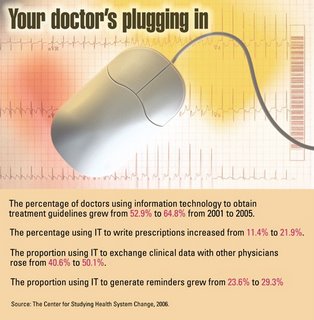
EMR (Electronic Medical Records) is a hot topic these days. HIPAA has some EMR mandates that are coming on-line [ed: ugh! now that's a bad pun], and, of course, there are economic benefits, as well.

Dr Rob Lambert has more on this over at The Medical Blog Network. As a practicing physician himself, he has a unique - and helpful - perspective on the issue.

Monday, July 17, 2006

Monday Money

The Carnival of the Capitalists is up, presented by AnyLetter. Our intrepid host, Andrew, fought a bout with bronchitis to bring it to us...now that's dedication.
This post, at Mine That Data, has an interesting tool that one can use to prove that old adage that it's cheaper to keep a current customer than procure a new one.
And this week's Carnival of Personal Finance is up at Just Another Money Blog. With over 40 posts, you're sure to find (at least) one to like.
For example: My Financial Awareness examines how the ancient concept of tithing works in our "modern world."

Sunday, July 16, 2006

Insurance Dispatch

The latest column is up at The Medical Blog Network. This week, we begin our examination of price transparency in health care.
Come on by.

Friday, July 14, 2006

Cavalcade of Risk (#4) - Submissions Due

Next week, the C of R will be at MedBill Manager. Chris is looking for a few (okay, many) good posts. You can submit yours (or someone else's):
■ Via email,
■ At the Blog Carnival, or
■ At Ferdy's
Remember, entries are due by next Monday (the 17th)

Thursday, July 13, 2006

Health Wonk Review: Mid-July Edition

The Health Care Economist hosts the newest edition of the HWR. Jason has an interesting take on HWR: he's essentially made the compendium of posts a sort of debate about health care costs versus health care quality. It's really unique, and thought-provoking.
Joe Paduda (the "father" of HWR) takes a look at how hospitals are rated, and whether rankings are really such a good idea, after all.

Mass Health: Update

A while back, Bob reported on the new Massachusetts health insurance program. Well, some new details have come out, and (as usual) we're on the case:
■ Mass businesses can avoid the $295 fine...er, uh, "fee" if at least 25% of their full-time workers are enrolled in their health plan, or if the company contributes at least 33% of the premium cost. That's actually a lower percentage than what most employers pay now [ed: oops!].
■ On the other hand, employers won't be allowed to count employees receiving health insurance from other sources (e.g. through their spouse's employer or government programs).
■ And, the "fee" requirement applies to businesses with more than 10 full-time workers.
■ Massachusetts' Division of Health Care Finance and Policy is projecting that the "fee" will affect about 8% of the state's 35,000 eligible companies (which represents less than 2% of all Massachusetts' employers). They're hoping to raise about $26 million, which they plan to use to subsidize health insurance for low-income individuals.
Under this new proposal, employers would have to inform the state about whether their workers were offered employer-sponsored health insurance and whether each employee accepted or declined. Workers who decline the employer's offer and don't have alternative coverage will be required to file a form acknowledging responsibility for medical care. It's not clear whether this will relieve the employer of the $295 "fee."

Tuesday, July 11, 2006

A Very Grand Rounds

TC, host of the provocatively named Donorcycle blog, presents this week's Grand Rounds. Divvied up into interesting and helpful categories, almost every one has notes on context and content.

Medical Connectivity has some real concerns about how more of your private health info is available (and vulnerable?) than you might have thought.

Monday, July 10, 2006

Up, Up & Away!

According to actuarial consultant firm Milliman, average medical expenses for a family of four rose by 9.6% last year. Interestingly, this tracked with average annual increases for the past 4 years, as well. Milliman expects that these rates will stay in the 9 to 10% range for the foreseeable future.
The numbers are based on medical claims, including:
■ office visits (37% of total costs)
■ inpatient hospital services (30%)
■ outpatient expenses (another 15%)
■ and rx (also at 15%, and much lower than I'd have thought)
What surprised me the most (aside from the relatively low rx number), was that the greatest rate of inflation was in- and out-patient expenses. Counterintuitively [ed: ooooh! a $3 word!], the rise in pharma costs slowed significantly.
Bob Cosway, one of Milliman's consulting actuaries, averred that "There have been more and more drugs going off patent, and more therapeutic classes have good generic drugs available. We think many of those market forces will continue for pharmacy."
He also indicated that technology, new drugs and managed care policies have allowed more medical problems to be handled with outpatient services and medications, rather than the more expensive inpatient care.
The report (which you can read here) also shows that the different components are trending at different rates. Rx costs, for example, increased almost 13% between 2004 and 2005, while hospital services (inpatient and outpatient) as well as physician costs grew at rates of about 8%.
Of course, this will have an impact on health insurance costs; it's not just greedy insurance companies looking to increase market share and profitability.

Carnival Time!

First out of the gates this morning is the Carnival of Personal Finance, presented this week by The Real Returns blog. Almost 60 posts grace this week's edition, along with helpful summaries.
We've blogged on Identity Theft before; this post, from Dogberry Patch (another candidate for cool blog name) questions whether it's really such a big deal.
And the Carnival of The Capitalists is now up, hosted by Fat Pitch Financials. Over 50 posts are presented, in a unique (and useful) "table" format, which can be sorted by site, category, and title. Very cool.
Joe Kristan, of Roth & Co fame, posts this infuriating story about the gummint taxing a business...in order to subsidize its primary competitor. Infuriating, but enlightening.

Sunday, July 09, 2006

Insurance Dispatch

This week's column is up at The Medical Blog Network. We answer reader mail, and set a commenter straight.
Good times, good times.

Saturday, July 08, 2006

Underdog vs Google

As you may recall, FoIB Chris Parks has been working on a powerful, free, useful, no cost to the consumer, innovative and free on-line tool that will help reign in the out-of-pocket cost of healthcare.
Well, it seems that Chris almost had need of some ICU-type healthcare when he read that the 800# gorilla that is Google seemed to be poaching on his territory.
Never fear, though, our intrepid hero eventually came to realize that, rather than competing with his new project, Google was, in fact, reinforcing the need (and desirability) of it.
Bravo!

Thursday, July 06, 2006

M.I.B. II

I have received a reply from my correspondent, explaining the circumstances and issues.
 
Turns out, an application for health insurance was recently turned down because of discrepancies between the app and the medical records. Apparently, the applicant’s physician had included several health-related problems in the records, none of which were applicable. Some of these were quite serious (COPD, for example, and hypertension). All told, there were 10 such discrepancies [ed: no wonder the app was declined!].
 
So, after reviewing all the “problems,” my e-friend met with the doctor, discussed all the items, and agreed that they needed to be corrected. Subsequently, the doctor documented this for his patient, and this letter was forwarded to the insurer. At this point, no word has been received from the carrier as to whether or not this will affect its earlier verdict.
 
But that’s not the end of it. My e-friend is concerned that the declination has been reported to the afore-mentioned MIB, and will become a permanent source of problems for future insurance applications. For now, COBRA is in place, so there is at least a safety-net in place during this process.
 
Okay, so what’s my role in this?
 
Along with Bob, I spend some time each day helping folks at an insurance-related consumer bulletin board. My e-friend read some of my posts, and thought that I might be of help straightening out this mess, or at least supplying helpful directions.
 
Which I have done.
 
I explained that the MIB has an appeals/corrections process, which consists of writing them a letter and waiting for a reply. I suggested that such a letter be sent, along with a notarized list of corrections provided by the doc. I also suggested a follow-up phone call, and posited that this will not be a speedy process. Lastly, I suggested that the whole bundle be sent in such a way that it could be tracked, and with a way to confirm delivery (signature, etc).
 
The next piece of advice was to avoid the initial carrier altogether (for a number of reasons, none of them really relevant here), and to seek the counsel of a professional, independent agent with a minimum of 5 years experience in the health insurance field. Since I have the privilege of knowing quite a few “good guys” all around this great land of ours, I offered to help find one if necessary.
 
Finally, I suggested that it’s not always necessary (or even desirable) to keep an entire family on one’s COBRA. Sometimes, it’s better to “spin off” other family members to a separate policy. Again, a pro will be able to help determine this.
 
At the very least, this is an interesting experience. It’s nice to be able to help out, and it’s also nice to have the opportunity to learn more about agencies like the MIB. In fact, Bob sent me a gaggle of links on this subject, which I’m starting to go through even now.
 
As my correspondent has promised to keep me posted on any progress, I’ll pledge the same to you.
 
UPDATE: Have you ever heard the term "Common Knowledge?" That's where everyone just knows that such-and-such is true, or that so-and-so is a genious, or whatever, but then it turns out not to be true at all?
 
Well, like many of you, I just "knew" that MIB is notified whenever a company turns someone down.
 
Turns out, that's just "CK:"
 
From: MIB Info Line [infoline-at-MIB.com]
To: insureblog-at-hotmail.com
Subject: RE: Declinations
An MIB Report does not indicate the amount of coverage applied for or if a policy was issued, declined or charged an extra premium.
Interesting, no?

Wednesday, July 05, 2006

Something Different: Carnival Wednesday

Over at Raising 4 Boys, host "Dad" presents this week's Carnival of Personal Finance. Each of the 38 posts is neatly summarized.
I thought this post from Debt Free, on pre-paying one's mortgage, quite interesting.
Dominick at Trader Knowledge has the 3rd Edition of the Cavalcade of Risk. He's done a fine job of organizing the posts, and he's included helpful notes about each one.
As one who's always found the Worker's Compensation system to be mysterious yet unncessarily complicated, I found Jon Coppelman's post on workers comp and the Supreme Court to be quite fascinating.

Tuesday, July 04, 2006

Independence Day Capitalism

The July 4th edition of the Carnival of The Capitalists is up, hosted by My Money Forest. With over 50 entries, you're sure to find (at least) one that piques your interest.
As one who has always believed in treating my clients the way I'd like to be treated, this post at Trizle really hot the spot.

M.I.B. (NOT Smith & Jones)

Conventional wisdom ("common knowledge") is interesting, fun, and most often, wrong. What prompts me to make this observation is an email I recently received:
 
"I was very surprised with a little known fact concerning the Medical Insurance Board (MIB). Do consumers really understand the ramifications of their medical history in this system?"

Apparently, my correspondent has had some recent troubles obtaining health insurance. I'm still not sure what, exactly, the missive's author wants from me; I replied, of course, and am waiting for more information.

In the meantime, it may be useful to bust a few myths about what the Medical Information Bureau really is, and what it really does:

First, the MIB does not keep a copy of one's medical records. One doesn't really even need to read the FAQ on their website to know this; it just doesn't pass the "smell test." Think about it: even before the draconian privacy measures mandated by HIPAA (which, we'll grant, aren't exactly enthusiatically enforced), how would such an organization go about getting all the files from all the doc's that one has ever seen? And where in the Wide, Wide World of Sports would they keep them?

Second, only folks who have applied for insurance (life or health) from one of the 600 companies who participate are even subject to its "review" (IIRC, there are something like 1,800 such carriers). And of these, the Bureau is informed regarding only those who have been rated or declined. Then, if such a person applies for another policy, with another participating carrier, will it even matter?

Third, these notes are kept for a maximum of seven years, after which they are purged. So it's not "forever," anyway.

It is true that most (if not all) life and health applications (and to be accurate, I'm lumping in Disability and Long Term Care policies under the general heading of Life and Health) include a question regarding previous insurance experiences. That is, they ask if one has ever been rated or declined for insurance. Some carriers give this question (and its implications) greater weight than others; conversely, some carriers are notoriously stringent in their underwriting process, and that has a certain significance, as well.

The primary mission of the M.I.B. is "to detect and deter attempts by applicants of life, health, disability, or long-term insurance who would omit or misrepresent facts." This is actually a powerful tool for us consumers: fraud helps drive up the cost of insurance (as if it needed any help to get more expensive). By working to minimize it, organizations like the M.I.B. help to hold down those increases.

While I take each email (and, for that matter, each comment) seriously, I think that sometimes folks let their imaginations run a bit wild. It may well be that this person has had a bad experience, and I will try my best to help resolve it. But the M.I.B. isn't the enemy.

Monday, July 03, 2006

Darned if you do, or don’t...

Recently, my mother was hospitalized for a week, the victim of a prolonged headache that just wouldn’t quit. Turned out to be an inflammation of an artery, and not (as feared) something worse, such as a tumor.
In many such cases, folks start thinking about their own (and/or their parents’) long-term prospects, and the thought of Long Term Care eventually surfaces. Thankfully, Mom’s condition is (relatively) easy to treat, and she should be fine soon. ‘Course, I am concerned that she found the hospital food superior to her own home cookin’, but that’s a discussion for another day.
All of this by way of introduction to an interesting, if disheartening, study undertaken by the John Hancock (okay, you purists will have noted that I used “the,” a throwback to “the old days.” I also put an “e” at the end of envelope, and spell dilemna with an “n.”), which shows a startling disconnect between what we know to be true, and how we choose to deal with the truth.
To wit: even though we know about the graying of our population, and we know that health care costs keep escalating, we choose to ignore the connection. According to the JH study “Americans are less worried today than they were roughly a decade ago about needing and paying for LTC.” This is stupid. We know that gas prices have risen, and we grumble about those. We know that mortgage rates are on the rise, and we worry about that. But we can choose a smaller house, or a more fuel-efficient vehicle; what is the alternative to living longer?
I know, trick question.
Here's what's weird: while over half of those surveyed were concerned about the cost of care, that's still a 12 point drop from folks 10 years ago. On top of that, compared with the '97 study, fewer people were concerned that they'd even need long term care.
OTOH, almost 2/3 of the respondents thought they'd make it to (at least) 85, and that the cost of LTC would have a substantial (and negative) impact on the post-retirement financial position. This concern, by the way, is an increase over the old study.
And so, we have a population that is ageing, that believes that it will get even older, that believes that there is a greater likelihood that they'll need more (and more expensive) care, and yet aren't really worried all that much about it.
I have a picture in mind.
Something else I found interesting is that, after a decade of sales pitches, advertisements, promotions, news articles and studies, most of those surveyed had no more knowledge about the nature and cost of long term care than their counterparts did 10 years ago. That’s a bit scary, no?

Sunday, July 02, 2006

Cavalcade of Risk Reminder

Submissions for the upcoming C of R are due by tomorrow (Monday the 3rd). Submitting a post is easy:
■ Via email
■ at the Blog Carnival
or
■ at Ferdy's
Don't forget, if you've seen a relevant post at another blog, feel free to submit it, as well. If you have any questions, stop by the C of R home page, or drop us a line here.
Have a great (and safe) 4th of July!

Insurance Dispatch

My latest column is up at The Medical Blog Network. We look at how cat claims are paid under both Co-Pay and High Deductible plans.

Comments welcome!